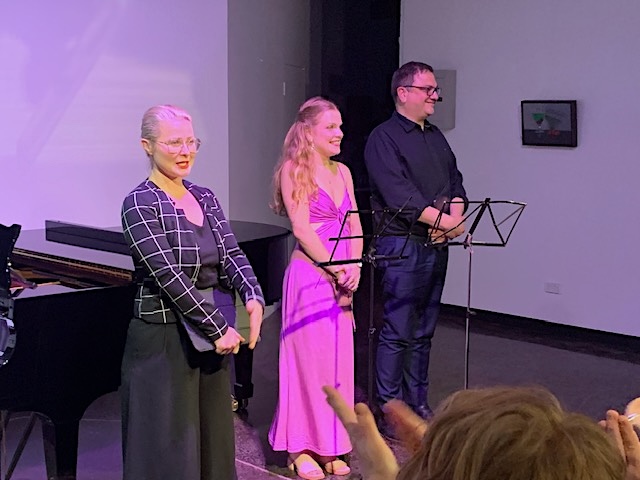
If you’ve never been to Nightingale Gallery, it’s worth a visit. On Friday night white walls featured “MIXOLOGY”, a vibrant series of paintings by LLael McDonald, while cocktails were available in an adjacent room as an extension of the theme of the artworks. An immersive experience indeed! The main gallery is big enough to accommodate a grand piano, a small ensemble and nearly eighty people comfortably. The polished concrete floor also gives the space an extra acoustic boost. During the Pride Month of June, the venue is playing host to a series of concerts celebrating the richness of queer culture and its power to shape the artistic landscape.
Curated by Meta Cohen, Temporality is the second of four concerts on successive Fridays for this inaugural Queer Nights at Nightingale under the artistic direction of renowned pianist: the indefatigable and inspirational Coady Green. Although the Pride context might appear somewhat “niche”, the works on the program seemed more inclusive – a celebration of humanity in its diversity conveyed by music that goes beyond a queer framework.
The opening work, which aims to present “music that explores moments of queer love, playfulness and resistance across time” certainly emphasises the playful aspect of music. Jennifer Walshe is a notable Irish composer and vocalist specialising in ”extended techniques”. In his introduction to her short work for solo piano, becher / container (of styles and genres in this case), Green gave an amusing account of having to prepare the work at impossibly short notice. Intense preparation of a fiendishly difficult work that seems like a whirling kaleidoscope of musical references – “micro quotations” – would have challenged the most virtuosic pianist at the best of times. Think of an extended, adrenalin-charged “Spicks and Specks” tune identification game and you have some idea of the energy involved. But it was not merely the spot-the-tune and speed that generates the excitement, it is the way the fragments transition and resonate. It is the sequencing of the material, changes of key, meter, tempo, dynamic mood and touch that provide the main interest. Of course, Green’s command of the intricate layering was also a major part of the thrill and wonder of this “fragmented, eclectic and playful journey through time”.
Award-winning composer Connor D’Netto is mainly familiar to Melbourne audiences through his artistic association with a number of major musical organisations and, most particularly, Coady Green. Seven Percent Etudes was commissioned by Green as an aid to his recovery from hand surgery and because of a dearth of music designed for the right hand alone. The brief was an etude for each hand and a third for both hands, along with a reference to an inspiring LGBTQI+ figure. As Green explained when introducing the work, D’Netto’s choice of the English mathematician Alan Turing provided a special level of emotional engagement given Turing’s tragic fate. The so-called “Turing Machine”, designed by Tom Whitwell, has “the ability to set the probability that each note in a repeating sequence might change”. In this case the probability was set at seven percent for changes in other parameters as well such as bar length and key/harmony for the first two etudes. All of which sounds very cerebral, but in fact was quite compelling in the way D’Netto has constructed the work The changes unfold with much more variation than could be expected from a mechanical description. Much of the figuration is quite delicate and each etude assumes a meditative quality. The third etude is fascinating in the way the hands seem to work independently and become gradually rhythmically aligned.
A suite of pieces for piano and electronics commissioned by Coady Green this year, Bryn Renard’s queer being, queer being is more overtly programmatic in its reflection of the composer’s experience of queer life “in all its beauty, intimacy and difficulty”. An emotional response, it encompasses Acts of joy and intimacy that come from sharing as a community along with shorter Interludes of isolation and anxiety that arise from queer existence. The theme of time is presented by employing the musical technique of aleatory – music without time – with the performer free to “sculpt the sound”. Beginning simply with a soft sparse treble note, a delicate filigree of sound resonates with pedal weight until a shiver turns to a panic of fast repetition. Dynamic and tempo variations, pauses, bass tremolos, fragmented figures might sound like the previous works on paper, but the trajectory and even the atonal language are very different. Pulsing repetition provides some surprising effects, but most surprising is the labored breathing required by the pianist before electronic dimension enters about half way through this longer piece. Fortunately, Green had warned us that what appeared to be a pianist in distress is an integral part of the score. The electronic layer is skillfully woven into the sonic texture to provide an absorbing musical experience.
After interval (with cocktails for some), we heard two works by the evening’s curator. As Meta Cohen remarked in her introduction to The Warning Never Heard, the idea of not being believed is quite a modern phenomenon. A suite for solo piano in four movements, it draws on the Greek myth of Cassandra, the Trojan princess, who was given the gift of prophecy along with the curse of never being believed. Cohen writes of Cassandra’s predicament feeling “circular”. She is trapped in a loop with many sections of the music “wave-like” as the piano desperately tries to communicate without being able to speak. Movement i, “one day” begins ominously. Whether it was because Walshe’s earlier piece had primed me into a spot-the-tune frame of mind, Vidor’s “Toccata” seemed to be referenced there and at the beginning of the final movement, “she has spoken”. Other musical allusions seemed to appear in this chiefly melodious work, perhaps picking up the “strands of time” mentioned in the program note. In movement ii, “you will know”, heavy bass notes build to a passionate outburst of repetition that peters out on a fading trill. The undulating waves of movement iii “the truths” evoke Cassandra’s shadowy visions that slow to a final soft low note. The suite ends strongly – assertively but, equally, despairing.
The allure of Julie D’Aubigny as the subject for an opera seems irresistible. It would be hard to find a more colourful historical figure than a seventeenth century sword-fighter, opera singer and arsonist than this cross-dressing queer icon. Co-created by Cohen, librettist Evan Bryson and director/dramaturg Alyson Campbell, the “theatrical song cycle”, Sword Songs, is part of the development of a new chamber opera that traces key aspects of D’Aubigny’s life. In the excerpts presented in this concert with piano accompaniment, mezzo-soprano Jessica Aszodi sang from D’Aubigny’s perspective while soprano Rachael Joyce sang as her lover, the Marquise de Florensac and as D’Aubigny herself in a varying “shape-shifting” dimension. The six songs performed began with Aszodi establishing the swashbuckling defiance of the protagonist – a strong characterisation that she sustained throughout, portraying a range of expressive details that gave credence to the more masculine attributes while looking decidedly feminine, despite the pants and jacket. A confident musician and performer, Aszodi was able to communicate effectively while negotiating a vocally and musically challenging role. Both she and Rachael Joyce have technically assured, beautifully resonant voices, Aszodi firm and vibrant on the lower and middle notes and both glorious in the upper reaches. While suitably contrasting in some respects – Joyce all feminine fragility in appearance but with a brilliant upper extension to her beautiful crystalline voice – they blended superbly in the “No World Without Us” love duet.
If the enthusiastic response that greeted the defiant ending of these Sword Songs is any indication, this is one chamber opera in the making that deserves support. It was an exciting conclusion to an evening of some of the most interesting music around. And there’s more to come for the next two Fridays.
_____________________________________________________________________________
Heather Leviston reviewed “Queer Nights at Nightingale: Temporality”, presented at the Nightingale Gallery on June 12, 2026.