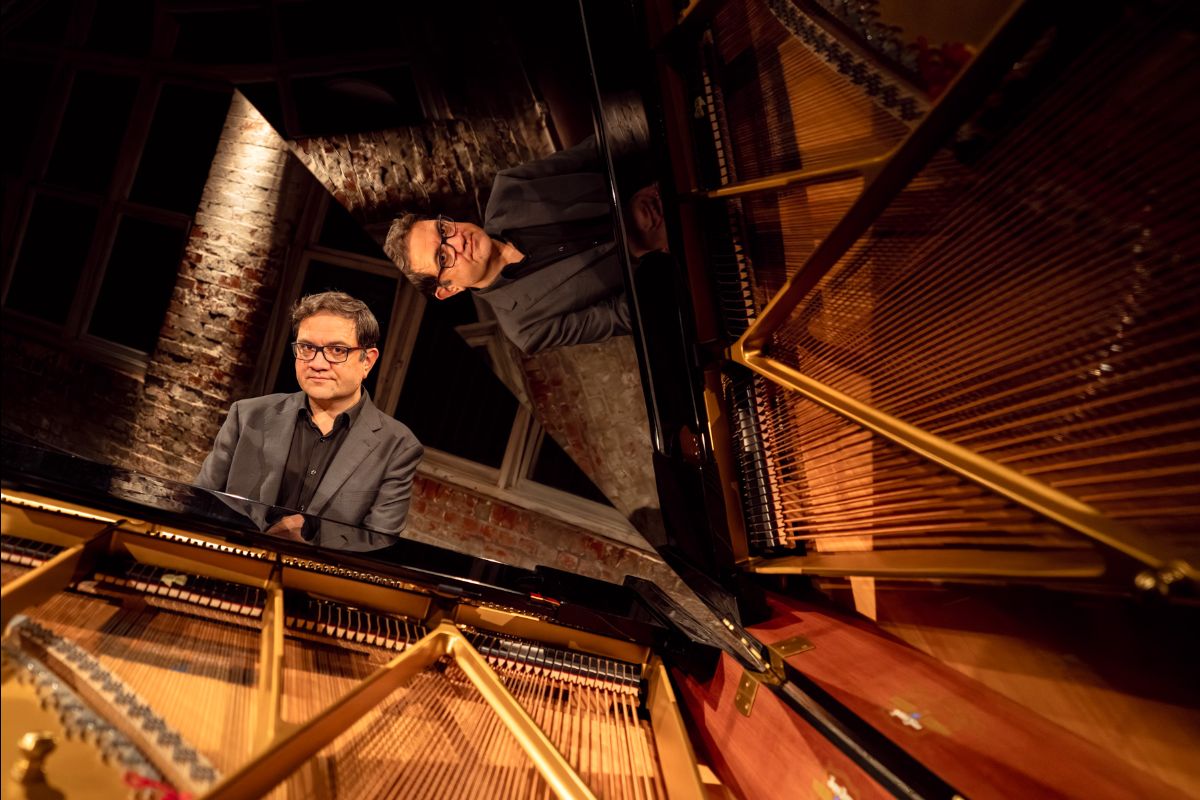
We can not give enough accolades to the organisation and founders of fortyfivedownstairs, Flinders Lane Melbourne, who for 24 years have given a home to independent theatre, live music, and a host of visual artists, bringing us award-winning established artists and new and inspiring “risk-takers”. Their partnership with extraordinary pianist and inventive program curator Coady Green has produced an annual Chamber Music Festival, with the 2026 program offering 16 inspiring concerts.
Tonight’s closing event certainly took the audience to thought-provoking territory with rarely heard and new works. Festival goers may recall the opening night of the 2024 Festival, when Green programmed a memorable performance of Satie’s popular ballet music, Parade, accompanied by animated film. Rarely heard Satie was to be featured again, closing this year’s festival.
Having just performed the principal role in Handel’s opera Acis and Galatea down the road with the Royal Melbourne Philharmonic, soprano Lily Flynn introduced Satie’s rarely performed work Socrate, regarded by his contemporaries as an innovative work of its time. With texts by the Greek philosopher Plato, this very moving 30-minute composition immersed us in the reflections and conversations of Socrates’ closest friends, with a mesmerising musical score.
Flynn described her fascination with Socrate, a work originally commissioned for female voice and orchestra, causing some controversy as male “voices” were scripted in Plato’s texts. Flynn added gentle and soulful video projections to this Festival’s performance, collaborating with multimedia artist Judy Kong. Satie’s own piano reduction of the original score was performed by Coady Green with full empathetic connection and colouration in a most sensitive partnership with Flynn’s excellent delivery of text, refined theatrical presence, beauty of tone and clear French dialogue. Sadly for the audience, translations of the texts shown at the bottom of the smallish screen tended to be lost in the general ebb and flow of the changing videos that engaged us fully with their symbolism and moving textures.
No. 1 Portrait of Socrates, (The Symposium). In the form of a flowing recitative with sparse and repetitive accompaniment, Alcibiades’ monologue praised his most valued and influential friend. No. 2 “On the Banks of the Ilissus” (Phaedrus) gave us a discourse on love and friendship in a poetic dialogue between Socrates and Phaedrus, with Satie’s spacious themes, repetitive rhythms and a delightful languorous French waltz complementing the imagined scene. In the more dramatic No. 3 “The Death of Socrates” (Phaedo), the piano never lost its gentle flow, with low pulsating piano chords accompanying dark views of oceans at night as Phaedra described the final story: “Is the river connected with the soul?”. Beautiful high misty chordal clusters above a repeated single tone pierced our hearts with tranquillity and sorrow. Green and Flynn certainly held us in their hands for this unique performance.
With many stage credits in Australian theatre and television, Paul English held our attention with his finesse, charm and emotional engagement in his narration of the intense writings of Rainer Maria Rilke’s The Song of the Love and Death of the Cornet Christoph Rilke. Again, Green’s accomplished piano playing communicated the musical drama and soul of the vibrant piano score by Austrian composer Viktor Ullman (1898 – 1944). Ullman was a talented student of composition with Arnold Schoenberg, influenced by the developments of atonality, and fated to be imprisoned with artists and dissidents in a concentration camp at Terezin, Czechoslovakia, where he continued to be a most active composer and contributor to the musical life before his last days at Auschwitz. Described as a prose poem, Rilke’s stories describe adventures and memories of manhood, the journey of a soldier travelling with his company, a night with his lover, fighting in war and being mourned by an old woman. An often programmatic and intensely percussive piano score supported the emotional landscape and text – “Riding, riding, through the day and night, the heart is tired and the longing is vast”. Lighter piano scenes referenced a young boy in his home garden, and sensitive piano accompanied a letter written home: “To my Dear Mother, I carry the Flag”. Fragments of a waltz, the glitter of the dance and the scent of a woman fragmented into the dreams of the night, and, as “time has fallen away in the camp dorms, there is no yesterday and no tomorrow”, quirky piano trills were running on the spot. The cry to arms brought percussive blasts and, bugles blaring, a huge descending forte glissando silenced that scene. In this Triptych of Shadows program, this was powerful recitation with powerful pianism.
A delightful taste of a new work from Linda Kouvaras’ ever-expanding composition library closed the Festival. The Boarding House, Carlton 1972 featured the rich and broadly toned baritone voice of Alex Owens, whose natural acting ability beautifully communicated descriptions of conversations and events affecting two young students experiencing a new world and a motley crew of tenants when moving away from home. Kouvaras’ new works continue to delight with inventive themes and musical phrases, colourful and fresh harmonic chordal patterns, clarity and simplicity balanced with sophistication. Four “sketches”: “The Return of Mr Jones”; “The Lost Lagoon”, with gorgeous pedalled piano effects imaging bells ringing under water; “Some Bad Girls (Go to Heaven)”; and “SPY”, with exotic bass riffs and hints of suspicious percussive chords and Eastern modal flavours. We anticipate that more characters and events from Carlton 1972 will extend this delightful work further.
This was the perfect nightcap for the Triptych of Shadows after a huge, deeply engaging and musical journey.
________________________________________________________
Julie McErlain reviewed “Triptych of Shadows: Satie, Ullman, Kouvaras”, presented as part of the 2026 Chamber Music Festival at fortyfivedownstairs on May 2, 2026.