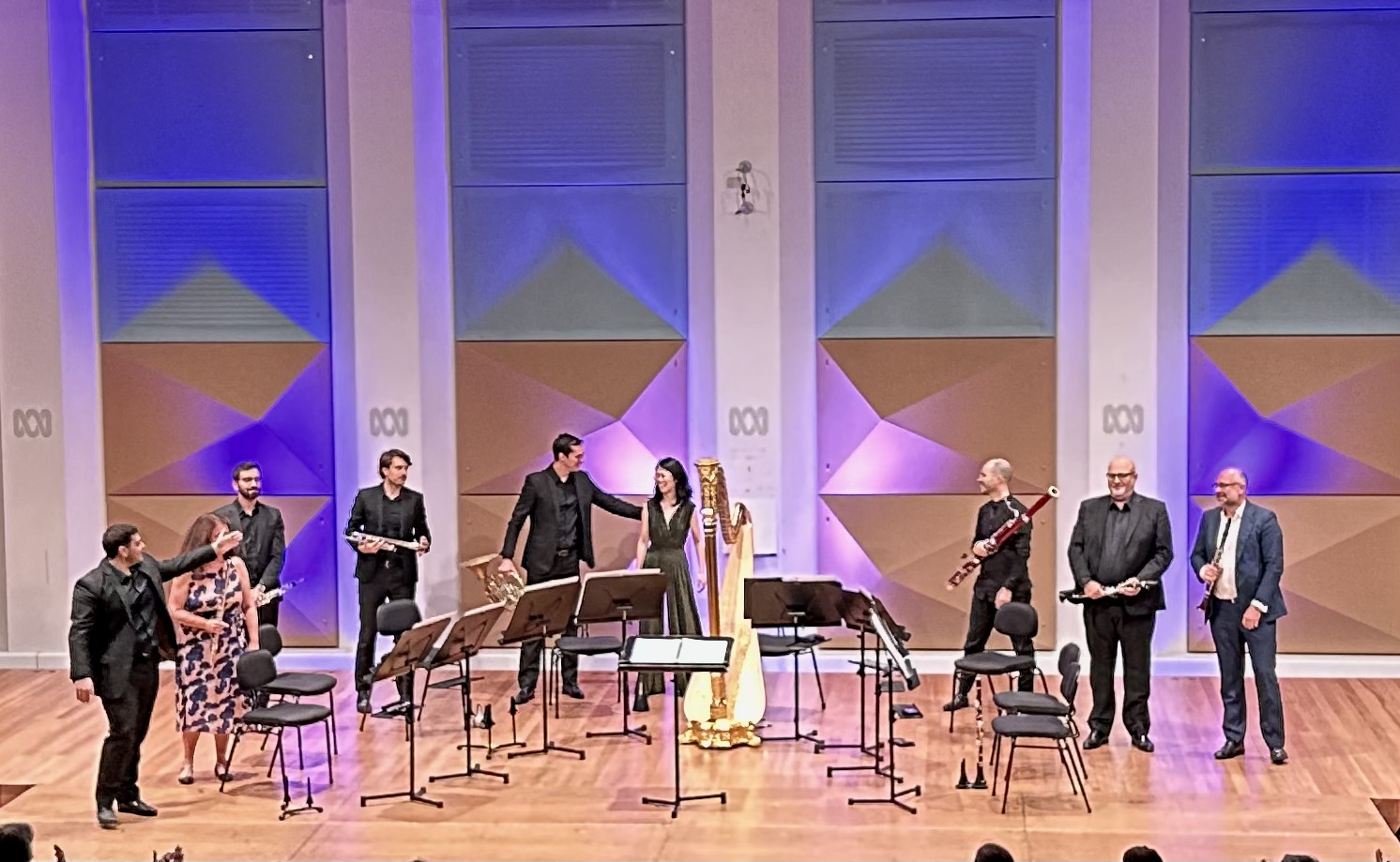
As the Melbourne Symphony Orchestra continues to bring inspiring orchestral performances to Victoria’s largest and well-loved concert halls, we are now relishing a new series of chamber concerts in the hallowed ABC’s Iwaki Auditorium. With a seating capacity of just 400, it was no surprise that this event would be sold out early, as audiences are certainly welcoming an intimate Sunday morning concert in Melbourne’s arts precinct. Best of all is the highly rewarding opportunity to connect with MSO members “up close and personal”, visually and artistically.
Program curator and presenter, MSO harpist Yinuo Mu had chosen fresh and rarely heard repertoire, with colleagues Prudence Davis (flute) and Jack Schiller (bassoon) flanking her golden harp for the opening work Herbsttag (Autumn Day). Composed by Uruguayan/American composer Miguel del Aguila in 1984 and inspired by the words and existential reflections found in Rainer Maria Rilke’s poetry, this was a very calming, at times introspective autumnal work, where solo melodies gently explored the atmosphere in wide steps or curious, circling patterns, with a touch of nostalgia and the soul of a jazz ballad accompanied by varied tone colours from strumming or imitative plucked guitar accompaniment on the harp. Very beautiful, flute and bassoon paired with brief encounters, gentle, restless and searching activity, and a most touching final dissipation into softness, shadows and isolation.
Oboist Johannes Grosso came to the stage for Ravel’s Menuet antique, a fine warm and sunny piece perfectly fitting this Autumn morning program. This audience was quite spellbound, intrigued by the superb technical artistry on display in this adaptation by Jocelyn Morlock for harp, bassoon and oboe. In a dynamic, colourful and at times folk-like piece, the instruments wove and blended with clarity, balance and united crescendos, with the harpist articulating fine softnesses in her accompaniment, varied timbres and more prominent richness in Ravel’s expansive twentieth century chords.
Again the audience was most appreciative of the fresh vision of instruments and new repertoire, and Skaila Kanga’s arrangement of Ravel’s gorgeous Le Tombeau de Couperin brought familiar themes, warmth and woodwind vibrancy to an elegant Prelude, Minuet and Rigaudon. So well loved through the centuries in European courts, the gilded harp came to the fore in the Menuet, with beauty and musical personality complemented by firm footsteps from a smooth bassoon. Lilting solos from paired oboe and bassoon held our full attention giving us a chance to see and hear the oboe featuring with impressive melodic solo work in the higher register. With modal melodies and further engaging oboe solo melodies, the closing Riguadon reflected the character of a buoyant folk-dance style, joyful, energetic and fun to hear and watch – a perfect Sunday morning treat to raise our spirits.
Barber’s Summer Music, Op. 31 for wind quintet brought notable French horn player Nicolas Fleury into a perfectly balanced ensemble whose seamless unity and timing as dynamics grew or faded, was impressive. Gentle and varied sections gave us a hint of summer breezes, with brightness and uplifting lines from Prudence Davis’ flute, Philip Arkinstall’s clarinet and Jack Schiller’s bassoon, especially bursting with life as they raised the pace towards home with surprising lengthy trills and an acceleration of new ideas in a bright and quirky closing scene.
Completing the septet for Carlos Salzedo’s Concerto for Harp and Seven Wind Instruments, Jonathan Craven (clarinet), Owen Morris (trumpet), and Cybec Assistant Conductor Daniel Corvaia were welcomed to the stage. Yinuo Mu played the MSO’s recently purchased Lyon & Healy harp, an American-built powerful instrument, and she described the challenges in Salzedo’s modern concerto where frequent pedal changes were required for the greater demands of chromaticism and more complex melodies and tonal colours, only achieved by players using different parts of their fingers for glissando and gliding effects or by playing on different parts of the strings.
In its three-movement form, the Concerto unusually opened with a Prelude where the harp was given central prominence in an early cadenza, with great precision in accented metrical groupings taking the piece to a fortissimo destination. Gentle moments of weird and wonderful chords captured our attention in the Nocturne, where a broad range of emotion gave us a sense of the things that do creep and creak in the night. A sequence of characteristic dances made up the final movement, with the opening Minuet flowing through a sometimes-illusory 5-time metre; the harpist was in the driving seat for the acceleration in the Farandole, adding an obligatory percussive touch in fine imitation of the traditional tambour. Most alluring was the Pavane, where Yinuo Mu employed dampening techniques and echoing harmonics on the harp’s lowest notes, a sort of antique “out-of-tuneness” from the mists of time. Quite astonishing.A Galliard closed the dance sequence bringing us more sharply defined plucked strings, with the ensemble members skipping together into a series of joyful glissandos and excited winds showing off their highest registers.
The MSO is to be highly congratulated for this Chamber music initiative, opening the Iwaki auditorium for the orchestra’s admired principals to perform as soloists in new ways to old audiences.
___________________________________________________
Julie McErlain reviewed “Music for Harp and Winds”, presented by the Melbourne Symphony Orchestra at the Iwaki Auditorium on April 27, 2026.