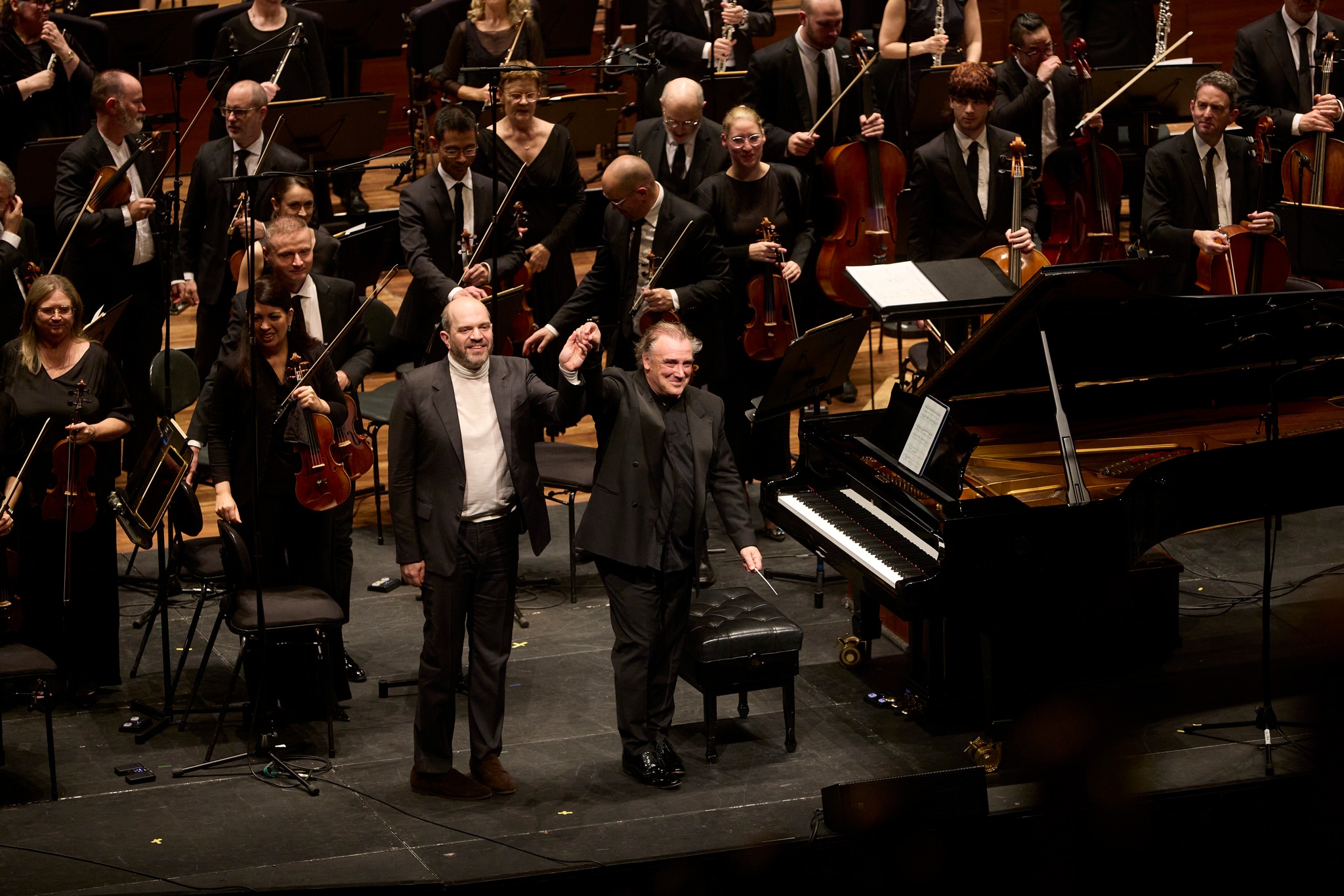
A truly fine Melbourne Symphony Orchestra delivered not only a superb Saturday afternoon concert at the conclusion of its three-part Symphonic series, (the program performed twice in Hamer Hall, and once in Costa Hall, Geelong), but stretched its musical program further into the public arena with creative collaborations reaching out to a new public and also enhancing the audience’s knowledge and deeper experience of the ticketed MSO event.
Earlier in the week, the ABC Southbank building had opened its venerable studio and now regular concert venue, the Iwaki Auditorium, for a piano masterclass to be given by the MSO’s featured soloist this week, Kirill Gerstein, a most compelling educator, speaker, and highly admired pianist. With a passion for commissioning new music and a broad involvement in a range of classical and contemporary genres, his previous work with the composer Francisco Coll (b. 1985) led to his commissioning of the Piano Concerto being premiered by the MSO.
A well-established training partnership between the Australian National Academy of Music and the MSO provided an inspiring opportunity for three young developing pianists to perform in the Iwaki, an intimate musical and physical space where audience, performers and Gerstein could share a highly rewarding musical experience. It also gave the pianist an early chance to speak to us informally about the Coll Concerto, praising the composer, in addition to connecting with both the public and ANAM pianists with his unique and colourful analogies and quite memorable quotes.
At concert venues MSO audiences are also relishing the regular opportunities to hear performers and artistic directors giving excellent pre-concert talks. Harpist Megan Reeve began her session to an “over-flowing audience”, first asking the question: Is the piano a percussion instrument or a stringed instrument? With a 50/50 response, she assured everyone they were all correct pre-empting the colourful craziness we could expect in Coll’s new concerto, with a short, recorded illustration.
Hamer Hall was again close to a full house, including seating in choir stalls. The opening Welcome to Country played by string section leaders was played lightly and joyfully, receiving firm applause, before Jaime Martín brought his great warmth and authority to centre stage for an all-time classic favourite, Vltava (“The Moldau”) from Má vlast (My Country). A perfect work for an Autumn day, bubbly, breezy themes on flute and harp introduced the pictorial colours of Bohemia’s river and homeland, admirable MSO strings delighted us with smoothly surging crescendos and diminuendos, and the audience murmured when the familiar Moldau theme entered most passionately. Martín held a very long silent space when the orchestra faded in breathlessness to silence before the immediate final cadence, the effect bringing much applause after the ensuing triumphant close.
Inspired greatly by paintings, colour, texture and shape, Francisco Coll’s three-movement Piano Concerto created a wealth of panoramic scenes and activity, inspiring our visual imagination. A most attention-seeking first movement: Humoresque – Impromptu, opened with a blast. Orchestral interjections interrupted a busy flow of scintillating piano rapidity, full of surprises and exclamation marks. Jazz influences and helter-skelter short rhythmic snaps and melodic snatches circled constantly, unpredictably through the orchestra. Gerstein powered expressively through this exciting movement, adhering to the composer’s markings: Celere luminoso (swift and bright), and later “shamelessly reckless” and “absurd”. The second movement Paisaje took us to a broad, twilight scene, where sustained strings allowed a sparkling and virtuosic piano to impart much orchestral colour, then surprise us with repeated bare single notes as if searching for new pathways. Orchestral intensity was forged by apocalyptic lower brass in Coll’s magical orchestration where patterns and textures expanded and contracted. Short patterns were passed helter-skelter around the stage with innovative combinations of instruments giving voice. The third movement, Rag, brought many flashing soundbites from high winds, and hard mallets played on xylophones and woodblock. In a nod to jazz big band styles, with some touches of Gershwin, Bartók and Stravinsky, Gerstein slapped clusters of keys with his palm, and brass, wind and violin bows were raised in this exciting musical adventure. The audience was fascinated by this Australian premiere performance of a challenging work, appreciating the connection between composer, pianist and the MSO.
Long applause brought Gerstein back to the stage for a solo piece by British composer Thomas Adès (b. 1971) a piece with fresh harmonies, his right hand resembling a celeste played over a soulful, deep vocal melody – surprising, different.
Following interval, how perfectly did Dvořák’s Symphony No. 7 in D minor, felt by many to be his greatest work, complete this most satisfying orchestral experience. Despite its D minor seriousness, there were so many moments of great beauty and emotional sustenance, with French horn bringing quiet strength and pure gold, and clarinet and flute solos bringing affirmation, clarity and calm.
This was Jaime Martín’s night, with his conducting being a pure joy to watch, his personality and love of music shared with all. As a dancer has fluidity of movement and expression, Jaime Martín takes every part of the score to every performer with his physical language – not just leadership from the baton, but true creative inducement – with a shoulder “nod”, a sweep of a hand, a head-nod or turning his full body to the side, as audiences can also fully see his expressive facial solicitations.
The warmth, colour, community and musicianship generated in this MSO performance brought us a very satisfying program that had everything.
Photo credit: Laura Manariti
__________________________________________________
Julie McErlain reviewed “Jamie Martin conducts Dvořák Smetana & Coll”, presented by the Melbourne Symphony Orchestra at Arts Centre Melbourne, Hamer Hall on May 30, 2026.