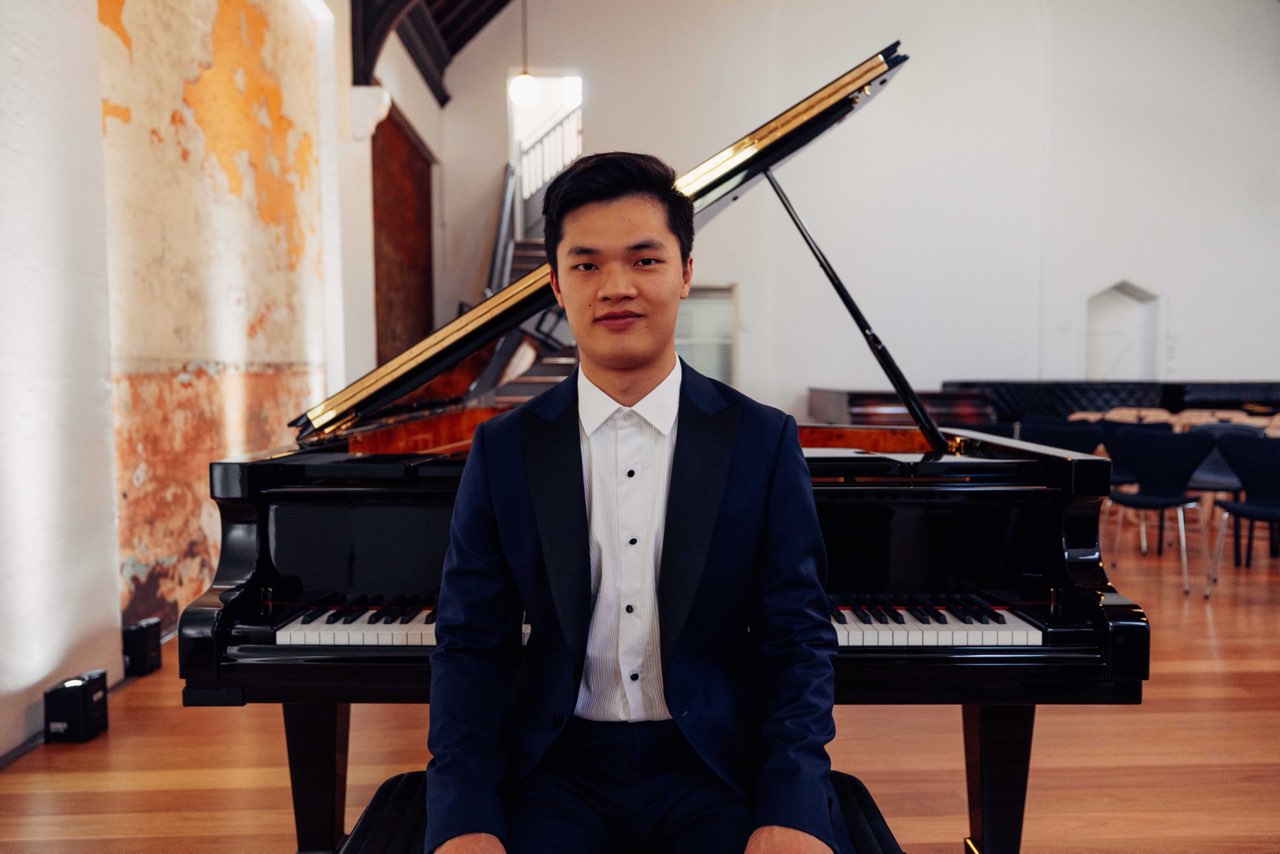
How often do we hear audience members proudly saying they have followed the development and career path of young Australian musicians, always remembering their debut performances. Praise must go to the Cope Williams Foundation for their ongoing commitment to supporting young performers with the essential sponsorship and promotion needed. Impressed with the outstanding talent of young Sydney pianist Joshua Han, Alex and Jan Moffat are to be credited for their commitment to supporting his rising popularity and wider recognition as their Foundation brings new concert venues and open-hearted audiences to share the developing careers of our very best solo artists.
Best known for winning First Prize at the 2024 Australian National Piano Award and the International Bach Piano Competition in Germany in 2025, Han is a remarkable pianist, a prolific award-winner, a pianist who is relaxed and at ease on stage. Unusually too, he openly spends time – both pre-concert and post-concert, and even at interval – connecting with his audience and new friends. At 24 years of age Han is also remarkable for his impeccable memory, his quiet humour and refined stage presentations, a creative exponent of classical improvisation and extemporisation, and, most surprising, is also in his final year of study for a Degree in Medicine.
The unique and historic venue of the Savage Club provided an elegant and intimate space for Han’s recital. The Bach-Busoni Chaconne in D minor, with its imaginative and dramatic variations on the well-known theme from Bach’s Partita No. 2 for solo violin, was a perfect opening. Following the ceremonial grandeur of the opening theme, Han showed impressive maturity and authority, colouring each variation with considered contrasting levels of tone, touch and timbre. He enticed an array of keyboard and orchestral colours, with finely delineated melodies – prominent, warmly glowing upper bell like phrases, clear string bass melodies, carefully pedalled string timbes and dazzling scale runs. Like a slow burn, the run home was a controlled crescendo that began in a soft subdued underworld, building up to a mountainous and triumphant close – maestoso with an orchestral fffff fortissimo required!
The familiar broodiness and moments of turmoil in Beethoven’s Sonata in F minor, “Appassionata”, warmed us in one of the composer’s best known and loved works, with Han fully exploring contrasts in emotion and passion, and always highlighting melodic themes with clarity and thoughtful expression. Outbursts of despair, intense silences and trembling trills took us into the composer’s soul in a work where both hands are so often pitted against each other. Then how lyrical and heavenly is the chorale theme of the angelic Andante con moto section, where Han released high-shining lights in a very sparkling upper accompaniment whose flowing patterns almost belied the technical difficulty of this sonata. Han’s final section was forged with fire and agitation as he accelerated into a fiery, symphonic close.
Nicely programmed, the tender melodies of Chopin’s Andante spianato et grande polonaise brilliante next took us to the illusory romantic world of the dance, where we felt lightness and movement in the air and the sparkles of diamonds, appreciating Han’s clarity, precision and musical sensitivity. He brought us to earth with the polonaise, delivering an uplifting portrait of vibrant colour and fanfare. Themes were clothed in sparkling costumes; tonal colours of brass and gold were added to the spicy harmonies describing the theatrical flair and athleticism of the popular Polish Dance. Cascading ornaments, powerful chromatic surges and a myriad of virtuosic scales and free-falling chromaticism brought us much enjoyment before interval, where a second round of generous refreshments brought much appreciation for the Foundation.
Fritz Kreisler’s music was perfect music for the historic setting and décor of the Savage Club, and his violin and piano pieces Liebesleid (Love’s Sorrow) and Liebesfreud (Love’s Joy) always delight. Rachmaninov’s arrangement surrounded the familiar Mazurka and Waltz dance rhythms with spicy harmonies, freedom and unexpected feverish chromatic acceleration. The pieces were decorative and effervescent, combining devilish surprises and merriment with notable creative and virtuosic technical elements, always elevating the lyricism and feeling of Kreisler’s original work.
Han completed his grand recital program by taking us further into the exciting and multi-coloured repertoire of orchestral music where monstrous transcriptions are a treasure chest for concert pianists. His performance of Stravinsky’s Firebird, arranged for solo piano by Guido Agosti, himself a student of Busoni, was a breathtaking finale. Han showed his most explosive and rhythmic power, maturity and mastery, as he became the orchestra of the day. Always communicating the importance of melody against new blends of tone, he astonished us with the accelerating final glissandos and layers of many bells ringing. This fiendish work left the audience speechless, admiring Han’s extraordinary talent and feeling privileged to be hearing wonderful performances and follow his brilliant career.
Photo supplied.
_________________________________________________
Julie McErlain reviewed Joshua Han’s Cope Williams Foundation piano recital, presented at The Savage Club on June 20, 2026.