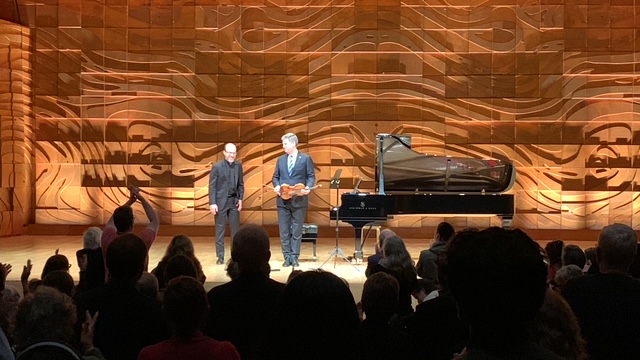
James Ehnes gleefully pointed that, having reached the tender age of 50, he gets to do what he likes, so he’s filled this “variety show” with the duo’s favourites. Their program was both varied and substantial, with a suite by Korngold, and three sonatas (Debussy, Brahms, and Grieg).
All these works were written by composers at the peak of their considerable powers, and the same could be said for Ehnes and pianist Orion Weiss, who are both highly acclaimed, award-winning musicians.
Melbourne’s stunning Recital Centre is a drawcard for top-flight performers, so local audiences are blessed with a constant supply of great musicians. What took this event to an unsurpassable height was their deep-seated happiness and unaffected confidence, which sealed an already formidable partnership and won the audience’s hearts.
The concert opened with Erich Korngold’s arrangement of his incidental music for a production of Shakespeare’s Much Ado about Nothing at Vienna’s Schӧnbrunn Palace in 1919. Korngold’s music evokes the atmosphere of the play and is grounded in the Viennese culture of the day. This colourful, finely chiselled performance highlighted the beauty of this arrangement, which exploited both instruments’ and both performers’ capabilities.
Next came Brahms’ first violin sonata. It was not an early work – he was in his forties – but it was the first one in this genre to survive the brutal cull of drafts that didn’t meet his expectations. Again, Ehnes and Weiss played Brahms’ lush score with rich, warm tones and combined very effectively to communicate the music’s broader narrative arc.
The second half began with Debussy’s one and only violin sonata. By way of context, Ehnes explained that Debussy composed the sonata in 1917 as the third of a planned six-work chamber music project. Written when he was already ailing, it was to be his last major work, and its premiere in 1918 was his final performance.
The sonata has all the hallmarks of Debussy’s works: exotic melodies; explosions; languid, ambiguous harmonies; and rhythmic guitar-like motifs. Ehnes and Weiss gave an imaginative interpretation, using their considerable tonal range to bring out the constantly changing moods and textures in Debussy’s score.
Next came Grieg’s third (and final) violin sonata, a program choice that was bound to please. The three movements are marked “passionate”, “expressive”, and “animated”, and this performance showed all three qualities. There were gorgeous lyrical passages, brilliantly executed musical exchanges between the violin and piano, and perfectly synchronised climaxes.
The sonata finished on a high, and so did the audience. They leapt to their feet, whooping and clapping until they got their encore(s): the last movement of Prokofiev’s second sonata; and, after another burst of applause, an arrangement of “Marietta’s Lied” from Korngold’s opera, Die Tote Stadt.
It’s not hard to fall under the spell of these two accomplished musicians, and it would be foolish to resist. It wasn’t just their musicianship, which is exceptional by any standard; it was their warm and unstinting engagement with the music, their partnership and the audience that made the performance memorable.
___________________________________________________________
Sue Kaufmann attended the recital “James Ehnes with Orion Weiss”, presented by the Melbourne Recital Centre in Elisabeth Murdoch Hall on June 19, 2026.