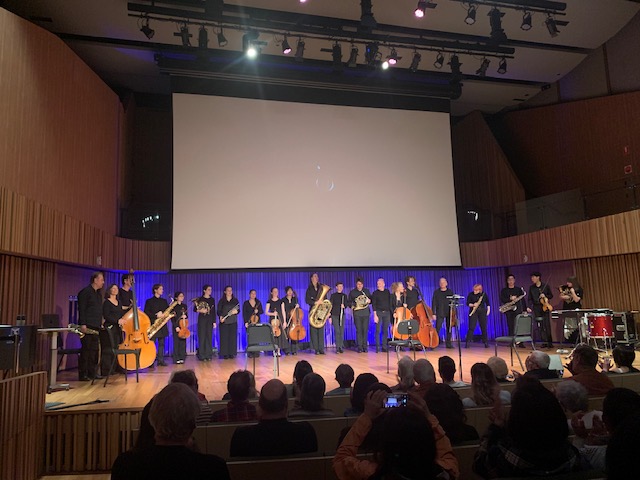
Swiss Ensemble Contrechamps, en route to Canberra for the annual International Music Festival, gave Melbourne’s musical community plenty to think about when it performed a handful of contemporary works in collaboration with Melbourne Conservatorium of Music students.
I came with “green” ears, having never heard any of the programmed pieces before, while the bare details provided in the program and introductory remarks ensured the audience came to this live performance with no limiting expectations, i.e. open ears.
My curiosity was piqued by the breadth and depth of the works in this program and I left wanting – determined, in fact – to understand conceptually how these works came into being. So this review reflects not only what I experienced in the live event but also what I learnt later from the composers’ published notes.
The concert opened with solo violist Hans Egidi playing the Prologue from French composer Gerard Grisey’s cycle, Les espaces acoustiques. This opened with a short sequence that turns out to be the musical seed for the entire piece. The endlessly varied repetition of the opening phrase created a pleasurable mix of calm and suspense. The repetition instilled a sense of calm, a feeling that the music was predictable; while the endless variation kept the listener on tenterhooks, wondering how the melody’s tail would unfurl. Egidi nurtured each iteration with great care, and his pure, rich tone was a highlight of this performance.
The subject of Melody Eӧtvӧs’ work, Tardigradus (aka water bear or moss piglet), is a virtually indestructible caterpillar-ish animal about the size of a grain of sand, which moves slowly and awkwardly on clusters of claws extruding from eight stumpy legs.
Eӧtvӧs’ musical portrait of this remarkable creature is scored for flute and vibraphone with a fixed-audio soundtrack evoking the sounds of the Australian bush. Tonally, the flute and vibraphone were well-matched, and the perfect synchrony between Susanne Peters (bass flute and piccolo) and Thierry Debons (percussion) made for a very cohesive interpretation of a highly atmospheric piece.
British composer Naomi Pinnock wrote Everything does change to accompany a short film compiled from super-8 “home movies” by the Czech artist Pavla Scerankova, who was paying homage to moments from her family history that she herself had not experienced. While the film records the simple joys of children at play, Pinnock’s soundscape has a sober, more contemplative quality. It plays with a descending two-note phrase that is repeated at different pitches and intensities as it is passed between the viola (Hans Egidi) and cello (Martina Brodbeck), seated beneath the screen. The gestures they used to connect their intertwined parts underlined the metrical but variable pulse that the music added to the film.
The full Contrechamps Ensemble performed the Sooty Owl Nightcap by Melbourne-based composer Miriama Young. The Nightcap comes from Young’s five-movement Borderlands Biophony, which features endangered fauna from the country of the Bundjalung people on the New South Wales / Queensland border. Young’s writing highlighted the variety of tones and effects available with this combination of wind (flute, clarinet, saxophone), string (viola, cello and double bass) and percussion instruments. Highlights of this very atmospheric piece included the delicate opening (viola and flute), the progressive addition of new instrumental parts, one at a time, and the deep, resonant sound produced when the whole ensemble was finally brought in.
There is a hard-to-define quality about Young’s score that connects it to the environment; a listener familiar with the Australian landscape might well recognise the inspiration for this work, even without knowing the title.
The number of performers involved in each item had increased as the concert progressed. For the final item, Enter the impossible, by the composer, drummer, and scholar Jessie Cox, the Conservatorium’s fifteen-strong New Music Ensemble joined Contrechamps. Those with the largest instruments were lined up across the stage, backs to the audience, while the rest – with instruments but no music – spread out along the side aisles.
All eyes were focussed on the screen. A giant planet covered in musical code began to rotate; an infographic gave its name (LBD), gravity (normal) and life (intelligent), and note or chord sequences, while a digital stopwatch measured the planet’s time before us. Enter the impossible presented a succession of other heavenly bodies: an ice planet; a moon with jungle life; and a planet with no atmosphere. Each planet seemed to have a distinctive sonic palette, with the musicians improvising the individual parts within some predetermined constraints.
Their collective contributions created a dynamic, yet strangely cohesive sound. Jungle life, for example, was full of trills, explosive sparky sounds, booming brass, and a raft of exotic percussive effects; while on Planet FT, devoid of atmosphere, we heard only sporadic knocking and fleeting bubbles of sound. When two planets collide, the musicians created a violent, fiery eruption of sound that matched the conflagration on screen.
Enter the impossible was an immersive, theatrical experience, in which the audience was close enough to the performers to sense their involvement in the creation of this live soundscape. Cox’s website aptly describes his music as his “own strand of musical science fiction, one that asks where we go next”.
If you’re curious by nature, and you get the opportunity to see Contrechamps Ensemble during their Australian tour, take it.
___________________________________________________________
Sue Kaufmann attended the performance given by Ensemble Contrechamps, presented by Melbourne Conservatorium of Music at Hanson Dyer Hall on April 23, 2026.