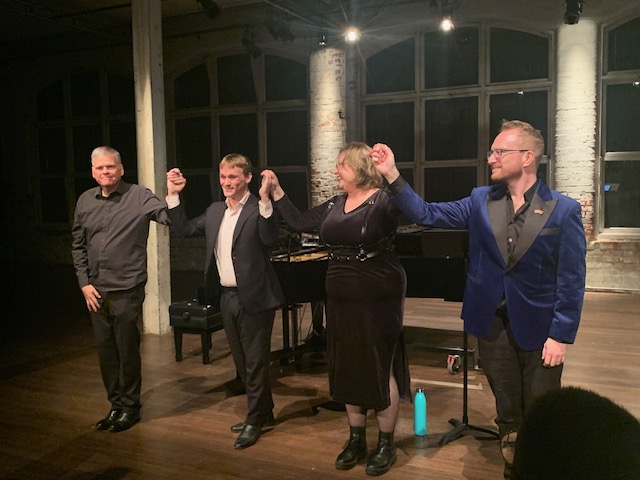
Hard on the heels of a mighty Beethoven’s 9th Symphony in an arrangement by Franz Liszt for two pianos, the 2026 iteration of the fortyfivedownstairs Chamber Music Festival, predictably, presented something completely different. The Festival’s curator and tireless dynamo, Coady Green, welcomed the audience with a particularly interesting introduction to Thursday evening’s program.
As the title suggests, “My Favourite Penis Poems (and Other Love Stories)” is bound to raise eyebrows and potentially provoke controversy. In fact, this was only the second time that My Favourite Penis Poems (1998–2002) by Pulitzer Prize-winning American composer/pianist David Del Tredici (1937–2023) had been performed in its entirety – a remarkable outcome for such a distinguished composer. Green himself had been about to perform it on an earlier occasion, but was banned from doing so after the venue management read the poems. Being of a more sophisticated and adventurous mindset, the management at fortyfivedownstairs recognised the merit of the work, and Melbourne has had the opportunity to hear a group of fascinatingly inventive and humorous songs performed by three exceptional artists.
We were privileged to have Marc Peloquin as the pianist, thanks to Green’s initiative. His status as Del Tredici’s two-decades-long collaborator and executor of his estate make him singularly well placed to reveal the composer’s intentions.
The six songs comprising My Favourite Penis Poems are settings of poems by Antler, Marilyn Kallet, Edward Field, Rumi and Allen Ginsberg. Del Tredici described it as a “song cycle to celebrate sex — raw, rough, and risqué”. It could also be viewed as reflecting a wave of protest against the oppression suffered by members of the gay community – an injustice railed against by activists such as Ginsberg.
The cycle begins with “Now You Know”, a song for tenor. Boyd Owen is a highly accomplished vocal technician and a fearless performer, as those who saw him in the Victorian Opera production of selected scenes from Gregory Spear’s opera Fellow Travelers know. The opera concerns a secret, gay love affair between two men during the Lavender Scare in 1950s Washington, D. C., and covers territory very familiar to Del Tredici. His song about babies having erections in the womb, and all that implies, was heralded by a firm “ta-da” of piano chords and then a spoken “New studies reveal…”. The music is accessible – it struck me initially as reminiscent of Noel Coward, but goes beyond that – and full of variety in tempi and dynamics, ending on a forte celebratory note.
Marjorie Butcher, perhaps best known for her spectacular work as first soprano in a number of vocal ensembles, notably Divisi, displayed her enormous capacity for vocal range and colouring in “Die Forelle”. Throughout the song cycle we heard references to other famous compositions, but Schubert’s trout was the most conspicuous with its constantly repeated rippling motif that begins the Lied. Like Owen, gesture was used judiciously to convey the story. Kollet’s poem is long, and although a printed copy of all texts was available, it was not easy to absorb the detail. Butcher ensured that important features were conveyed, managing to make an erotic point at the end without looking sleazy.
This ability was even more important in the song based on “The Importance of Gourd-crafting” by the thirteenth century Sufi mystic and poet, Rumi. It begins, “There was a maid servant who had cleverly trained a donkey to perform the services of a man”. This has been enough to slam the door shut on earlier performances, but moral instruction is an important part of Rumi’s writing. Del Tredici’s musical rendering of the poem is flamboyantly graphic at times, but Butcher’s spectacular vocalisations and facial expressions, sometimes of wonder, transcended the more sordid element.
Between the trout and the donkey, Boyd Owen sang “Street Instructions: At the Crotch” and “Hot to Trot”, the former to music sometimes romantic, at other times pensive in nature, and the latter infused with quotations from Richard Strauss’s Der Rosenkavalier.
Before the final song, “Please Master”, Butcher (already discreetly harnessed) handed another harness to Owen to emphasise the S and M point. The only duet, the music is unexpectedly romantic considering the topic. Whether it was an intended reference to the repeated phrase “say you love me” from Phantom of the Opera’s “All I Ask of You”, a connection was easily made. Given the gay community’s enthusiasm for musical theatre, it may well have been. Of course, it went well beyond that gentle tone to frantic outbursts with Butcher achieving impossible vocal heights. Owen continued to achieve an astonishing level of vocal control. His ability to move seamlessly between registers and colour his voice with total command of pitch and volume was remarkable.
Also remarkable in its vocal virtuosity was Bailey Montgomerie’s performance in Gay Life (2001), Del Tredici’s song cycle for baritone and piano, transcribed from the original orchestral version. Another Australian premiere, it is based on six poems by Michael D. Calhoun W. H. Kidde, Paul Monette, Thom Gunn, and Allen Ginsberg. A rolling, whirling piano music introduced “Ode to Wildwood”, a hint of Broadway evident – although the reference to Julie Andrews is ambiguous as it is also a place name. Extreme crescendos and decrescendos, and changes of pace and mood were skilfully negotiated by Montgomerie, who possesses a formidable vocal palette to the point where you wonder just what type of voice he has; he moved with ease between tonal qualities of bass, baritone and tenor in combination with a reliable falsetto, but maintained a vibrant, steady core of well-produced baritone. A moderately paced “In the Temple” saw a passionate climax and perfectly controlled diminuendo.
Throughout the cycle Montgomerie’s breath control and phrasing were exemplary. The two Ginsberg poems, “Personals Ad” and “After the Big Parade” were amusing, but the repeated pealing of bells for “Parade” became darker as the “Corridors of Death” were invoked. The segue into Monette’s “Here” struck an even more solemn note as the piano tolled in funereal tones to punctuate a tale of loss. The final song, “Memory Unsettled”, was a natural transition as death and loss (Gunn’s poem a memorial to victims of AIDS) began with music from “Dido’s Lament” by Purcell. More farewells were heard in re-imagined excerpts from Isolde’s “Liebestod” and even a few final fragments of Rosenkavalier. Much of Del Tredici’s work relies on repetition, used extensively in this song with a “remember me” sounding like the voice of a ghostly spirit desperately reluctant to depart. The simple emotional gravity with which it was performed was intensely poignant, as each repetition seemed to re-make the plea. Montgomerie’s unwavering focus and immersion in the music created a riveting experience.
In both works, Marc Peloguin’s playing was masterly in the nuanced way it evoked each emotional shift, be it witty, light-hearted humour, distress, profound sorrow or unbuttoned excess.
By obeying the command to “prick up your ears” we were rewarded with outstanding performances of striking works that sometimes shocked but ultimately moved.
____________________________________________________________________________
Heather Leviston reviewed “My Favourite Penis Poems (and Other Love Stories)”, presented as part of the 2026 Chamber Music Festival at fortyfivedownstairs on April 24, 2026.