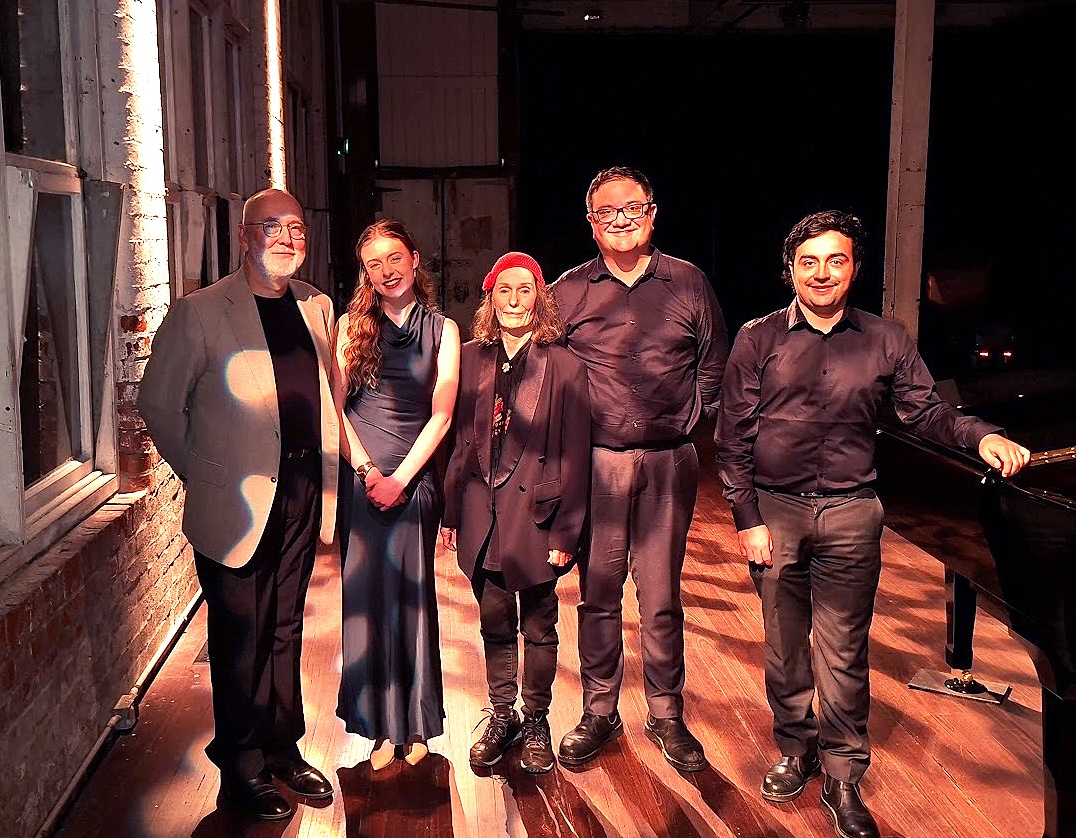
The annual Chamber Music Festival at fortfivedownstairs is a highlight of Melbourne’s music calendar – arguably, The highlight. Curated by the ridiculously gifted and energetic Coady Green, it has reliably brought us a succession of interesting and daring works performed by some of Melbourne’s top artists. Green is not only a virtuoso pianist; he is also an imaginative entrepreneur and an extremely active supporter of young talent.
For opening night, Green designed a diverse program of works inspired by Shakespeare’s plays, namely, Hamlet, Twelfth Night and A Midsummer Night’s Dream. Most works involved arrangements for two pianos, with Green on the primary one and Ian Munro on the second piano.
Following Green’s friendly introduction to the Festival and its many offerings, he and Munro astonished the audience with American composer Edward MacDowell’s Hamlet and Ophelia Op 22 (1885), arranged for two pianos by the composer. In two sections, the first is a depiction of Hamlet’s fluctuating state of mind. It begins gently enough but soon erupts into dramatic climaxes that rear up in urgent trills and turbulent Angst; more serene, meditative passages are soon overtaken by passionate outbursts. Ophelia’s music is more of the “melodious lay” variety, slower and quieter, although even she becomes increasingly agitated at one point, with insistent repeated notes until she is back serenely floating down the river. It was a vivid performance by the two pianists, who worked together as one impressive sonic unit.
A change of program saw a vivid performance of Eric Korngold’s Songs of the Clown, Op. 29 (1937). When the composer first moved to Hollywood in 1934 to write music for films, his first was for Reinhardt’s A Midsummer Night’s Dream, so this change was particularly apt. Korngold has written songs for Shakespeare’s characters, and these five are for the clown Feste from Twelfth Night, the – “if music be the food of love…” play. Soprano Genevieve Gray introduced the songs by explaining the role of the clown and the particular shades of meaning being expressed. Accompanied by Ricardo Roche Idini, she captured the varying moods of the songs, also presenting the essence of the character through gesture – cheeky, tongue-in-cheek mournful or swaggering. It’s hard to swagger when you are an attractive, delicate, very feminine young woman in a slinky gown, but Gray managed. So animated and captivating was she that it took me a while to realize just how good Idini’s playing was – a perfect musical match for her expressive realisation of these songs. Apart from good control and steadiness on higher sustained notes, Gray’s voice is remarkable for its special allure; there is a quality of pathos with substantial texture in the middle voice. I was not alone in being struck by its similarity to Siobhan Stagg’s. I know one should not make comparisons because all voices are so individual, but…
Liszt demands extraordinary virtuosity and that is just what we heard in Green and Munro’s playing of his Hamlet S.644, arranged for two pianos by the composer. It is a much darker musical interpretation of the Dane than the one we had heard earlier and compelling in its rumbling moodiness, intensity and aggression.
After interval, we heard what most members of the audience would have considered the main attraction: Helen Morse reading extracts from A Midsummer Night’s Dream while Green and Munro played Mendelssohn’s Incidental Music Op. 61 from same, arranged for two pianos. With the ten musical sections followed readings of the relevant action of the play (except for the extended Overture), Morse assumed a variety of roles – no mean feat. At times, it might have been difficult to follow the storyline for those who were unfamiliar with Shakespeare’s play, but Morse was able to differentiate the characters remarkably well by using different registers to pitch her voice and employing different accents. Morse has a lovely, natural speaking voice and is able to project it effectively, but a microphone would have given her greater leeway regarding volume changes. Whether as Oberon, Titania, a Fairy, Hermia (that reading was particularly poignant), the mechanicals, Theseus or Puck, she was a class act. The basic story was easy enough to follow, and the pianos created a magical Mendelssohn world of glittering fairies, rough tradesmen and Athenian lovers. Green’s little musical interpolations as Morse read enlivened the performance even further.
This was a splendid Festival opening: most entertaining and expertly performed. And there’s a lot more of that to come.
______________________________________________________________________________
Heather Leviston reviewed the opening night of the 2026 Chamber Music Festival, presented at fortyfivedownstairs on April 21, 2026.