A glance at the publicity material for this Chamber Music Festival concert might note the words Bellini, Xanthoudakis, Romeo and Juliet, and Manhattan; the combination might lead to thoughts of bel canto arias along with a couple of musical theatre hits for good measure. What we heard was very different.
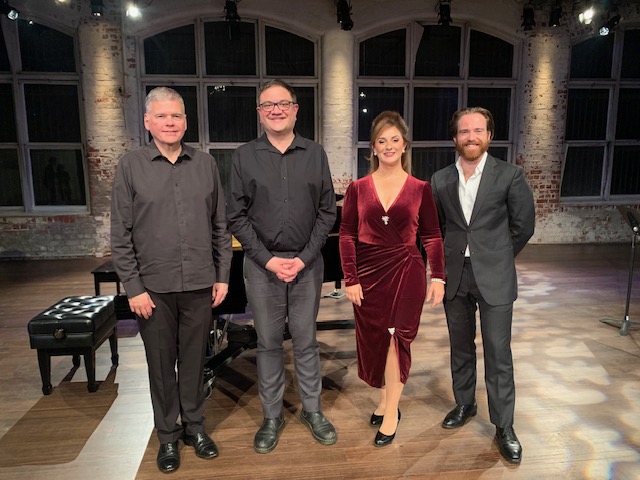
The Bellini component was the short Overture from his I Capuleti e I Montecchi, arranged for piano four hand by Hugo Ulrich, and played on two pianos by Coady Green and notable American pianist Marc Peloquin. It was Peloquin who introduced this work pointing out that, instead of text, the themes of Love and Death and a story’s emotions are expressed musically in more abstract terms. The fate of Shakespeare’s star-crossed lovers is familiar enough to understand how Bellini’s music reflects some aspects of the story, with conflict, drama and courtly heralding predominant. Somewhat all-purpose in nature – there’s not much you can cover in five minutes – but given Bellini’s spirited tunefulness and the duo’s impressively dynamic playing, this performance was an energising way to start the evening.
Whereas few would have recognized Bellini’s music, Tchaikovsky’s Romeo and Juliet Overture-Fantasia is very familiar, and with a program based on Shakespeare’s play, the listener can follow key events easily. Karl Klindworth’s arrangement for two pianos is extremely demanding, and it was amazing that Green and Peloquin were able to achieve the level of synchronisation they did given their ultra-busy schedule. There might have been some imperfect technical moments, but the deeply romantic essence of the score was present. After skilfully negotiating the passages of weighty drama, helter skelter string transcriptions and hectic syncopated rhythms of Tchaikovsky’s score, the perfectly synchronised slow ending came as a moment of beauty – illustrating the gorgeous depth of tone that can only be achieved with two pianos working as one.
Although not listed in the advertised program, David Del Tredici’s Ballad in Lavender (2004) was a welcome addition. As Del Tredici’s long-term collaborator and executor of his will, Marc Peloquin is the perfect pianist to interpret his works, so it would have been a wasted opportunity not to include at least one work by this notable American composer. As the title suggests, this piece for solo piano is by a composer keen to progress gay rights, “lavender” being a colour associated with gay culture. When composed, Ballad was programmed to precede Schumann’s Kreisleriana, so fragments of that work were incorporated. An elaborate Introduction with Cadenza led to dance-like rhythms, followed by a building climax and a recapitulation of thematic material. In a work more Manhattan than Verona, Peloguin’s command of the virtuosic figurations and coherent sense of the work as a whole produced an interesting and enjoyable experience for the audience.
A work by another American composer, Ned Rorem, provided the most engaging work for the evening. Variously referred to as a “song cycle”, “concert cantata” and “four art songs”, Four Dialogues (1954) for two voices and two pianos, is a 20-minute work that could equally qualify as a mini opera in four scenes. A story of the rise and fall of a romantic relationship, in the first edition its author, Frank O’Hara, called it “The quarrel sonata”. It is highly entertaining, with a witty libretto and lyrical music. The action moves from the couple’s meeting in “The Subway”, when attraction is instant and somewhat overenthusiastic on the part of the man: “I must have you”, to “The Airport”, where things take a more erotic turn in the carpark: “I feel your desire” (in waltz time), to “The Apartment”, where things go downhill as a happy wife is accused: “Did you put a wrinkle in this newspaper?” and rapture turns to rupture: “You hateful man. Leave while you can”, and, except for an unaccompanied shouting match, busy piano music becomes even spikier and more aggressive. After weighty piano chords, the mood calms and becomes nostalgic for “In Spain and In New York” as, apart, they confront their loneliness: “I wonder if he”/”I wonder if she”.
Although options are available for other voice types, this performance featured soprano Elena Xanthoudakis as the woman and tenor Douglas Kelly as the man. Both lauded singers of outstanding ability, they conveyed the changing dynamics of the relationship convincingly. Xanthoudakis has great purity and beauty of tone and produced some wonderfully melting portamenti, the highest notes incorporated seamlessly into the vocal line. Kelly’s tenor voice was well-focused, firm and vibrant encompassing the ardent and aggressive outbursts effectively.
All Festival singers so far have used tablets (usually with a music stand), but all, without exception, have made minimal use of them, seeming to have memorised much of the music in a desire to communicate the emotional substance of the stories more immediately. Sung text is not always easy to follow, even when the singers have excellent diction, as these singers did. Surtitles have been a boon, so when a fully staged performance of Rorem’s work is mounted – as I hope it will be – these will prove an asset. Meanwhile, what Coady Green and his fellow artists have given Festival audiences so far has been a succession of stimulating musical experiences.
____________________________________________________________________________
Heather Leviston reviewed “From Verona to Manhattan: Romeo and Juliet in Music”, presented as part of the 2026 Chamber Music Festival at fortyfivedownstairs on April 25, 2026.