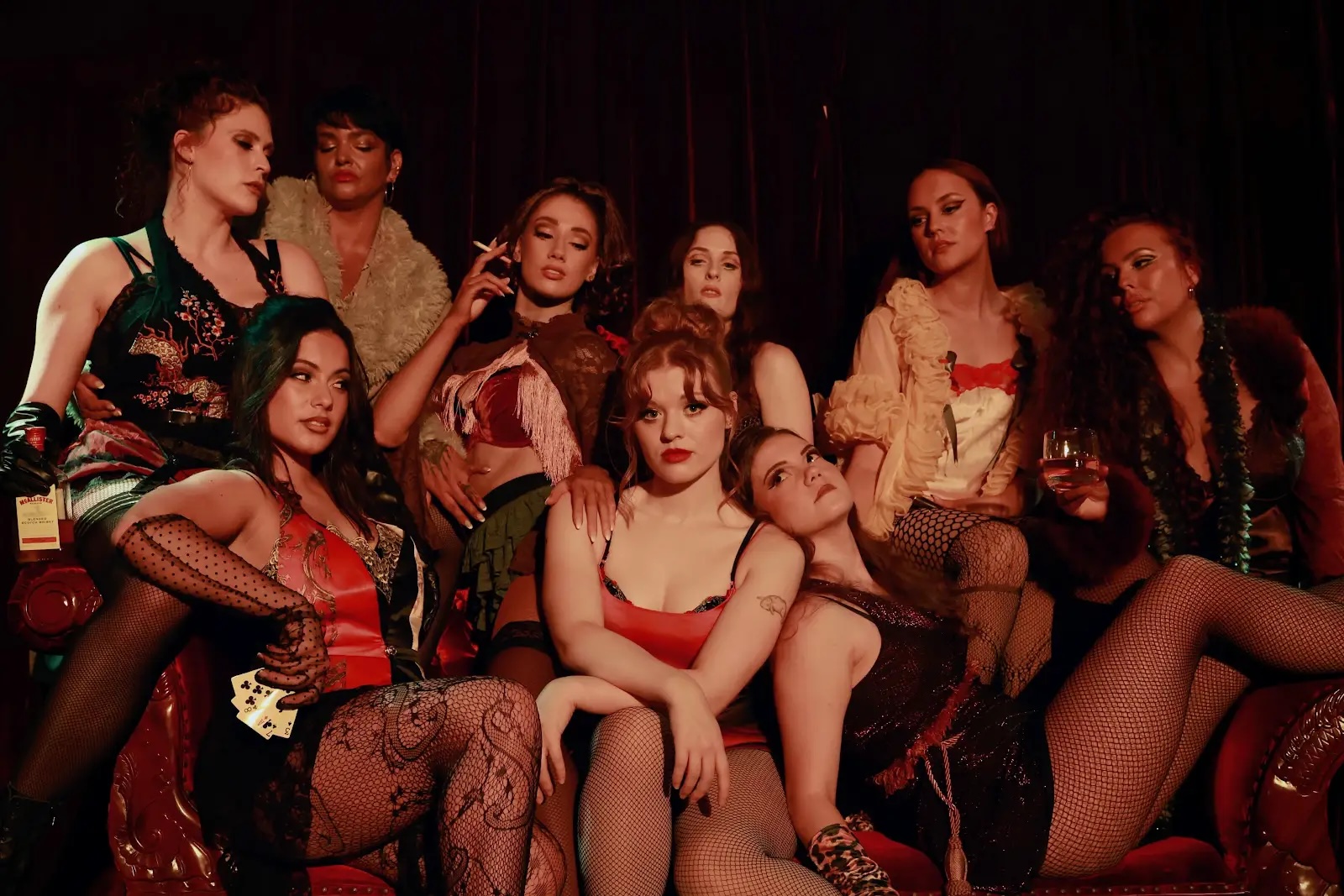
Celebrating the sixtieth anniversary of Sweet Charity, Heirlume Productions and co-producer Forest Collective have approached Cy Coleman, Dorothy Fields and Neil Simon’s classic musical with both affection and imagination. Adapted from Federico Fellini’s 1957 film Nights of Cabiria, upon which the musical’s book and lyrics are loosely based, Sweet Charity has always occupied a curious space between bittersweet comedy and melancholy parable. Under the assured direction of Madison Lee, this chamber-scale production embraces that ambiguity, reimagining the piece through contemporary perspectives on queerness, identity and belonging without sacrificing its essential optimism.
Set between the Lavender Scare and the Stonewall riots, this Sweet Charity exists in a world of performance and disguise. Ruben Laine’s industrial scaffold design physically separates the women of the Fandango Ballroom from the world of conventional respectability below. The resulting imagery evokes something distinctly Felliniesque, recalling the bittersweet clowning, circus motifs and dreamlike social vignettes of Nights of Cabiria. Like Cabiria herself, Charity becomes a kind of sad clown, bearing witness to a world she inhabits but is never fully permitted to join. Lee’s conception demonstrates a thoughtful maturation of the original work. Rather than imposing a contemporary ideology upon the musical, the production interrogates themes already latent within it: agency, sexuality, performance and the yearning to be loved. Although some of the queer dimensions outlined in the program notes remain more implicit than fully dramatised, the production nevertheless succeeds in illuminating fresh aspects of the material.
At the centre stands Erica Wild as Charity Hope Valentine, delivering a performance of remarkable conviction and stamina. There is nothing self-conscious about Wild’s portrayal. Their fourth-wall asides are effortless, the comic timing natural and the emotional truth unwavering. Charity emerges as an appealing blend of the tragic innocence inherited from Cabiria — Giulietta Masina’s unforgettable heroine in Nights of Cabiria — and an indefatigable American optimism. Wild possesses that elusive quality that compels belief; character and energy never waver. Vocally, Wild demonstrates a keen understanding of Coleman and Fields’ Broadway idiom. Rather than treating the score as a succession of stand-alone songs, they maintain dramatic momentum throughout, shaping the clipped, speech-like lines with stylistic assurance. “If My Friends Could See Me Now” became one of the evening’s highlights, with Wild’s dexterous dance with Vittorio’s cane and top hat confirming their credentials as a consummate triple threat. Equally impressive was “I’m a Brass Band”, ingeniously staged with improvised props and crowned by umbrella choreography of infectious exuberance.
Clancy Enchelmaier, a graduate of the Queensland Conservatorium’s musical theatre program, proves equally versatile in the multiple roles of Charlie, Vittorio and Oscar. His finest work comes as Oscar Lindquist. What might easily become caricature instead emerges as an unexpectedly sympathetic figure whose anxieties eventually culminate in tragedy. The famous elevator scene is beautifully judged, while the final confrontation reveals a character who is simultaneously victim and eventual perpetrator of patriarchal violence. Enchelmaier’s rendition of “Too Many Tomorrows” offered some of the evening’s most affecting singing. His sweet mixed voice and refined softer dynamics lent the bittersweet ballad an introspective quality entirely suited to Vittorio’s emotional indecision.
Among an impressive array of triple-threat performances, the ensemble’s exuberant “The Rhythm of Life” proved another high point. Here, the titular church becomes a gay-rights gathering, with Daddy transformed from dubious spiritual guru into an idealistic activist whose courage ultimately falters when police arrive to disperse the crowd. At its centre, Sarahlouise Younger delivered a tour de force performance. Her thrilling full-belted soprano combined power, security and stylistic flair, producing some of the most exhilarating vocalism heard throughout the evening.
Elsewhere, Madeleine Pratt and Hannah Gutierrez Cañon brought warmth and humanity to Nickie and Helene. Particularly touching was their rendition of “Baby, Dream Your Dream”. By subtly suggesting a romantic attraction between the two women, the production deepened one of the score’s most tender moments. The duet became not simply an expression of friendship, but of companionship and unspoken affection, offering a quietly moving alternative to the succession of male fantasies embodied by Charlie, Vittorio and Oscar.
Indeed, one of the production’s most intriguing achievements lies in its treatment of gender and theatricality. Apart from Enchelmaier, who alone embodies Charity’s successive romantic figures, gender increasingly becomes symbolic and archetypal rather than fixed. The effect is to place Charity and the women of the Fandango Ballroom firmly at the centre of the drama. These women inhabit a paradoxical world. The Fandango Ballroom functions as an implicit extension of the sex trade; they are fashioned as commodities for the male gaze, yet reveal themselves as individuals of wit, longing and resilience. Like the women who populate Fellini’s Nights of Cabiria, from which the musical ultimately derives, they exist simultaneously as performers, caricatures and deeply human individuals. The tension between spectacle and suffering, objectification and agency, gives the work much of its enduring poignancy.
Jesse Matthews’ choreography honours Bob Fosse without merely replicating him. The familiar vocabulary of angularity, isolation and sensual precision of dances seen in Fosse’s other defining works, such as Cabaret and Chicago, Matthews infuses with fresh energy and has adapted intelligently to the chamber setting where momentum never wanes.
Musically, the production benefits enormously from the contribution of Forest Collective. Under the direction of Evan J. Lawson and Max Kielly, the band achieves a polished professional sound. Coleman’s score emerges full of Latin spice, jazz colour and gospel exuberance while retaining admirable clarity. Special mention must be made of trumpeter Bodhi Scott-Jones, whose stylish solos in the first act were consistently thrilling. Equally impressive was Lukas Battey’s sound design, which maintained exemplary balance and clarity throughout.
If reservations remain, they concern the extent to which some of the production’s more ambitious ideas are fully integrated into the drama. The opening soundscape and program essays promise a more overt engagement with queerness and neurodivergence than the staging ultimately delivers. Yet perhaps the ambiguity itself becomes part of the work’s appeal. Charity resists labels. Her defining quality is neither sexuality nor ideology, but an irrepressible capacity to love. In doing so, Heirlume Productions and Forest Collective rediscover something central to the spirit of this ever-evolving musical: compassion for those who continue to hope despite disappointment. “Sweet Charity” may stumble and suffer, though refuses to surrender their belief in love, dignity and the possibility of renewal. It is funny, compassionate and impossible not to admire.
Photo supplied.
___________________________________________________
Stephen Marino reviewed “Sweet Charity”, presented by Heirlume Productions and artistic director Manda Rozen-Flannery in association with Forest Collective, at Chapel Off Chapel, Prahran, on Sunday June 18, 2026.