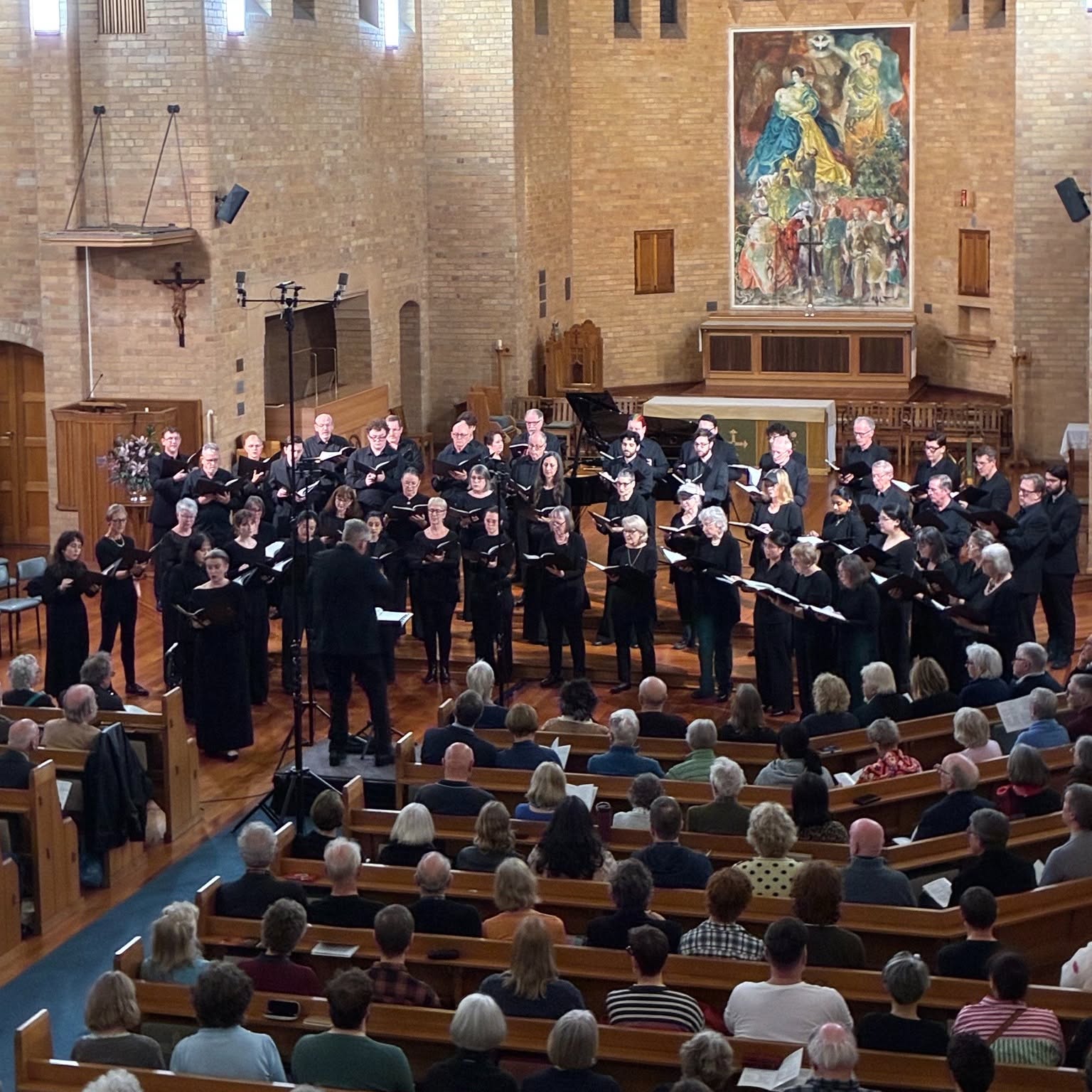
The music of Sergei Rachmaninov and Ukrainian composer Yuliy Meitus may seem an unlikely pairing. Yet Melbourne Bach Choir’s performance of Rachmaninov’s Vespers Op. 37 (The All-Night Vigil) interspersed with six Ukrainian art songs, revealed connections that run deeper than contemporary tensions. Shared Orthodox traditions, a common linguistic heritage in Old Church Slavonic and experiences of exile, memory and longing formed subtle bridges between two cultures whose histories remain deeply intertwined. The programme was made more poignant through its association with the late Ukrainian baritone Pavlo Hunka and his Ukrainian Art Song Project, whose work to preserve this neglected repertoire continues beyond his recent passing. In this context, the evening became less a juxtaposition of Russian and Ukrainian traditions than an affirmation of a common spiritual inheritance expressed through different voices.
St John’s Camberwell proved an ideal setting for the sonorous world of Rachmaninov’s masterpiece. The church’s warm acoustic enveloped the audience in a luminous wash of sound, enriching sustained harmonies while preserving sufficient clarity for individual lines and the ebb and flow of the chant-inspired textures to register with remarkable immediacy. Under conductor Rick Prakhoff, the Melbourne Bach Choir approached the opening Vespers with conviction and tonal warmth. “Oh Come Let Us Worship” unfolded with focused sonority and unified diction, the contrasting phrases shaped with equal radiance and culminating in carefully tapered cadences. The louder passages proved especially effective, while the choir’s disciplined phrase endings preserved a reverent atmosphere. In “Bless the Lord, O My Soul”, based on a Greek chant, the carefully balanced “Amen” cadences framed mezzo-soprano Belinda Paterson’s entry with consolation and repose. The responses from the upper voices, supported by the lower parts, created an atmosphere of lamenting serenity.
The first interpolation, Meitus’ “Rustling Poplars”, introduced baritone Alex Pokryshevsky and pianist Kathryn Pisani. Pokryshevsky’s rustic tone and confident dynamic shaping were matched by Pisani’s colouristic accompaniment, whose added-note harmonies and delicate figuration evoked the rustling imagery of the text. The piano writing occasionally recalled Liszt’s pictorial treatment of nature while the subtle use of minor ninths lent the song an almost impressionistic atmosphere. “Blessed is the Man” demonstrated a particularly fine blend between altos and tenors, with growing intensity in the repeated Alleluia refrains sustaining emotional momentum. “O Gladsome Light”, derived from a Kievan chant, opened with a warm sustained tenor line and featured a beautifully judged contribution from Michael Petruccelli. His brief solo, supported by resonant alto textures, deepened the movement’s elegiac quality.
Paterson’s interpretation of Meitus’ “An Unforgettable Moment” was one of the evening’s highlights. Her resonant lower register coloured the pastoral imagery with rich melancholy, while Pisani’s nostalgic accompaniment and moments of shared rubato produced some arresting phrase climaxes. Equally memorable was Petruccelli’s solo in “Lord, Now Lettest Thou Thy Servant Depart”. His warm and effortlessly sustained tone floated above the surrounding voices with a caressing tenderness that preserved the movement’s lullaby-like character. Even the celebrated descent into the depths of the bass register retained remarkable clarity.
The celebrated “Rejoice O Virgin” (Bogoroditse Devo) possessed a quiet sense of forward motion. While moving a little more freely than some interpretations, Prakhoff maintained a devotional atmosphere throughout, the flowing tempo lending freshness without disturbing the movement’s sense of reverence. Particularly pleasing was the prominence given to the relayed alto and tenor lines on “yako spasa rodila”, which often disappear within the surrounding textures. Perhaps the most unusual of the interpolated songs was Meitus’ “I Pluck at Seven Strings”. Its chromatic piano writing and expressive vocal lines suggested affinities with Wolf, early Schoenberg, Berg and even Scriabin’s harmonic mysticism. Sensuous and melancholy, the work stood apart from the more overtly lyrical songs while revealing the eclectic influences that shaped Meitus’ output. The Matins section further demonstrated the choir’s strengths. “Glory to God in the Highest” emerged from lilting alto phrases and angelic soprano responses before blossoming into a resounding crescendo and dissolving into a perfectly blended pianissimo cadence. Confident bass singing brought lustre to “Praise the Name of the Lord”, while “Blessed Art Thou, O Lord” generated moments of fervour and rich golden tone, even if certain passages felt more reflective than dramatically urgent in depicting the witness of the Resurrection. Pokryshevsky’s second contribution, “Seize the Day”, brought welcome contrast. Its folk-inspired melody and colourful accompaniment suggested an imaginative ensemble of rustic instruments and infused the hall with the spirit of a lively village dance.
Following the interval, “The Resurrection of Christ” displayed the choir’s command of dynamic contrasts and registral shifts. Particularly striking were the sustained upper voices supporting sombre passages in the lower parts. In “My Soul Doth Magnify the Lord”, Prakhoff’s buoyant gestures shaped the movement with a strong sense of architectural purpose. The refrains grew progressively in intensity before culminating in a full tonal bloom. Another memorable contribution came from Paterson and Pisani in Meitus’ “A Dream”. The recurring seconds and ninths in the accompaniment suggested bells, incense or drifting mist before flowering into rippling sonorities beneath Paterson’s warmly expressive middle register. Her final outpouring of passion transformed the song into a poignant meditation on hope and liberation. “The Great Doxology” highlighted the demands Rachmaninov places upon the alto section, whose singers negotiated both radiant upper lines and deep resonant sonorities with assurance. Likewise, “Today is Salvation” revealed the wide range demanded of the choir, with high tenor entries remaining unforced and the soprano line sustaining its luminosity. Petruccelli’s final Meitus offering, “Where Are You? I See Clouds in the Blue Yonder”, unfolded with sweetness of tone and lyrical warmth. Beginning with gentle wistfulness, the song deepened into an impassioned search for lost love and memory.
The concluding movements of the Vigil confirmed the extraordinary breadth of Rachmaninov’s conception. “When Thou Hadst Risen from the Tomb” featured beautifully sustained soprano lines and sensitive text colouring, while the final hymn, “To Thee, the Victorious Leader”, brought the evening to a triumphant conclusion. Its march-like energy broadened into a consoling final sonority that lingered in the resonant acoustic of St John’s.
Photo supplied.
______________________________________________________
Stephen Marino reviewed Rachmaninov’s All-Night Vigil and Ukrainian Art Songs, presented by the Melbourne Bach Choir under the direction of Rick Prakhoff at St John’s Anglican Church, Camberwell, on Friday 12 June 2026.