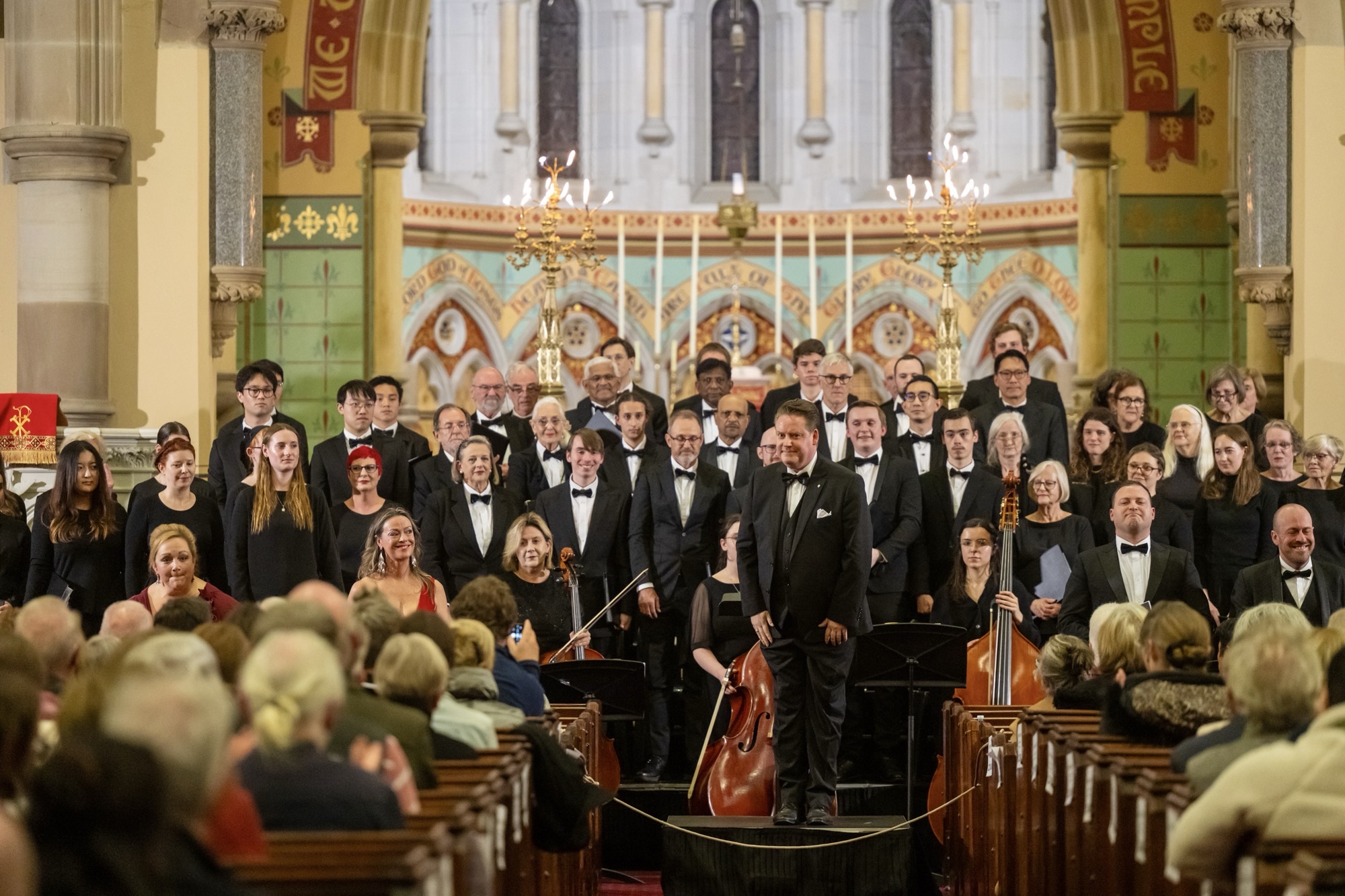
Saturday night was the second time in recent years that a performance of Anton Bruckner’s magnificent Te Deum (1884) has been presented at All Saints Anglican Church, St Kilda. As a space consecrated in the late nineteenth century, it provides a more appropriate setting for two major sacred choral works composed around the same time than any concert hall, no matter how splendid or acoustically ideal. All Saints does, in fact, have a reasonably resonant acoustic, even with the large audience on this occasion.
As Artistic Director and Chief Conductor of the Royal Melbourne Philharmonic Choir and Orchestra, Wailes led a superb performance of Bruckner’s Te Deum in September 2023; this time it was with two of his other choirs, Melbourne University Choral Society and Box Hill Chorale, but with the same outstanding soloists: soprano Helena Dix, mezzo-soprano Dimity Shepherd, tenor Michael Petruccelli and baritone Christopher Hillier. Once again, Andrew Bainbridge provided invaluable support on the organ, demonstrating its orchestral possibilities
The concert opened with Dvorak’s seldom performed (at least in Melbourne) Mass in D major, “The Luzany Mass”. Using the 1888 version for choir and soloists accompanied by a cello, two double basses and organ, the string component was at times overshadowed by a choir of 140 voices. Even so, those low notes made an important contribution to the rich texture of Dvorak’s soundscape and proved an important asset when doubling a lower vocal line.
The organ was prominent in the opening Kyrie, as were the sopranos, whose shining tone immediately indicated that they would be up to the challenge of a vocally taxing evening that ended on a sustained high C. Dvorak composed the extended, rhythmically swinging Kyrie in a way that gives ample opportunity for all sections to be clearly distinguished. Although the tenors and basses were well and truly outnumbered by the sopranos and altos, they held their own, singing with earnest vigour. The four soloists are introduced in the Kyrie, the first of many times they are woven into the fabric of the choral singing.
Rhythmically like the pealing of bells, the Gloria begins on a jubilant note. Dvorak’s word-painting then transitioned to slower sections, bringing some impressive singing by the soloists: Dix clear and lustrous as she spun out the soprano line; Shepherd, rich and mellow; Petruccelli and Hillier vibrant and well-projected. There was some particularly lovely singing on Shepherd’s part in reverential “Et incarnatus est” of the Credo, so tastefully accompanied by Bainbridge’s choice of organ registrations. The following dramatic exclamations by organ and choir were most effective, the hushed passages for choir beautifully blended. This mass is full of quickly changing variations and contrasting effects, which were confidently negotiated by the choir under Wailes’ strong direction, characterised by exacting attention to detail.
A precise, buoyant Sanctus ended with angelic soprano tone. It was followed by a Benedictus initiated by warm hushed tones and later marked by excellent observation of dynamic changes that built and receded as the choir sang as one unit.
Some beautiful interweaving of soloists and choir was a feature of the Agnus Dei, with the tenors excelling in the repeated “misere”. The final humming diminuendo of “dona nobis pacem” was a most satisfying ending.
Following a few enlightening words from Wailes, Andrew Bainbridge played a short work for solo organ: Bruckner’s Perger Präludium in C major. A slow stately work, it is one of the rare organ pieces that Bruckner, famous for his organ improvisations, actually wrote down.
Two further short works by Bruckner were heard before his Te Deum – a superbly blended performance of Locus iste (This Place), for unaccompanied choir, and Tantum Ergo, for choir, organ and instruments. The instruments for this performance were “minus the violins” and comprised organ and trumpets – played with mellow discretion by Isabella Thomas and Mosa’ati for this appealing work.
A French horn, two tenor trombones and a bass trombone joined the trumpets, organ, choir and soloists for Bruckner’s Te Deum in C major, a work that would have to rate as one of the most electrifying in the choral repertoire – even without timpani. The excitement begins with the opening päen of praise, the choral outburst reinforced by jubilant brass. The program notes refer to the effect of wide, open fifths as: “massive sonic building blocks form[ing] a ‘cathedral of sound’”. This soon moves to a swoon-worthy, echoing trio for soprano, tenor and mezzo-soprano. The choir sounded as though this was the most wonderful piece of music to sing such was their enthusiasm. Special mention must go to the basses in this movement.
The second of the five sections, “Te ergo quaesumus” (Therefore, we beg you) features solo tenor, handled with good ringing tone by Petruccelli. The other three soloists added to a nicely blended quartet, Dix sounding extraordinary on soft high notes. Such a serene ending on “redemisti” gave even more impact to what followed: full choral might underpinned by weighty organ and brass for “Aeterna fac cum sanctis tuis” (Make them be numbered among your saints). It is a strange setting of the words as the music sounded more like an aggressive demand than a plea. Urgency was uppermost, however, in this performance.
After the rush of adrenalin, it was back to a focus on the tenor, who once again had to negotiate some fearsome upward intervals in “Salvum fac populum tuum” (Make your people safe), which Petruccelli accomplished with notable success. More fine work came from the choir and other soloists, Hillier reliably firm on the bass notes. Also noteworthy was some atmospherically shaded work from the brass.
For all the wonders that had gone before, it was the final movement, “In te, Domini, speravi” (In you, Lord, have I hoped) that the most thrilling ones came for this listener. The echoing phrases between Dix and Petruccelli, both voices free and radiant, were quite literally spine-tingling, and the final long phrases that climbed higher and higher for the sopranos, reaching an almost impossible top C were phenomenal. Bolstered by Dix, a handful of selected choir sopranos did not falter. It was a glorious ending to a musical masterpiece that was given its due in this performance, as the enthusiastic response of the audience confirmed.
Photo credit: Paul Dodd
_________________________________________________________________________________
Heather Leviston reviewed Bruckner’s Te Deum and Dvorak’s “Luzany” Mass, presented by Melbourne University Choral Society and Box Hill Chorale at All Saints Anglican Church, St Kilda on May 23, 2026.