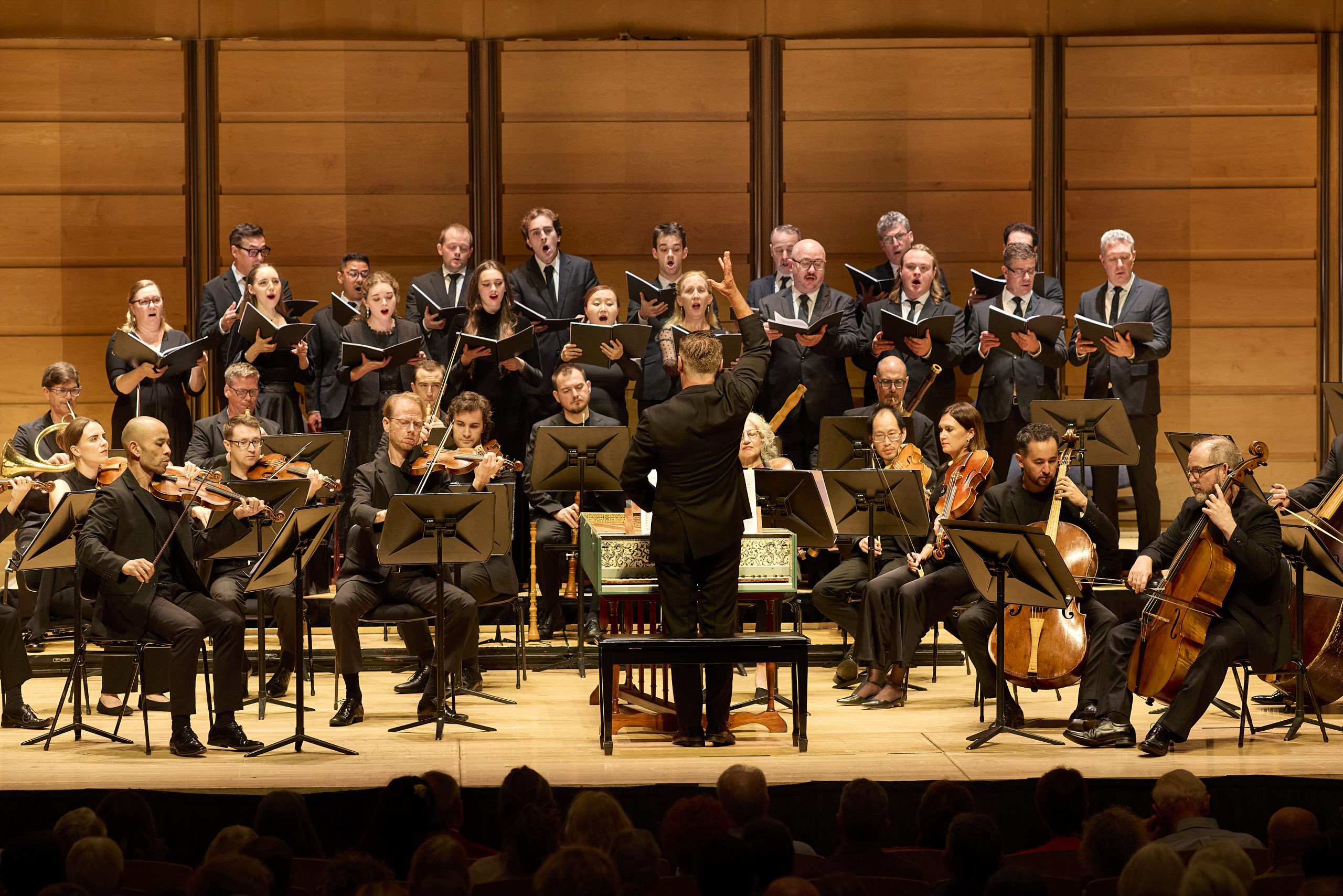
Having already performed this program five times in Sydney last week, the Australian Brandenburg Orchestra launched its 2026 Melbourne season in style with “Choral Splendour” with what was a mainly Bach / Handel affair full of baroque hits, but with the added treat of the ABO’s fine choir in tow for about half the program.
The natural warmth of the textured wooden interior of Elisabeth Murdoch Hall was sympathetically lit to produce a richly layered backdrop to the performers, and from the very start that warmness was not only a visual feature, but also a musical one.
ABO Artistic Director Paul Dyer commenced with no fanfare, launching straight into two movements from J.S. Bach’s Advent cantata Wachet auf, ruft uns die Stimme, BWV 140, (probably better known to many as the famous Sleepers Wake cantata), dating from 1731 in Leipzig and often regarded as one of Bach’s most mature and popular sacred cantatas. The ABO choir produced a warm and well-blended tone from the get go, the six Brandenburg sopranos ever-reliable during the famous cantus firmus passages in the chorale fantasia first movement, based on a hymn by Philipp Nicolai.
Generally leading from the harpsichord, albeit apart from a few brief moments when he delivered his customary grandiose gestures to reinforce the “big picture” of the musical architecture, Dyer set a brisk pace, with the cantata’s final chorale movement almost perfunctory in its delivery. Despite the disciplined ensemble and well-enunciated German text from the choir, the voices didn’t seem to have their usual impact from where I was sitting, but did produce a polished and pleasing sound nonetheless.
More Bach followed, but next was the famous Concerto for Two Violins in D minor, BWV 1043 featuring instruments only. This performance showcased the duelling violins of ABO stalwarts Sean Lee-Chen and Ben Dollman, who both provided a nice foil for each other. Not only were the two soloists well matched, they were also well supported by the orchestra, with close attention to detail and some lovely articulation in the more florid passages. The beloved Largo movement was performed with little sentimentality, the performers letting Bach’s mellifluous writing speak for itself. A shout out to the lower strings in particular, led by baroque cellist Jamie Hey, who all played with homogenous restraint so as not to dominate or swamp the soloists. The Allegro finale was given energetic treatment with the driving tempo set, placing quite a few technical demands on both soloists and orchestra, but both were up to the task, providing us with a nicely-controlled and well-balanced performance from start to finish.
Continuing the all-Bach theme of the first half, we heard two short movements of another much-loved cantata: Herz und Mund und Tat und Leben, BWV 147, which dates from 1723 during Bach’s first year as the Thomaskantor (director of church music in Leipzig). Firstly, in the opening chorus, which begins with an instrumental ritornello, the addition of Richard Fomison’s valveless baroque trumpet added a suitably majestic quality to the soundscape, and the ABO oboes combined for the solemn opening fanfare before an animated fugal exposition with the various colla parte instruments takes over. With the re- arrival of the choir we again heard the steely, bright sopranos dominate, ringing out clearly over the orchestra, in contrast to the inner voices which at times didn’t quite penetrate as well as one may have liked. Perhaps a little more diction from the choir may have been welcome, as they sounded a little restrained at times.
For the famous sixth movement, Wohl mir, dass ich Jesum habe (better known by many as “Jesu Joy of Man’s Desiring”), the simple four-part writing for the choir was nicely balanced with the strings, with the entire ensemble led by the plaintive oboe solo of Adam Masters.
The arrival of extra trumpets and winds in the ebullient Sinfonia from Wir danken dir, Gott BWV 29 added a significant splash of splendour and power to proceedings, and this movement presented several highlights. Firstly, the immaculate organ solo by ABO principal organist Heidi Jones on the Klop Chamber Organ was spectacular. That said, I did feel that the placement of the organ so far to the side of the orchestra did make it seem a little disconnected to the orchestra at times, although the positioning probably helped the organ in terms of balance so it made sense. Secondly, kudos to the trio of natural trumpets led by Richard Fomison, and Brian Nixon’s timpani for their fine support, which demonstrated excellent intonation, rhythmic attack and control. Just enough power to make the music exciting, but never too much to overpower the strings. The choir saved their best singing of the first half for the final item, the chorus Wir danken dir, Gott, singing with a more full-bodied sound and stronger attack, which made for great listening.
After the interval Artistic Director Paul Dyer beamed with pride as he introduced three of the ABO’s youngest and most recently arrived musicians – Arkie Moore (baroque trumpet), Ben Roe (baroque oboe) and Elizabeth Harper (soprano). It is wonderful to see a new generation of talented players taking their place alongside their more experienced colleagues and fitting in so seamlessly, and Dyer and the ABO is to be commended for providing such meaningful mentoring opportunities to some of Australia’s early music stars of the future.
Telemann’s “Ouverture” from the Overture Suite in D major, TWV 55 began with an austere maestoso, with Dyer’s wide-armed gestures and extravagant conducting style a good match for the grand music with its stately trumpets, oboes, flutes and bassoons, before concertmaster Sean Lee-Chen led the spirited Allegro fugal section that it quickly gave way to. Here the entire orchestra was in good form, and the all too short curiosity served as an ideal curtain-raiser to what was perhaps the other least-known work on offer in this concert: the Concerto in F major by the early 18th century German composer Johan Heinichen.
In the rousing vein of Handel’s Water Music, stirring horn calls dominate the outer movements of this piece. Featuring the duelling “hunting calls” of the natural horns of Michael Dixon and Dorée Dixon in the energetic opening vivace movement, the music provided a nice contrast to what had come before it, with a bit more bite. The second section of the work – a beautiful adagio – provided a gentle, more idyllic mood, and featured a charming consort of winds led by the two baroque flutes of Melissa Farrow and Mikaela Oberg, accompanied by gentle pizzicato strings. The fiery Allegro that concludes the work featured excellent rhythmic playing from the strings, and a more aggressive attack from the two virtuosic horns. The natural horn (also known as corno da caccia) is always thrilling to hear. The sound produced by it is always a bit “edgy” and in a piece as technically demanding as this, it is high risk music-making for even the very best players. With the exception of a few split notes (always to be expected) this was an exciting and refined performance from both orchestra and soloists who both demonstrated some spectacular high ornamentation that was simply thrilling.
The concert finished with two movements of Handel’s famous Coronation Anthems. Zadok the Priest begins with its famous ritornello in D major, based on rising violin arpeggios over richly spaced repeated chords for the lower strings and woodwinds, which prepares the way for a resplendent climax at the entry of the voices, together with the trumpets and drums. Handel specifies no tempo and no dynamics in the score except soft at the start and loud at the entry of the voices; but the music implies a long-sustained crescendo that conveys an overwhelming sense of expectation and suspense. Dyer managed this effectively, before choosing a very quick tempo for the “And all the people” section which tested the choir. Despite some very impressive melismatic singing (especially from the baritones and basses), which also highlighted the important contribution of the bassoons of Sim Walters and Ben Haodley who provided clean, well-articulated support throughout, the altos and tenors seemed to struggle a bit with projection at times.
Handel’s The King Shall Rejoice was chosen to end this concert, although interestingly it was actually the first to be heard in the Coronation service of 1727 when this music was first heard. The final movement of the Anthem is an exuberant double fugue that gives the piece a magnificently grand and elaborate conclusion which, as it was most likely performed at the actual crowning section of the coronation service, would have matched the occasion perfectly.
For this Anthem, Dyer again chose quick tempi, and the musicians were generally able to rise to the challenge with some fast, accurate and lively playing and singing from all on stage. Whilst the slightly larger soprano section managed to penetrate the orchestra a bit more successfully than the lower voices throughout most of the evening, the rest of the chorus found something extra in this final piece, with the altos and tenors finally managing to emerge briefly at various points.
Clearly, the natural ambience of the Melbourne Recital Centre is not quite as generous as one would expect in a space like Westminster Abbey, but the lack of reverberating sonic grandeur was compensated for by the high fidelity and accuracy of this spirited performance.
Photo Credit: Keith Saunders
_________________________________________________________
Andrew Wailes reviewed “Choral Splendour”, performed by the Australian Brandenburg Orchestra and Choir at the Melbourne Recital Centre on April18, 2026.