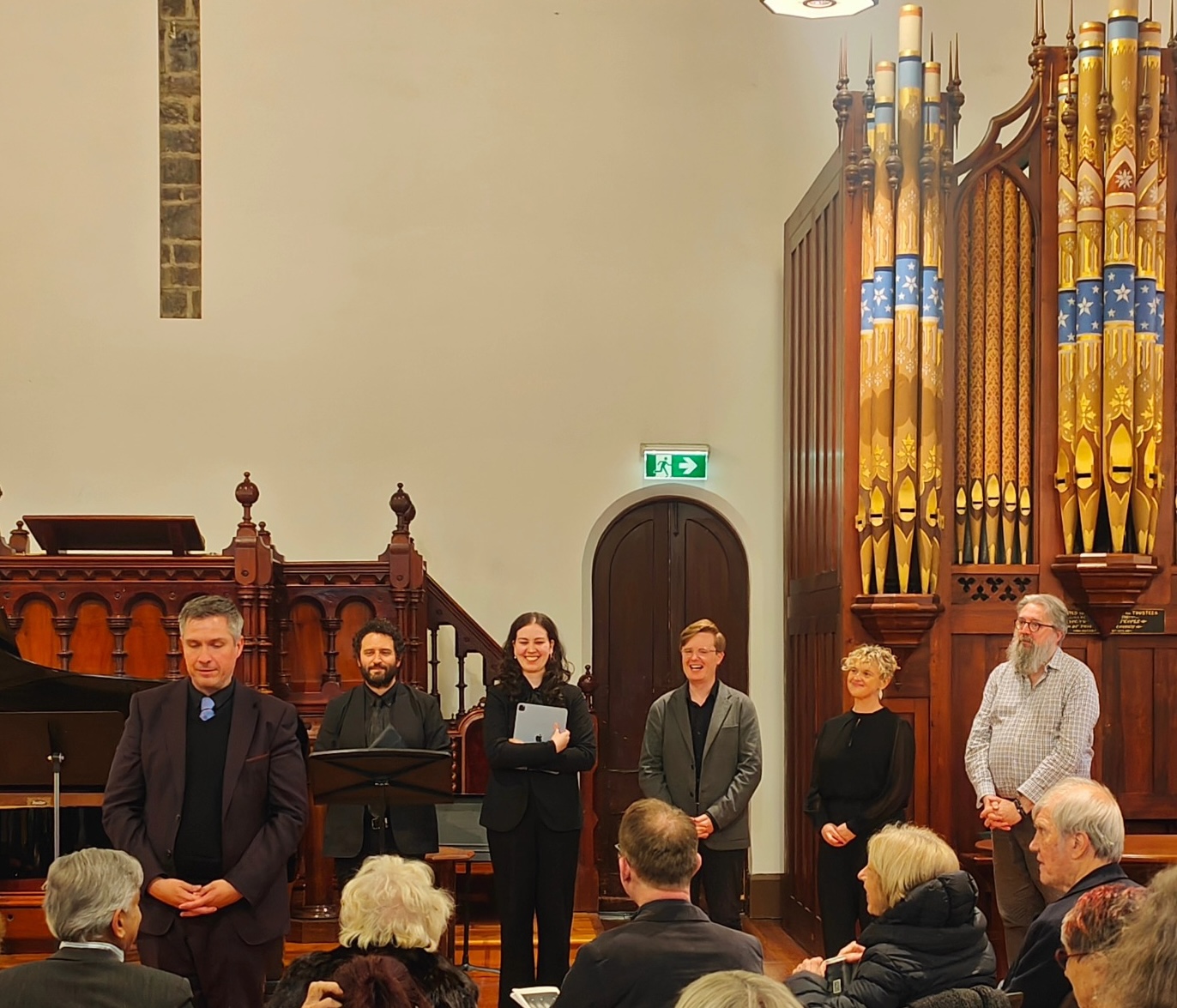
No wonder Carlton’s Church of all Nations was full; Lyric Opera had assembled an irresistible program together with some of Melbourne’s finest artists. It must be a long time since Canticles by British composer Benjamin Britten (1913-1976) were given a public performance in Melbourne – a timely reminder that this year marks the 50th anniversary of Britten’s death. On Sunday afternoon, we heard three of the five Canticles alongside premieres of two song cycles by award-winning Melbourne composer, Kevin March.
Instead of program notes about the compositions, all texts were (mercifully) included, together with information about the artists. Essential information regarding the works and their relevance to the concert’s title were explained by “Host”, Patrick Burns, Lyric’s impressive Artistic Director and Conductor. Always articulate, interesting and enthusiastic, Burns made a persuasive case for “Songs of Devotion and Desire” as a fitting description for all works, although the Desire aspect assumed special importance in the Canticles.
Canticle 1 Op. 40, “My beloved is mine and I am his”, was written in 1947 for a memorial concert for Dick Sheppard, founder of the Peace Pledge Union and former vicar of St Martin in the Field. The lyrics, by the 17th century metaphysical poet Francis Quarles, are based on the Song of Solomon. Although the text ostensibly celebrates the poet’s relationship with God, Britten’s personal and professional relationship with his partner and muse, the tenor Peter Pears, is clearly the subtext – a very brave declaration at the time. Louis Hurley and Stefan Cassomenos gave a most sensitive account of the work that begins with a quietly rippling piano accompaniment for the smoothly flowing opening sections then passes through a more declamatory passage and tripping staccato to a gently rapturous ending. Hurley’s command of breath and dynamic shaping were outstanding, and his tenor voice was a constant pleasure to hear. The ending, with its repeated pianissimo “that he is mine” captured the moment perfectly, with piano and voice expressively at one.
After Burns had described the genesis of his collaboration with Kevin March and described the composer’s sense of connection between nature and the sacred, mezzo-soprano Olivia Federow-Yemm sang the five songs that comprise March’s Sacred Songs Book 1. Boldly “strummed” lyre-like piano chords opened “Orpheus Sings!” – a dramatically effective opening for a song cycle. Based on a poem by Rainer Maria Rilke, it was full of colour: pauses, spoken words, accompanied and unaccompanied voice plus a wide range of dynamics, pitch and tempi – all of which tested the abilities of pianist and singer. Like Hurley, Federow-Yemm possesses a beautiful instrument and displays technical control and musical refinement. Both are very focused performers with the ability to create a strong sense of atmosphere.
The following songs, with texts by various authors (translated by March if in a foreign language) were generally on the moderately slow and serene side – meditative reflections of the natural world – but full of musical interest. In ”Sometimes” (text by Hermann Hesse) birdsong was featured and the voice had some tricky extremes of pitch and dynamics to add to the drama. Although March’s work is generally attractively tonal, moments of atonality were added to the mix. Much of the piano part reflected the content of the text; we could hear rain droplets and swaying reeds in “Reeds in the Storm” for instance and a winding rippling effect in the piano accompaniment in the final song, “Come to me” (text by Sappho), which ended on a more assertive note.
Britten composed Canticle III Op. 55 (1954), “Still falls the rain”, for another memorial concert, this time for the Melbourne-born concert pianist, Noel Mewton Wood (1922 – 1953) – and what a tragic tale lies there! The text is a poem by Edith Sitwell, who is probably best known to the musical world for William Walton’s setting of her poems for Façade. Unlike the quirky humour of that work, this is a poem of a vastly different colour, beginning sombrely with “Dark as the world of man, black as our loss”. The loss refers to the death of Christ and the poem is replete with religious imagery. Composed for tenor, horn and piano, it is a work of gravity that includes verses echoing Gregorian chant with short interludes for piano and horn between sung passages. The combination of Hurley’s singing, Abbey Edlin’s horn and Cassomenos on piano in the verses gave this starkly moving work a most sensitive reading that recreated the drama of the text.
Loius Hurley performed March’s second song cycle of five poems, Sacred Songs Book II, this time with all texts by Taigu Ryōkan, a Japanese Zen Buddhist monk who lived much of his life as a hermit. Most of the music is gentle and evocative, suggesting that the simple objects of life are “worthy of esteem”, as Burns put it. We heard undulating piano movement in “Butterflies and Flowers”, and a spare bell-like accompaniment for “In the cool depths at night” as smoke rose from the incense and the moon rose. Hurley’s control of breath and tone was remarkable for the last words at the end of this piece and the following (final) piece, ”Snowfall” – “rise” and “fall” respectively. There was a long pause at the end of the cycle – the “sacred” moment held before enthusiastic applause.
If any of the Canticles deserves the name of “mini opera” it would be Canticle II, Op. 51, “Abraham and Isaac” (1952). A familiar Bible story of faith, obedience and sacrifice, Britten’s rendering for tenor, alto and piano is based on the version from the Chester Mystery plays. It was commissioned as a fundraiser for the English Opera Group and was first performed by Pears and Kathleen Ferrier, with Britten as pianist.
Hurley and Federow-Yemm quietly carried their music stands and placed them to face each other, singing the part of God in simple chanting homophony – ethereal and beautifully blended in tone. They then turned the stands and faced the audience to sing the parts of Abraham (Hurley) and Isaac (Federow-Yemm). All this was executed smoothly, allowing the story to unfold as Britten intended. Whether together or as soloists, with piano or unaccompanied, both singers captured the essence of the story with quiet dignity made even more powerful by declamatory outbursts such as Hurley’s entry as Abraham. Federow-Yemm has a luminous presence that projects dramatic intensity without unwanted histrionics. As she raised her arms whilst singing “My soul I offer unto Thee!” the brickwork cross carved into the wall behind her gave the gesture of surrender and the text even greater poignancy. The final section “envoi”, where tenor echoed mezzo-soprano, culminated in a slow hushed unison” Amen” followed by a lengthy silence until an explosion of applause broke the tension. An important element of this performance that made it so compelling was the pacing – never hurried but never dragging. The musical judgment of the pianist was a crucial element and striking testament to Cassomenos’ musicality and empathetic responsiveness to singers.
Patrick Burns was correct in emhasising the operatic nature of Britten’s Canticles; opera does not equate with Grand Opera or elaborate staging; great musical stories can be told simply and compellingly in the right hands, as “Songs of Devotion & Desire” demonstrated. The high quality of this concert really does demand further outings and a more permanent record than a single performance affords. On the basis of this concert and the high calibre of previous performances, which have attracted Green Room Award accolades, Lyric Opera of Melbourne deserves our whole-hearted support.
Photo supplied.
____________________________________________________________________
Heather Leviston reviewed “Songs of Devotion & Desire”, presented by Lyric Opera of Melbourne at the Church of all Nations on April 12, 2026