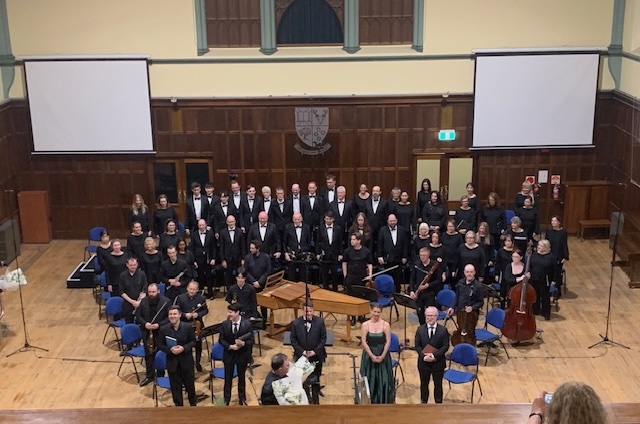
If you care to google “How many operas has the Royal Melbourne Philharmonic performed?” AI will respond with “selections from operas, such as a ”Magic Moments from Opera” concert in 1998”, and “have performed Handel’s Messiah over 246 times”. AI will also tell you that “RMP Chief Conductor Andrew Wailes has conducted specific operas … in other capacities”. Further research would show you why one of the greatest opera composers turned from opera to oratorio. Handel’s practice of storytelling within a setting of sublime music continued through genres supplying soloists and chorus members with a wealth of opportunities to give of their best.
A concert performance of Handel’s Acis and Galatea (1718) therefore seems a logical choice for the RMP and Maestro Wailes. A pastoral opera – also referred to as a serenata, masque or even oratorio – it is a thoroughly engaging work featuring choruses that are a pleasure to sing and hear, plus some of Handel’s most popular arias. Set to a libretto by John Gay, it was the most frequently performed dramatic work during Handel’s lifetime.
The story itself, based on a tale from Ovid’s Metamorphoses, is slight. The water nymph, Galatea, and the mortal shepherd, Acis, look for each other, find each other, are parted when the jealous monster, Polyphemus, kills Acis with a rock, leaving the bereft Galatea to use her divine powers to transform him into a fountain. Meanwhile, a chorus of nymphs and shepherds observe and comment on the action. The music, however, is rich with melody, harmony and expressive musical effects. This afternoon, extensive tasteful ornamentation added lustre to what was an outstanding performance in a host of ways.
The Assembly Hall is a most attractive venue with a resonant acoustic that allowed musicians and singers to be heard clearly from all vantage points. The sound was clear and vibrant without being muddy, particularly in the chorus work. Although sightlines were not ideal, a concert performance full of vocal and orchestral colour made this of comparatively minor importance.
Following a sprightly Sinfonia, with the small chamber orchestra of ten players in precise, buoyant form, a strange chirping and murmuring emerged as the chorus of happy nymphs and swains created an aural pastoral setting before launching into “Oh, the pleasure of the plains!” This was the RMP Chorus at its precise, disciplined best with crisply articulated rhythms and text. The crescendos on “Oh” gave the piece extra “zing” and all SATB parts were clearly audible, the small contingent of eight sopranos sounding fresh and bright and the tenors ringing and unforced.
The tenors were perhaps most impressive at the beginning of “Wretched lovers!” and all sections made this chorus one of the most exciting moments of the opera. It is a wonderfully graphic chorus with changes of dynamics and tempi that follow the text closely. The yearning wail of the beginning, the fugal beholding of the monster, precise staccato “ample strides” of the monster, the fast moving parts for tenors and basses while the sopranos sing the slower melody above – it’s no wonder the opera was such a hit, and remains so. There was also some terrific chorus work in ”Mourn, all ye muses” with all eyes glued to the conductor for the final “Ah, the gentle Acis is no more” with the final words repeated in strict unison. The separate moving parts were clearly defined and with excellent dynamic variation. The chorus also has the last word, comforting Galatea, but it was when chorus urged Galatea to “cease to grieve” that we heard one of the most beautiful moments in the opera. The orchestra, notably the strings and Stefan Cassomenos on harpsichord, gave this section a special, tender colouring that was very moving.
As Galatea, young rising star, Lily Flynn, was most affecting. She sang with a lovely, clear soprano voice with real “ping” and possessed all the technical attributes that enabled her considerable musicality to shine. Ample breath allowed her to draw out some satisfyingly long phrases, and excellent flexibility (including a proper trill) that enhanced her ornamentation of the da capo arias. The succession of upward leaps in “As when the dove” were managed with commendable ease. Flynn is also a singer who immerses herself dramatically in the role, even in a concert performance. Her vocal colouring, dynamic range, facial expression and gestures consistently reflected Galatea’s changing fortunes.
One of Australia’s foremost oratorio singers, Timothey Reynolds was also very much at home as the hero of this chamber opera. Although he was a little less overtly involved in the couple’s interactions, his Acis was splendidly sung – always full of vitality, accurate in all respects and musical. His first aria, “Love in her eyes sits playing” was a masterclass in vocal control, and his ornamentation, which included a nice trill in “Love sounds th’alarm”, impressively fluid.
As his fellow shepherd, the very practical Damon, Alastair Cooper-Golec, also used his very pleasant, well-projected tenor voice to good effect. Like Reynolds, he is musically sound and has excellent diction. Details of vocal colour were admirable – in “Softly, gently, kindly treat her” for example – and he displayed exceptionally good vocal agility.
For generating sheer excitement, Nicholas Dinopoulos as Polyphemus was unsurpassed. The florid choral bass line on “roars” followed by a great roll of thunder as chorus members’ shoes pounded the wooden floorboards created a spectacular aural introduction. His response was a theatrical “I rage – I melt – I burn!” Dinopoulos extracted every possible iota of drama from Handel’s score, rolling his r’s with relish, notably in “O ruddier than the cherry”. And there was plenty of bite in his “Cease to beauty to be suing” aria. In the trio with Acis and Galatea he was truly a force to be reckoned with, his “die presumptuous Acis, die!” a striking contrast to the softer tenor/soprano pairing.
When the bouquets were being handed out at the end of the performance, it did cross my mind that Kailen Cresp probably deserved a barrow-load of them. From the Sinfonia onwards, the oboes, with Ben Roe on second oboe, were often the dominant sound, especially when playing alongside such a small body of upper strings. Cresp modified his sound in some of the arias so that his oboe became part of a gorgeous, finely integrated texture. He also played differently pitched recorders that added bucolic colour on two occasions: a solo sopranino for Galatea’s “Hush, ye pretty warbling choir” and one of the two cooing descant recorders that complemented Galatea’s final aria in true pastoral fashion.
This was a high quality and immensely entertaining performance of Acis and Galatea. There is another Melbourne performance on Tuesday, May 5. Don’t miss it.
______________________________________________________________________
Heather Leviston reviewed Handel’s “Acis and Galatea”, presented by the Royal Melbourne Philharmonic at The Assembly Hall on May2, 2026.