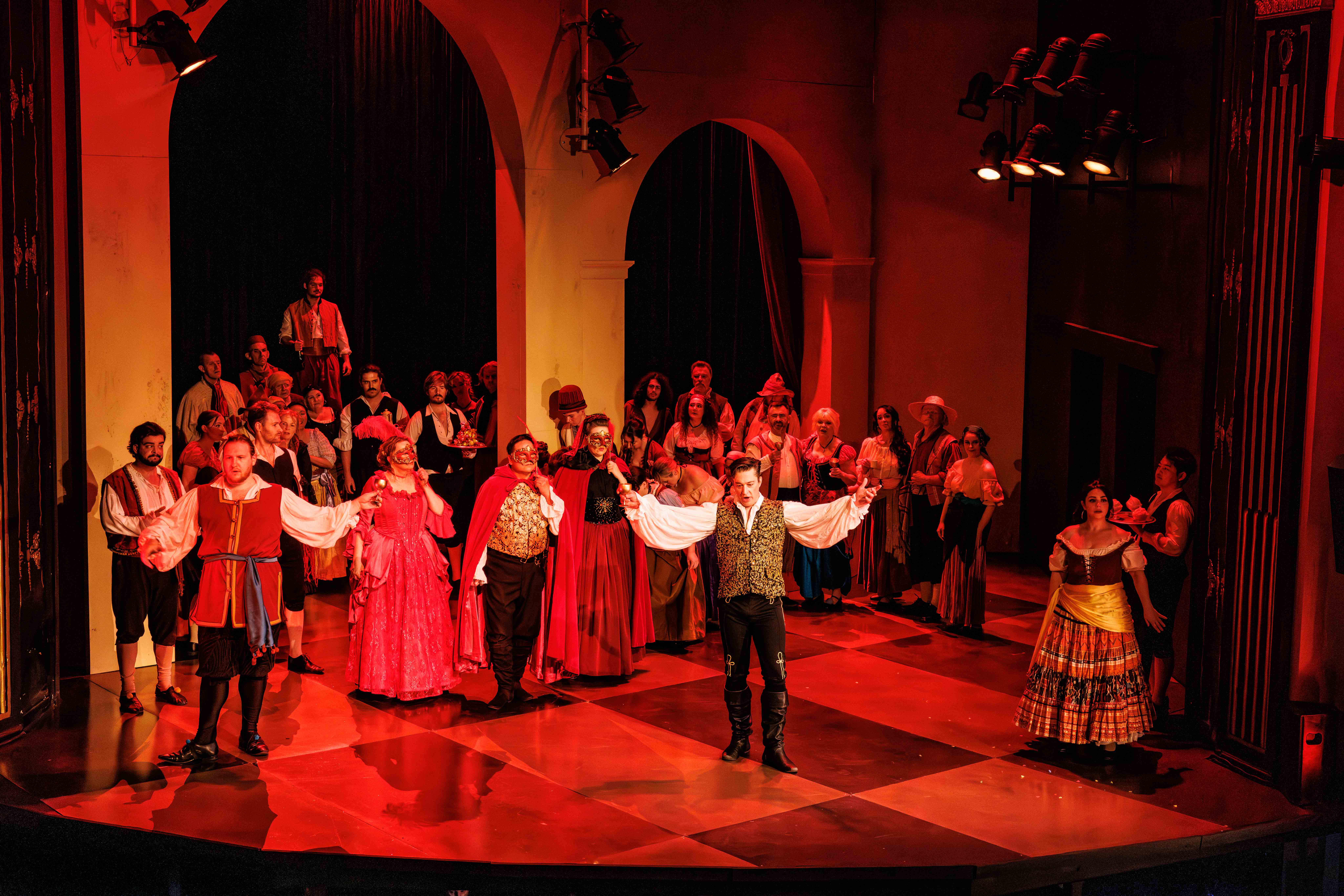
The fuller title used for Melbourne Opera’s production of Mozart’s operatic masterpiece, Il dissoluto, ossia il Don Giovanni (The Rake Punished, or Don Giovanni), indicates where director Suzanne Chaundy’s sympathies lie. The title does not refer to some charismatic lover of womankind, as Mozart’s brilliant librettist Lorenzo da Ponte has the Don portray himself, but a dissolute scoundrel intent on seducing or even raping women before abandoning them.
Still, the question remains as to why opera lovers have also been seduced by this incarnation of the centuries-old libertine Don Juan of Spanish legend, especially when the opera begins with the attempted rape and a murder. Part of the answer lies in the wonder of Don Giovanni’s spectacular success with all manner of women, and part in his unflinching defiance in the face of death while his servant cowers and groans. No deathbed repentance or conversion here; it’s a case of being true to his motto, “Viva la libertà!” right to the fiery end. The swashbuckling and seductive music Mozart gives him helps too, as does da Ponte’s libretto – as a friend of Casanova and a libertine himself, da Ponte would be in tune with the rake’s impulses.
The right singer is also a factor. Ruggero Raimondi cast an irresistible spell in Joseph Losey’s 1979 memorable film of the opera, and Teddy Tahu Rhodes managed to mesmerise by baring a manly torso. In this production, Christopher Tonkin’s allure lay in his handsome face, lithe figure, physical agility and suave singing as he tried to win over the ladies: seemingly gallant when offering help to Donna Anna; soothing when placating Donna Elvira; physically beguiling when flattering and tempting Zerlina, and at his vocally seductive best when wooing Donna Anna’s chambermaid with an aria beneath her window. Tonkin achieved all of this in addition to conveying a sense of self-assured power and more than an edge of menace. An emphasis on the comic lumbering buffoonery of Henry Shaw’s Leporello provided an effective foil for a façade of nobility.
So vivid was Shaw’s characterisation that, had it not been for the strength of the other cast members, he might have stolen the show. Leporello is his third principal role in Melbourne Opera’s recent productions of the three Mozart/Da Ponte collaborations, along with Figaro in Le Nozze di Figaro and Don Alfonso in Così fan tutte – all operas revolving around sexual politics. The Overture itself embodies the dual threads of drama and comedy in this “drama-giocoso”, beginning with two of the most intensely dramatic chords in opera before assuming a lighter character. Played with curtain down, the action began as mime in a theatre box, the focus then shifting to Leporello as he waited “on guard” for his master’s return, entertaining himself (and the audience) by reading the catalogue of conquests while perched or lying on the edge of the stage. Chaundy’s direction established an opera buffa tone that was repeated whenever Shaw appeared. His imposing size and high-spirited acting created comic highlights, notably in the “Catalogue aria” and when miming Don Giovanni’s serenade. Much lauded for the vitality of his acting and the richness and power of his voice, Shaw’s singing was consistently extremely well projected and musical.
Even in an age of #MeToo enlightenment, we are drawn into Leporello’s ambivalent enthusiasm for his master’s astronomical number of successes. Chaundy’s aim of making a stronger connection with the audience via Leporello’s actions, the use of the theatre box and having the chorus walk through the audience at the beginning of the opera worked well and matched Mozart’s device of having the ensemble of principals come to the front of the stage at the end of each of the two Acts to address the audience – both vocal highlights of this production.
There was even a dash of the comic in the portrayal of Donna Elvira, a dimension confirmed in her final actions after her erstwhile “husband” had been consigned to the flames. Eleanor Greenwood made a formidable and exciting Donna Elvira. With a commanding stage presence and an opulent soprano voice that met every vocal challenge with seeming ease, she scored a triumph in the role. A listener could believe that if this Elvira were to go off to a convent as she said, she would become Mother Superior almost instantly by sheer force of personality.
Chaundy successfully expanded the role of Elvira’s maid, casting her as an observer and chronicler of events as well as a sympathetic support for her mistress. Although Uma Dobia is a singer of distinction and the role is a silent one, she proved a most accomplished and focused actress and made a valuable contribution to the story’s emotional trajectory.
As the woman impervious to the Don’s sexual “charms”, Lee Abrahmsen was impressive in one of Mozart’s most vocally demanding roles. Her soprano voice was consistently pure and beautifully resonant, rising gloriously as the upper voice in the ensembles, and triggering goose bumps at one point for this listener. She sang her Act 1 vengeance-urging aria with strong line and dynamism and quickly recovered from a little falter in the vocally taxing final aria, attending to precise articulation in florid sections.
With tenor Henry Choo as Don Ottavio, Donna Anna’s fiancé, the serious elements of the opera were given due weight. Against the exuberance of other roles, these two characters are in danger of appearing comparatively pallid, but Abrahmsen and Choo were able to create a sense of genuine pathos and tenderness. Choo’s ringing tenor voice gave his two arias masculine weight while maintaining good line with excellent breath control and support. As Donna Anna’s father, Eddie Muliaumaseali’i was every centimeter the Commendatore – a mighty figure with a powerfully resonant bass baritone voice, and fearsome looking enough to lend credibility to Leporello’s quaking before his realistic graveyard statue.
Rebecca Rashleigh was an absolute delight as Zerlina. Her sweet soprano voice did seem on the small side from near the back of the stage initially, but became better projected later. Her finely calibrated portrayal of Zerlina’s wavering response to the Don’s seduction tactics was simply outstanding, and her interactions with her poor husband-about-to-be, Masetto, playfully charming as she wielded her own brand of seductive power. A great favourite with Melbourne audiences, Stephen Marsh was a convincing Masetto, his rich baritone voice more appealing and refined than those usually heard in this role.
Dale Ferguson’s fairly minimalist set featuring a couple of huge colonade arches was suitably imposing and serviceable, and the clusters of lighting rigs served to further reduce the sense of a barrier between stage and theatre. Tom Vulcan’s lighting played a major part in creating atmosphere. Changing colours intensified mood and extensive use of shadows added interest and sometimes humour, beginning with Leporello’s musings in front of the curtain during the overture. Rose Chong Costumiers created a range of splendid costumes, the vivid red gowns for the masked ball scene being the most striking.
The Melbourne Opera orchestra was in terrific form on opening night, playing Mozart’s miraculous score with energy and rich tone. Any brief tendency of the singers to lag behind the beat was quickly addressed by conductor Raymond Lawrence, who ensured a musical performance of crisp and expressive dynamism that still allowed soloists to shape phrases meaningfully. Mozart did not give the chorus much to sing, but what he did provide was undertaken with verve and well-trained precision.
For all the reprehensible behaviour portrayed in Mozart’s opera, Chaundy’s production was essentially uplifting and highly entertaining. Outstanding performances of great music make this Don Giovanni a rewarding experience. Highly recommended.
Photo credit: Robin Halls
_______________________________________________________________________
Heather Leviston reviewed “The Rake Punished, or Don Giovanni”, presented by Melbourne Opera at the Athenæum Theatre on April 26, 2027.