In an interview last week on 3MBS FM Lawrence Power spoke of the viola as being the closest string instrument for him to the human voice. Though he plays both violin and viola with equal brilliance, he describes the viola as his “mother tongue”, adding that, “You can speak other languages even if you have an accent!”
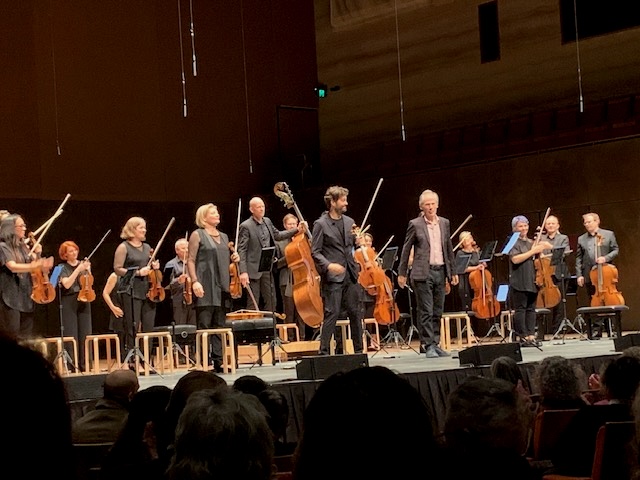
Directed by Power, the “Isles of Light” concert unfolded like a classical 17th century masque involving music, singing and a little acting from all members of the Australian Chamber Orchestra (ACO). From the outset the ACO played superbly, rising to and relishing challenges that enabled them to demonstrate their skills in the far reaches of extended string playing techniques.
The evening opened with an engaging talk from Power, viola in hand, as he explained how and why the concert was put together. We learnt of the extraordinary effect Vaughan Williams’ Fantasia on a Theme by Thomas Tallis had on audiences when it was first performed in 1910, notably upon two young men, Ivor Gurney and Herbert Howells. These two, a poet and a composer, would prove to be more than incidental to the evening’s performance.
The first item, “English Mixtape”, was a rapid sequence of works by Henry Purcell, Jonny Greenwood, Thomas Tallis, Kate Bush, Ivor Gurney and Edward Elgar. Power used the repetitive ground theme of Purcell’s Timon of Athens, Z.632 “Curtain Tune” to move into the concert while the ACO assembled itself onstage. Timon of Athens was a masque, a popular form of courtly entertainment involving music, singing, dancing and acting. Vaughan Williams himself wrote several masques, including Job: A Masque for Dancing (1930), as did his protégé Elizabeth Maconchy – The Birds (1967–68).
The Purcell, played by plucked strings, moved into Jonny Greenwood’s Popcorn Superhet Receiver: Pt 2b and then to Tallis’ “Why fum’th in sight”, the inspiration for Vaughan Williams’ Fantasia. To the delight of all, the ACO sang the Tallis work wordlessly – they make a fine choral ensemble. This was but the first of the demands made on the ACO to extend themselves.
As advised in Power’s opening remarks, the “English Mixtape” moved seamlessly into Garth Knox’s The Ancient Mariner: Concerto for Viola and String Orchestra. Written for Power, the work is a performance event, quite like a masque, retelling the Coleridge saga of the mariner who kills an albatross bringing utter misfortune to himself and crewmates. Anyone old enough to have suffered studying this at school will know the poem to be grotesquely over-written to the point of parody. I reread it before this performance and wondered what Garth Knox was going to do with it, wondered indeed why on earth he would attempt to use it.
Though Power delivered some of the lines, wisely Knox made it all about the sound world and more. The ACO was arranged in the outline of a boat and were asked to move, shift and sway as well as play. Asking musicians to act is sometimes and invitation to disaster, but not this night. Throughout the whole evening, each member of the orchestra totally “owned” their parts, playing and moving with confidence and conviction. The imagery of the poem was delivered through an amazing range of extended technique playing, such as swooshing bows down fingerboards to make wind sounds, scratching bows slowly over the strings to create creaking shipboard sounds, as well as the more recognisable techniques of harmonics and placing the bow up near the bridge.
The music Knox provided substantially conveyed the differing moods of the work, so it was not all about interesting effects. A couple of moments could have tipped over into pantomime: the players were all asked to drop heavily to their seats to emulate dead sailors falling to the decks – a bit too literal. At one point a violin or small viola was hung around Power’s neck to symbolise the dead albatross. From this flight of fancy I would like to ask Power if his instrument is at times a dead albatross.
Then there came the moment when Power declaimed, “Water, water, every where, And all the boards did shrink; Water, water, every where, Nor any drop to drink.” I would not have been surprised if half the audience chimed in with “nor any drop to drink”, and that was where the work got a little corny. So much more could be said about this remarkable work though. I hope it has a long performance life.
Onto the magic that was the second half. After interval the ACO launched into Elizabeth Maconchy’s Symphony for Double String Orchestra, written between (1952-1953). This started a time travel back to Vaughan Williams in the way Maconchy used two string ensembles to play with and against one another, just as Vaughan Williams had pioneered in the Fantasia. Afterwards, Power explained that Maconchy looked to Eastern Europe for much of her inspiration, found in composers such as Bartók, Janáček and Martinů. This certainly explained the spikiness, the liveliness and harmonic interest in her sound world. Power directed from the violin with the confidence, élan and the technical assurance he demonstrated throughout the concert.
Herbert Howells’ Elegy for Viola, String Quartet and String Orchestra is a response to Vaughan Williams’ Fantasia, setting the string orchestra into sections and clearly responding to Vaughan Williams’ harmonic and textural inventiveness.
The whole concert was a masterful dialogue – across a century or more – of music working from the now back to Vaughan Williams’ Fantasia (and indeed before with the inclusion of the original Tallis work). Vaughan Williams’ Fantasia is a favourite in the concert repertoire. ‘Isles of Light’ shone a bright new light on it, enabling us to hear and experience it anew, as fresh as it was when the 18-year old Herbert Howells heard it at its premiere in 1910.
___________________________________________________
Nick Tolhurst reviewed “Isles of Light”, presented by The Australian Chamber Orchestra, with violinist and violist Lawrence Power at Arts Centre Melbourne, Hamer Hall on June 15, 2026.