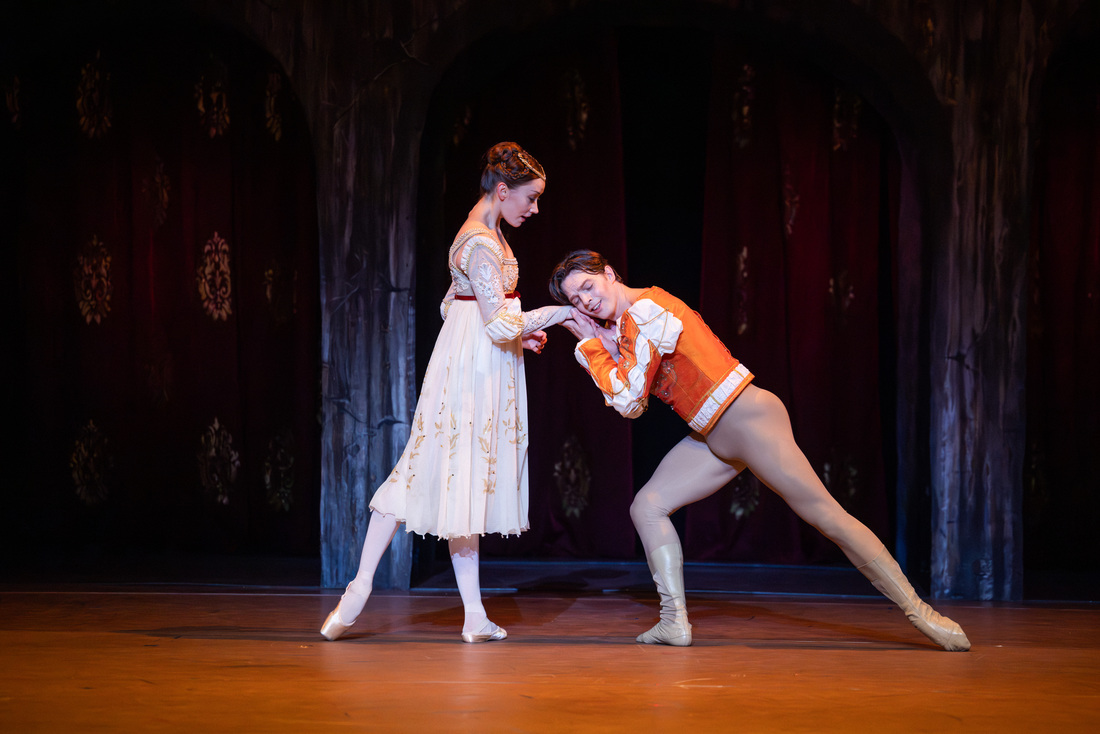
Star-crossed lovers bedazzle the stage in The Australian Ballet’s production of Romeo and Juliet. Shakespeare’s tale inspires resplendent performances by Soloist Grace Carroll as Juliet and Principal Artist Joseph Caley as Romeo. Their performances show great depth of character, especially Carroll’s emotional commitment. Her embodiment of Juliet strongly resonates carrying the story along with her flawless technique and fluidity of movement.
John Cranko’s choreography is set to Sergei Prokofiev’s popular score, which is cinematic at times. From quiet melodies to loud booming timpani the complicated score is laced with drama. Dance of the Knights in Act 1 is by far the most recognisable piece having been used much in popular culture. Orchestra Victoria conducted by Jessica Gethin delivers the thundering brass instruments with a string laden melody brought to full volume, sending goose bumps up your arms. There is something guttural and primitive about the music in counterpoint to the formal dress and simple walking step the dancers display in the majestic Capulet Ball scene. Bejeweled costumes in emerald and ruby give way to the smell of death echoed in the music. The movement continues with quieter sections led by string and woodwind instruments creating a moment for Romeo and Juliet to meet. Their fleeting interaction is interrupted by the return of the explosive brass theme, forcing the young lovers apart. It is one of the most remarkable moments in the ballet.
Set and lighting design merge together most effectively in the iconic Balcony Scene, which closes Act 1. With a full moon and hues of soft blue and green the young lovers come together to proclaim their love. The stage is divided horizontally with an upper level reflecting the separation in their lives. Prokofiev’s melodies take flight while the emotion of the scene pulls at the viewer’s heartstrings. Great tenderness is further developed by Carroll’s playful interaction in combination with her exquisite dancing.
Similar to the world of acting, Juliet is a most coveted role by ballerinas. The role presents both technical prowess and acting demands. Carroll meets all expectations with her unique style marked by a child-like vulnerability of an ingénue. As she flutters her beautifully pointed feet across the stage she is both innocent and beguiling. She masters the art of subtle body movement to better express emotion. She is quite simply a beautiful dancer to watch with elongated body lines and great flexibility in the legs and back. Her final touches include sustained balances en pointe in arabesque with equal parts confidence and abandon. Caley meets her for every step by supporting her ever-reaching lifts. He holds and carries her with great care and strength, giving their dancing an effortless quality.
There are many versions of the ballet Romeo and Juliet world-wide. This particular production was choreographed by South African John Cranko and premiered on the Stuttgart Ballet in 1963. Cranko’s strength as a choreographer lies in moving large ensembles into smaller groupings to form revolving patterns. This is shown in the village scenes of Act 1 and 2 with brightly colored costumes and lighting in contrast to darker themes of the story. His choreography can be quirky, intricate and difficult, especially in a male trio expertly danced by Caley, Drew Hedditch as Mercutio and Cameron Holmes as Benvolio. Bravado is most enjoyed when the dancers jump up in the air to turn within two revolutions in canon and unison multiple times.
The pace of Act 3 slows down, reflecting Cranko’s over-use of dramatic stance. This directing choice results in fewer opportunities for dancing; however, he successfully injects the dark tale with moments of lightness. This includes comedic bits in the opening to Act 1 with a reoccurring beggar man, an entertaining acrobatic jester routine to the Dance with Mandolins variation in Act 2, and an ethereal dance for eight ballerinas to the Aubade variation in Act 3. All support the ballet from becoming too melancholy.
The Australian Ballet has brought this production back from 2022 when I last saw it, and this cast is every bit as sublime. The ensemble scenes are vibrant with exacting unison and high energy. A particular stand-out in this year’s production are scenes including sword play especially in Act 2. The high skill of fencing brought an audible reaction from the audience as characters dueled it out. Jarryd Madden as Tybalt displays incredible stage presence and strength to his commanding character making his sword fight to the death with Caley particularly thrilling.
Romeo and Juliet is an enduring piece of artistic work. With relatable themes of passionate love and warring patriarchs it is a story that continues to move audiences. Romeo and Juliet is stacked with exciting scenes of violence and romance, with emerging talent dancing to an incredible score making it well-worth viewing again and again.
The Australian Ballet’s production of Romeo and Juliet continues to run in Melbourne through 16 June.
Photo credit: Daniel Boud
_______________________________________________________________
Paris Wages reviewed “Romeo and Juliet”, presented by The Australian Ballet at the Regent Theatre, Melbourne on June 6, 2026.