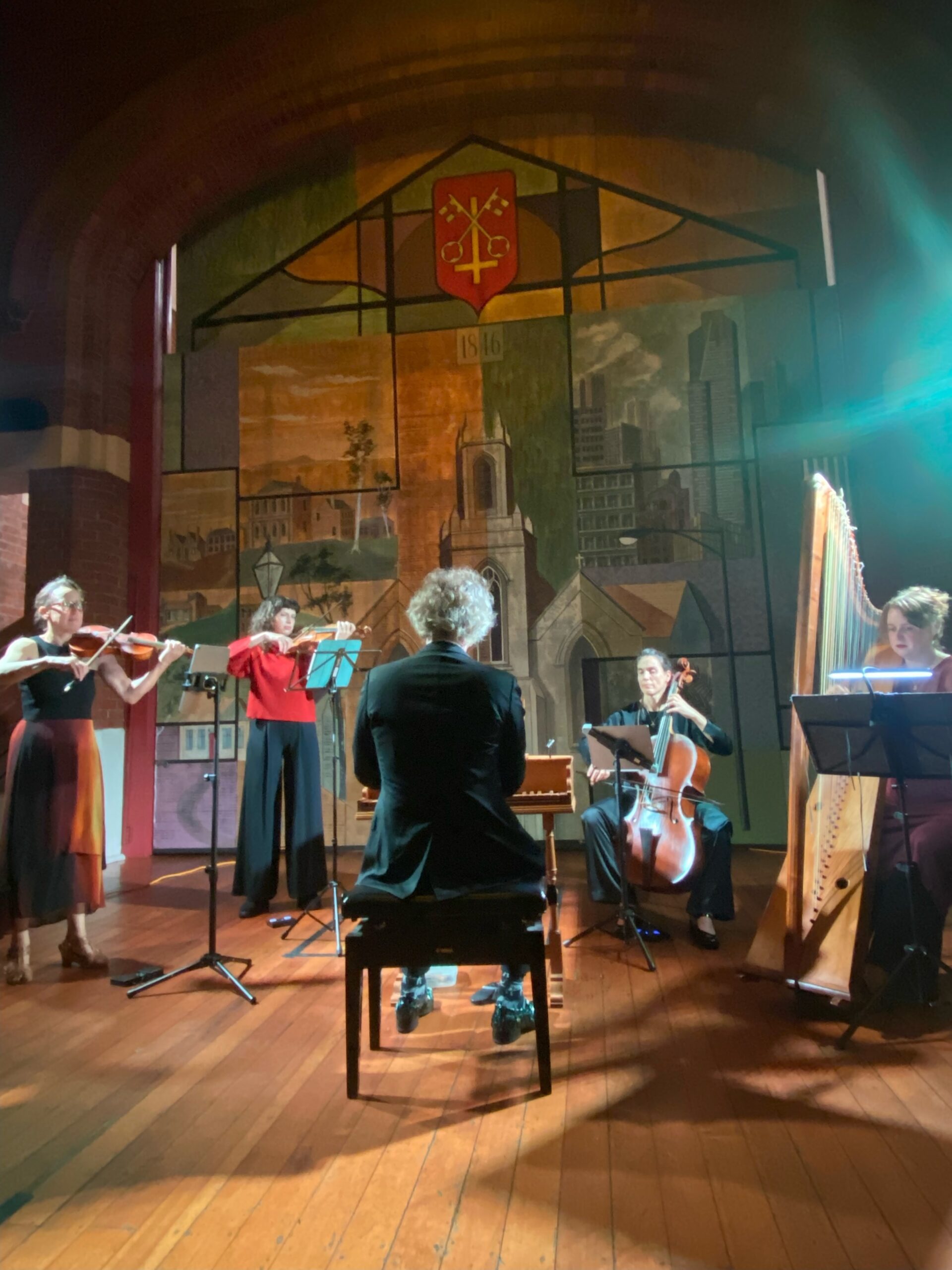
We can always count on Genesis Baroque to provide a fascinating and memorable experience for us with their imaginative and “historically informed” chamber music programs. While 6pm on a Friday may have seemed an unusual concert time, a welcoming escape from Melbourne’s peak hour and working week was provided immediately as patrons entered another world: a breath-taking historic hall at St Peter’s Eastern Hill precinct. Immediately we were transported back in time to the atmosphere of a royal castle where very tall soft brown brick walls, timber floors and softly melting lighting created the feel and intimacy of an ancient castle’s dining room where patrons mingled to share a warming vino and accompaniments while viewing Donald Nicolson’s centrally located harpsichord at close quarters.
In Jennifer Kirsner’s welcome, the Artistic Director carefully prepared us for the unusual timbres that audiences hear from baroque instruments as their gut strings require adjustments, lower tensions and tunings, which result in a warm, rustic and rich timbre. Tonight’s program offered a varied feast of “tastes re-united”, the French title referring to Francois Couperin’s royal chamber music suites.
The opening work, Partita in D minor (1692) by Franz von Biber, certainly illustrated Kirsner’s introduction, where the technique of altering the tuning did indeed produce the unique effects of “cordatura”. A fine resonance surrounded us in this historic space as Kirsner and Meg Cohen’s baroque violins wove their melodies with intricate variations over rhythmic dance pulse beats from cellist Edwina Cordingley and harpist Hannah Lane. Feeling the lilting dance rhythms of the Allemande with its technically florid variations, audience heads were gently nodding to the dance. We were drawn inside the dance itself, imagining the dancers enjoying the buoyant Gigue in Baroque times at a festive courtly occasion.
Nicolson introduced his own exciting arrangement of Couperin’s Les Fastes de la grande et Ancienne Mxnxstrxndxsx, (yes – the letter e was deliberately replaced by x) written for clavecin in 1717. This colourful cycle of satirical pieces described characters and personalities in a parade and we were enthralled with the musical craft in these portraits: first a youthful personality described by a lyrical solo violin, next an older character trudging heavily, supported by drones from harp and cello. A lively character skipped and danced to running harpsichord episodes, and after a dramatic entry from the cello, the music expressed the weariness and heavy weight of a larger-than-life clown or buffoon perhaps. Nicolson had prepared us to expect the final portrait to be helter-skelter patterns, with cello and violins racing around like scurrying monkeys. Imaginative indeed, colourfully executed, and highly applauded.
Marin Marais was a central figure in the French school of bass-viol composers, with a significant career as an opera composer. His Suite à 3 in G Minor (1692) was a most expressive French dance form, suitable for an elegant party, and ideal for this wonderful musical journey to another time and place. Refined, relaxed, balanced and totally charming, Marais’ Prelude was delicate and graceful, the Fantasie delivered with freedom and energy, and a lyrical Sarabande circled around us, its repeated hypnotic verses and fine Baroque timbres taking us to a candlelit place. Sweetness and beauty and a forward moving tempo did not allow the Plainte to surrender to pathos or heaviness, as further circling of phrases and melodic voices with repeating harmonic accompaniment gave a haunting dance movement through the final dance, a mesmerising Passacaille.
Geminiani’s Treatise of Good Taste in the Art of Musick (1749) was a guide to Baroque ornamentation and expression, featuring the composer’s arrangements of traditional Scottish melodies. Auld Bob Morris was warmly presented with “simple” variation, its gentle folk melody kept true and unadorned with minimal ornamentation. Nice!
Repertoire for The Director’s Cut was described by Genesis Baroque as being some of the music they love the most, evidenced in Nicolson’s arrangement of Diego Ortiz’ heart-touching Doulce Memoire. We now heard broad, warm and legato tones from the instruments in this sad and at times forlorn work, enchanting us as harp and cello melodies projected strong low tones, free and expressive in emotional delivery. Nicolson’s setting of La Follia (1553) continued to seduce us with its grounded hypnotising rhythms, repetition and earthy memories of Spain.
With a challenging violin line full of activity and dazzling variations, Kirsner led the ensemble in a joyful march with the closing work “Paul’s Steeple” also known as “The Duke of Norfolk” from Playford’s Division of Violin (1685).
How good was this event! This fine early music ensemble presented a fascinating and varied program in an intimate and historic venue with a gorgeous resonant acoustic, glowing lighting and ambience, with authentic and exceptional musical artistry.
Photo supplied.
_________________________________________________
Julie McErlain reviewed “The Director’s Cut – Les Goûts Réunis”, presented by Genesis Baroque at St Peter’s Eastern Hill on June 12, 2026.