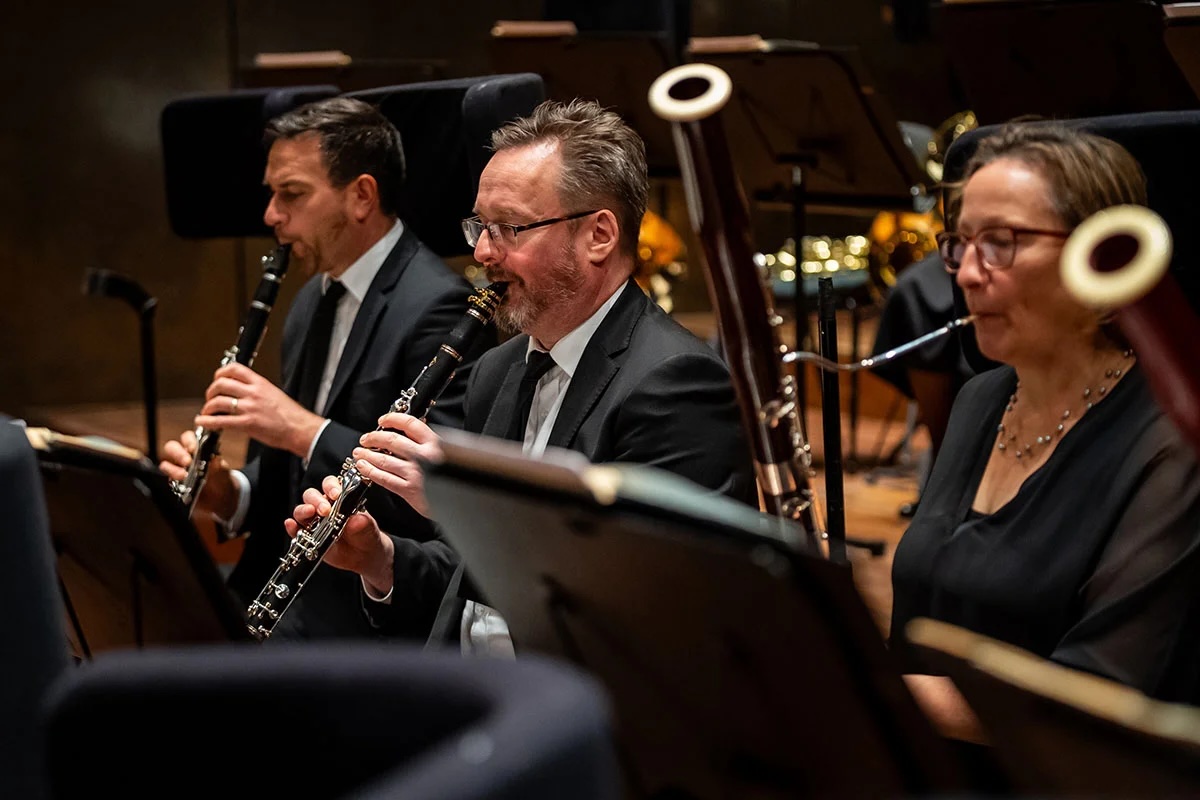
Presented by the MSO Wind Ensemble, this concert was a rare treat for Melbourne’s regular concertgoers and admirers of music for wind groups. As one of three programs in the MSO’s Sonic Spectacular series, Gran Partita comprised a performance of Richard Strauss’s Sonatina No. 1 in F major, Aus der Werkstatt eines Invaliden (From an Invalid’s Workshop) together with Mozart’s better-known Serenade No.10 in B flat major, K 361 (Gran Partita).
Strauss’s Sonatina No. 1, composed in 1943 during the gruelling circumstances of World War II, is a late work by Strauss. As such, you might expect it to be a gloomier and more reflective work. Instead, we find Strauss at the height of his abilities as a composer creating a work of great energy, humour and inventiveness. This was apparent from the dramatic opening of the first movement, Allegro moderato, where oboes and bassoons move chromatically in contrary motion building up to cascading runs on the solo clarinet (played by David Thomas) and the first resounding chords of the ensemble in full voice.
The distinctive soundscape of Strauss’s Sonatina No. 1 was produced by his unusual choice of instrumentation inspired by the wind ensembles of Mozart and Mendelssohn. For the Sonatina, Strauss chose to write for an even larger group of 16 wind instruments including pairs of flutes, oboes and bassoons, along with three clarinets (in B-flat, A and C), one bass Clarinet, a basset horn, four horns and a contrabassoon. The less common Clarinet in C, used liberally by Strauss in his opera Der Rosenkavalier, lightens the tonal colour and gives it a brilliance and wittiness that counterbalances the weight of the horns and bass instruments. Altogether, this was an impressive line-up of instruments on stage at the Elisabeth Murdoch Hall and made this rare performance of the Sonatina so special.
One of the most evocative sound qualities in Strauss’s tonal palette is that of the horn, used to great effect throughout the Sonatina not just as accompaniment but also in numerous solo passages. Strauss’s appreciation of the horn is understandable given that his father was Principal Horn with the Munich Court Orchestra for 49 years. In this performance, the four horns, including the MSO’s Principal Horn, Nicolas Fleury, gave a well-calibrated performance that was poised in the solos. Of special note were the outstanding contributions of Principal Oboe, Johannes Grosso, and Principal Clarinet, David Thomas, as soloists and in their ensemble playing. The clarity and brilliance of Grosso’s oboe and the warmth and fluidity of Thomas’s playing, especially in the glorious second movement, the Romanze und Menuetto, were exceptional.
Strauss’s Sonatina No.1 may be generally light-hearted but is anything but simple and straightforward. There are many interlocking parts and a continual development of ideas and exchange of motifs involving every member of the ensemble. This was very evident in the chirpy, scherzo-like last movement where Strauss’s wit and power of invention take full flight. Repeated chattering staccatos in the flutes and passed around the ensemble culminated in a beautiful lilting theme built on a hemiola pattern (2 notes played in the same time as 3) that was captivating. Unlike the end of the first two movements, which were marked by a series of luscious, carefully paced chords, the last movement raced to the end and seemed to take the audience by surprise. Another of Till Eulenspiegel’s merry pranks, one wonders?
The demands of Strauss’s Sonatina required all the musicians to take particular care in balancing their ensemble playing. David Thomas, as the Director, took responsibility, not only for its interpretation, but also for conducting the ensemble, which he did from his chair at certain pivotal moments in the performance. Not an easy task given the size of the ensemble and the complex nature of Strauss’s composition.
In contrast to Strauss’s less familiar composition, for the audience, listening to Mozart’s Serenade No. 10 for 13 wind instruments felt like coming home. Mozart’s compositional style seems more natural and accessible, yet his Serenade No. 10 is a work of great eloquence and depth that far exceeds the mere entertainment role of serenades in the Classical era.
Written somewhere around 1781, about 150 years before Strauss’s Sonatina No. 1, Mozart doubled the traditional Classical wind group to 13 instruments. With its pairs of woodwinds, including two basset horns, and without flutes and a clarinet in C (only just invented at that time) Mozart created a wind ensemble with a characteristically rich, woody timbre. For this performance, the contrabassoon was replaced by a string bass played with great elan by MSO’s Principal Double Bass, Jonathan Coco.
In the stately, introductory Largo, the syncopated rhythms of the ensemble were heard in opposition to the solo passages, played with great sensitivity on clarinet and oboe by David Thomas and Johannes Grosso. This opening established the importance of the clarinet and oboe as the central melodic voices in the work. Of only slightly less importance was the role of the bass instruments and particularly, the bassoons, played by Principal Jack Schiller and Hayden Burge with impressive dexterity in the fifth movement Romanze, for example, where the rapidly repeated bubbling pulse of the bassoons underpins the woodwinds.
This central importance of the oboe and clarinet was most evident in the sublime fifth movement Adagio section, made famous by the film Amadeus, and which has been described as the emotional heart of the Serenade. On top of the pulsating rhythm that is sustained by the bass instruments throughout the movement, the solo oboe enters almost inaudibly on one note that builds to a crescendo. This solo line is then taken up and repeated by the clarinet and basset horn. In this movement, the even, pure tone of Grosso’s oboe floated magically over the ensemble. The poignancy of the oboe solo could only have been enhanced, perhaps, by dampening the bass accompaniment a touch and even slowing the tempi by just a whisper. Mozart, however, provides us with another Adagio in the sixth movement Tema con variazione. Here, Grosso, now in control of the tempo, provided a hair-raising solo of deep feeling. This, for me, was one of the most memorable moments in the performance.
As a grand finale, Mozart gives us the short seventh Molto allegro movement, played “Molto presto” by the ensemble with great spirit and energy. The ensemble’s ability to synchronise their playing at such high speed while keeping together and retaining clarity of tone was indeed a testament to the virtuosity of the MSO wind musicians.
Overall, this was a performance of Mozart’s Serenade No. 10 that was as close to perfect as one can get in a live performance, and which was met with a standing ovation that it truly deserved.
Photo supplied.
______________________________________________________
Maree Gladwin reviewed “Gran Partita”, presented by the Melbourne Symphony Orchestra as part of the “Sonic Spectacular” series at the Elisabeth Murdoch Hall, Melbourne Recital Centre on May 17, 2026.