What a night! Opera Australia’s personable and articulate CEO, Alex Budd, launched Melbourne’s celebration of the company’s 70th Anniversary with a few words about its preeminent role in Australian cultural life. In a brief survey of highlights, the Acknowledgment of Country assumed special resonance given his mention of Leah Purcell’s opera, The Drover’s Wife, which opened this week in Brisbane.
ABC Classic’s charming and gorgeously-gowned broadcaster, Mairi Nicolson, made the ideal compere. Her dulcet tones and vast experience as an opera presenter, opera tour guide and all round opera devotee added a personal touch as she related her own adventures within a world considered to be the pinnacle of artistic expression – a world, as she put it, of “murder and mayhem”. Her anecdotes even embraced one of the more sensational experiences of set designers. Among the several curtains used was a backcloth for Il Trovatore by Sidney Nolan, who fell off the stage into the pit and broke both legs when he backed away to view his work from a distance. That drew gasps from the audience.
Artistic Director of Victorian Opera Stuart Maunder and Maestro Giampaolo Bisanti devised a program of highlights from the company’s repertoire, sung by 19 current and former principal singers, a chorus that included many local singers and that other jewel in Australia’s operatic crown, Orchestra Victoria. Having Stuart Maunder play such a central role in this Gala indicates the increasingly important role played by collaboration between Australia’s National and State companies. In addition to musical theatre productions and extravaganzas like the Handa Opera on Sydney Harbour, it would seem that collaboration is a key to financial survival. Box office revenue being another key, balancing the choice of repertoire and artists is also crucial.
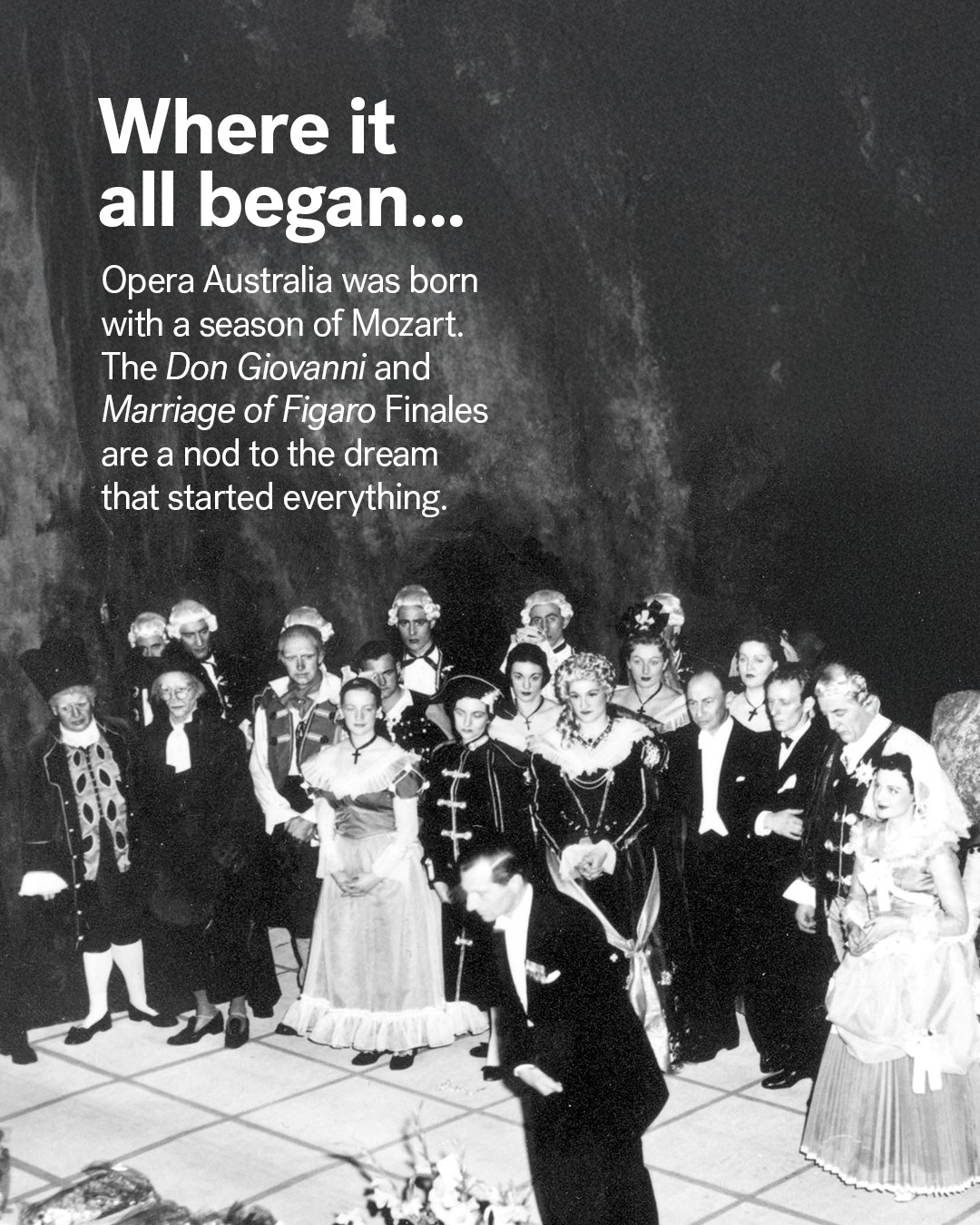
It was pointed out that Mozart was a pillar upon which Opera Australia was founded, with a national touring season of Mozart’s operas undertaken in 1956 with the dual purpose of marking his bicentenary and launching the company. Last night, we heard two excerpts: the Act 1 Finale from Don Giovanni and the Act 4 Finale from The Marriage of Figaro.
Although at least some of the singers would have been familiar to this particular audience, many people would have had no idea who was singing unless it was announced. Emma Matthews probably needed no introduction (though she did have one) as opera lovers have followed her stellar career over the decades from the time she stunned us all as Berg’s Lulu. This time, she sang the only recent (and only Australian) piece of music on the program: an aria Richard Mills’ The Love of the Nightingale. Written to showcase her singular talents, the “Nightingale’s Song” is a coloratura flight of fancy that swoops and trills – a reminder of Matthews’ huge success in all those bel canto roles. Along with the agility of her crystal clear voice we saw again an actress who could hold an audience spellbound with a twinkling look and a flutter of the hands.
Given her starring role in La Traviata, there was no mistaking Stacey Alleaume either as that miraculous resonance rode the top line of several ensembles. Her ability to spin a high note with seemingly endless reserves of breath continued to astonish. Pure and without a trace of the edge that seems to feature in many female voices nowadays, she was a pleasure to hear, and her acting was committed without being overdrawn.
The crazy ensemble from Rossini’s L’Italiana in Algeri does call for some ridiculous action, and attracted the biggest laugh from the audience as all members threw themselves into the action. It made a huge contrast to what followed: the sextet from Lucia di Lammermoor. Singing the major share of the high notes, Alleaume absolutely nailed them all. It is a pity that the split screen surtitles enabling you to tell who was singing what, as used for La Traviata, were unavailable.
Another soprano taking the high notes was Rachelle Durkin, who did much to animate proceedings, especially in the Rossini (as above). Not only was her ability to sing pinpoint high staccato notes impressive, but she was also a member of the ensemble singing the only twentieth century work on the program: Britten’s Peter Grimes. She and Celeste Lazarenko did a great job negotiating the syncopations of “Old Joe has gone fishing”. Under the very capable baton of Sam Weller, who conducted just this one ensemble, we had a small taste of the breadth of the company’s repertoire. Less expected was encountering Diego Torre’s versatility in the titular tenor role as we are accustomed to hearing him star in Italian repertoire. His robust Italianate singing of “Nessun dorma” from Turandot, and his ringing contribution to the Lucia Sextet in other parts of the program were what we have come to expect from this outstanding tenor.
Although a lighter tenor, Filipe Manu, also impressed with the vitality of his performance in the ensembles, his bright voice and the youthful charm that had made him an effective Alfredo definite assets.
Of the lower male voices, Andrii Kymach was outstanding as Simon Boccanegra, singing “Plebe, Patrizi, popolo” with notable Verdi grandeur as he sustained high notes with rock solid full voice. Always a compelling actress with a well-projected soprano voice, Olivia Cranwell made an impressive contribution to the Simon Boccanegra excerpt. Kymach certainly impressed Rachelle Durkin’s flirtatious smuggler as he sang a lusty “Toreador Song”. Simon Meadows made his mark with his strong vibrant baritone voice in ensembles, as did baritone Luke Gabbedy and bass David Parkin.
Of the 17 items on the program, we heard one each by Offenbach, Wagner, Mills, Puccini, two by Mozart, Donizetti and Bizet, with (understandably) three by those masters of Grand Opera, Verdi and Rossini. While Rossini would have to be one of the most ebullient of operatic composers (see L’Italiana), he does not guarantee that a concert beginning with one of his overtures will start with a bang. The choice of his lengthy Overture to Guillaume Tell was therefore a curious choice to initiate a celebration, but it was an unexpectedly suitable one. This overture is much more than its usual association with the exhilarating theme tune from The Lone Ranger, instead, it served to showcase various sections of the orchestra. In four parts, it begins with the warmth of solo cellos, moves to a storm featuring wind and brass instruments, then to post storm pastoral tranquillity of wind instruments before culminating in the familiar gallop. As he did for those exquisite Traviata preludes, Maestro Bisanti drew music of great sensitivity from the musicians.
The singing of “Va pensiero” from Verdi’s Nabucco was similarly carefully managed with respect to subtle dynamic control and balance. It is rare to find a body of singers with an almost equal number of male and female voices, and this chorus was a joy to listen to with sopranos not dominating unduly and tenors clearly audible. The final programmed item, the final scene from William Tell was similarly balanced, and ended on an appropriately jubilant note.
It wouldn’t have been a complete operatic occasion without Wagner. And what better way to set the second half of the program alight than the “Ride of the Valkyries”? The virgin warriors entered singing from various parts of the Regent Theatre, Celeste Lazarenko sounding particularly lustrous from her vantage point in a theatre box. It was a spine-tingling moment when they finally assembled across the stage, their war cries accompanied by brass-infused orchestral might.
A standing ovation following the Rossini prompted the inevitable encore of the “Brindisi” from Traviata, with all singers giving of their enthusiastic best. But wait, there was more: a reprise of “Nessun dorma” by all singers followed by a Lighting Designer Alex Lynn’s explosive “fireworks” and ticker tape. I’m sure there would have been quite a few sleepless people after the excitement of this celebration.
Image supplied.
______________________________________________________________________
Heather Leviston reviewed opera Australia’s 70th Anniversary Gala, presented at the Regent Theatre, Melbourne on May 17, 2026.