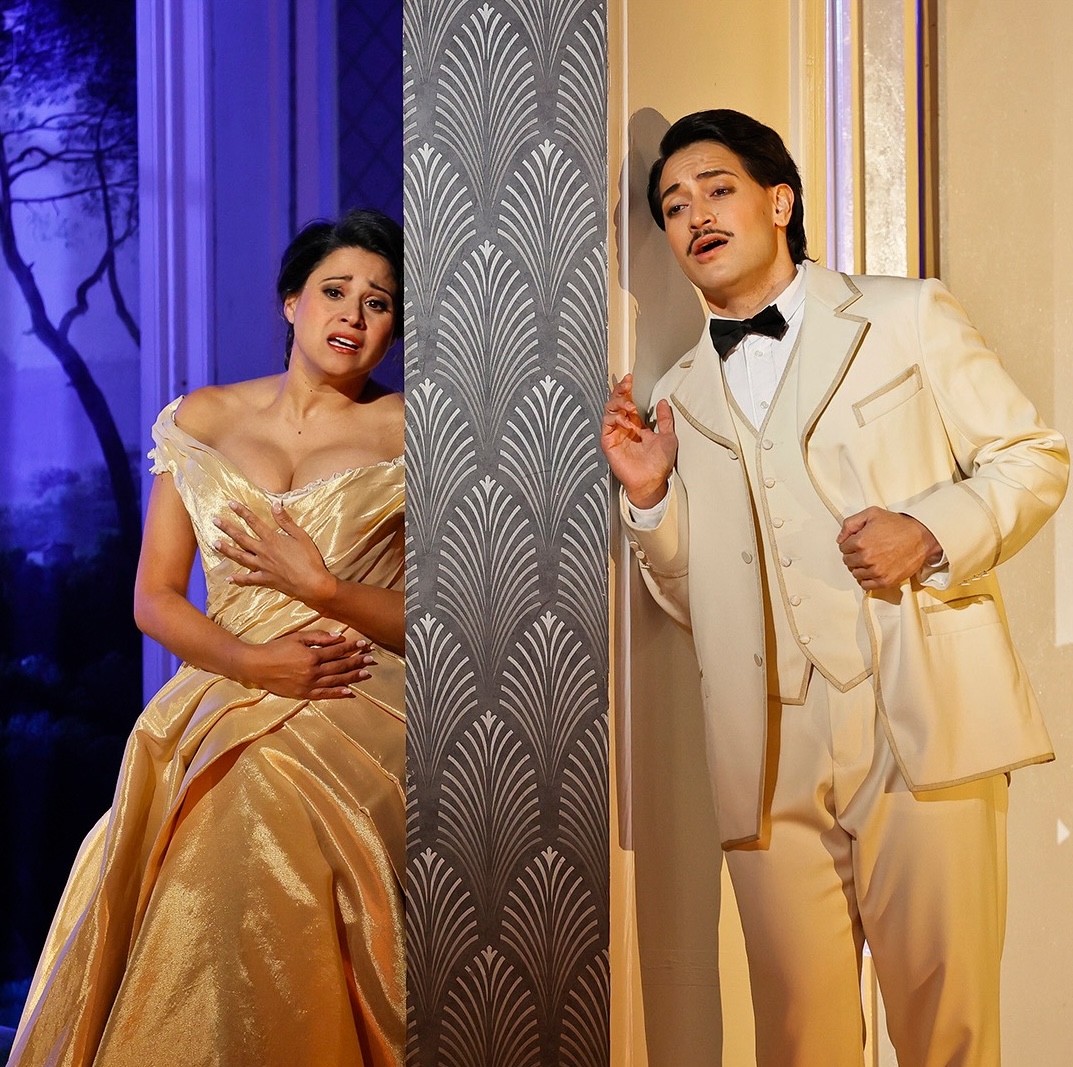
The last time a Melbourne audience saw an Opera Australia production of Verdi’s La Traviata it was at the State Theatre in 2022. Elijah Moshinsky’s much-lauded, lavish production had served the company well, but come 2026 it was time to give us something very different.
Instead of the jewel-like but crowded salon setting of the opening Act, where Violetta sought oblivion in champagne and gaiety, Opera Australia has finally brought director Sarah Giles’ grittier interpretation to Melbourne. A coproduction by Opera Queensland, State Opera South Australia and Western Australian Opera, first staged in 2022, it emphasises feminist aspects of the story and employs a much less literal style of staging, almost to the point of surrealism.
The set moves as we watch, walls disappear, sets remade and figures appear as silhouettes, blending Violetta’s imagination with “real” life. As the set is transformed, merging the fist two and the second two Acts – there is only one interval – time warps. The chorus too assumes a surreal dimension right from the start, moving in slow motion during the Prelude. In Act 3 they move as one closely packed body, almost like automatons, while watching Flora’s entertainment. Much of this is made even more striking by Paul Jackson’s lighting design. It is a challenging and thought-provoking production that commands attention.
Director Sarah Giles together with Set and Costume Designer Charles Davis have opened up the stage into three main areas, including a bedroom where Violetta’s predicament as a reluctant courtesan is graphically displayed during the Prelude. As soft translucent high strings reflect Violetta’s fragile health and the precariousness of her situation, the constraints of her relationship with her “protector”, Baron Douphol, are laid out. An enormous tied box arrives with a magnificent “cloth of gold” gown – a gift from the Baron – that she is expected to wear at the party going on in the adjoining salon. Trussed up in the Baron’s finery, she steels herself and enters the social whirl just as Verdi’s energetic party music erupts. As a piece of theatre, it is inspired.
Liberation, from corsets at least, comes when she sings the big Act 1 aria “Sempre libera”. Further signs of leaving a life of social constraint are alluded to at the beginning of Act 4. While the shimmering music of the Prelude foretells her imminent death, she unburdens herself of the fabulous gown she wore at Flora’s humiliating party.
For opening night, what the Giles and the Moshinsky productions did share was Stacey Alleaume in the title role of “the strayed woman”. In both she was a superb Violetta. She certainly looked the part: slender enough to pass as a dying consumptive, and beautiful, graceful and vibrant enough to warrant being the Baron’s trophy mistress and Alfredo’s romantic ideal. And she sang splendidly. The Regent Theatre is not a venue to flatter voices, but Alleaume has remarkable resonance and purity of tone that is able to carry well even at its softest. There might not be the weight of tone in the lower reaches that some sopranos bring to the role, but there was enough, and she was able to use chest voice to good effect at key moments.
As Alfredo, New Zealand-raised tenor of Tongan heritage, Filipe Manu, gave a creditable performance, his voice bright and firm and his acting convincingly ardent.
Ukranian baritone Andrii Kymach was an impressive Germont. Tall and imposing with a powerful voice, he gave dignity and gravitas to the role. You didn’t have to know his country of origin to think his vocal style proclaimed Eastern European. Listeners more accustomed to a “juicier” or more Italianate sound might have been surprised initially, but there was no doubting his ability to sing the role persuasively. It had me, yet again, wondering when Opera Australia was finally going to mount another production of Boris Godounov.
Minor roles were performed capably with Richard Anderson a rich-voiced standout as Baron Douphol, Shane Lowrencev a warmly sympathetic Doctor Grenvil, Angela Hogan a vivacious Flora, and Jennifer Black making a special impression in the role of Anina with her lovely voice and calm presence.
The ladies and gentlemen of the chorus were terrific, and it was especially pleasing to see so many of Melbourne’s best singers among their number.
Could the singers have wished for a more sympathetic conductor? Under the watchful eye of Maestro Giampaolo Bisanti, Orchestra Victoria played at their disciplined best, tempi gave the singers time to breathe and the dynamics, so carefully shaped by the conductor, allowed them to be heard. The singers performed with commendable precision and attention to detail – no easy matter in a theatre where the acoustic sometimes makes it difficult for the singers to hear the orchestra clearly.
For those who heard the opening night cast, it would be well worth making the effort to hear the alternate cast – and vice versa of course. It might be the same production, but it’s easy to miss finer details on first viewing, and those gorgeous gowns are such a pleasure to ogle. More importantly, the principal singers are vocally excellent and interpret the roles in their own individual way.
In particular, Italian soprano Maria Laura Iacobellis has a warm voice that is flexible, alluring and substantial. Like Alleaume, she is able to convey Violetta’s joy and distress convincingly. As Alfredo, her compatriot, Oreste Cosimo, was vocally outstanding and dramatically convincing. He possesses an instrument with a singularly attractive timbre and displayed good tone and agility in the “Brindisi”, Verdi’s famous drinking song that ignites the opera.
Given the creativity of the production, the exceptionally high standard of the singing and the brilliance of one of the most popular operas of all time, it would be a shame to miss out on seeing both casts. We can see operas from all over the world in our cinemas, but you can’t beat hearing and seeing gifted singers accompanied by a fine orchestra in the flesh.
Photo credit: Jeff Busby
_____________________________________________________________
Heather Leviston reviewed “La Traviata”, presented by Opera Australia at the Regent Theatre, Melbourne on May 8 and May 9, 2026.