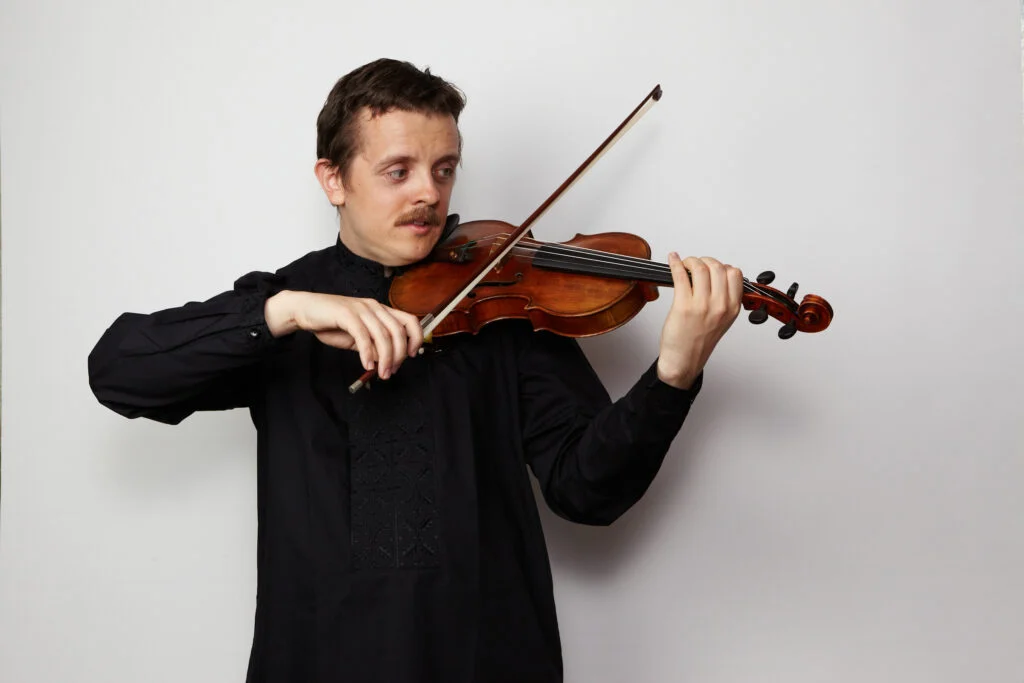
As a wintry chill suddenly descended on Melbourne, the third volume of Postcards from Ukraine was launched. A large, appreciative audience in a warmly lit Primrose Potter Salon was keen to hear items from the latest set of recordings by Ukranian-Australian virtuoso violinist Markiyan Melnychenko, this time accompanied by renowned pianist, Stewart Kelly. The participation of Associate Principal Clarinet of Orchestra Victoria, Justin Beere, was a further drawcard.
In addition to folksong and dance arrangements by earlier well-known virtuosi, Volume Three of Postcards: “Folk Dialogues” did include the six Ukranian folksongs in Melnychenko’s new arrangement for violin and piano played in the concert. Opening with big, dramatic piano chords, Ukranian Dance a slow weeping-into-your-vodka introduction accelerated into a wild dance that showcased Melnychenko’s technical skills and led to an enthusiastic ”Bravo!” from the audience.
Apart from wondering how anyone could possibly dance at this prestissimo pace, Melnychenko’s fearless virtuosity also had me wondering why he would arrange these pieces to present himself with such enormous technical challenges – a question that continued with increasing wonderment as the evening progressed. It seemed that he had explored every possibility until he played the next piece. Even more than the lightning speed of some passages was how much was packed into them. Name a violin technique and it was there – usually simultaneously. Double stops, harmonics, pizzicato, glissandi, bariolage, ricochet, impossibly high notes… no problem at all. All of this with well-shaped phrasing tasteful vibrato that ranged from relaxed to intense, tone that ranged from throaty warmth to gossamer thread – plus musical flair.
Violinist and pianist spoke briefly about the works with Melnychenko providing interesting background information. Three traditional Ukranian pieces were played in the first half of the program and another three after interval. The second piece, Moon upon the Heavens, is a melancholy song about love and loss. The tender, yearning melody begins with solo violin and is then taken up by the piano. Swooning double stops and pianissimo harmonics were used to create emotional impact rather than virtuosic display, and pliant musical lines were created to engage the listener’s imagination.
Before playing The Steppe Wind Blows, Melnychenko’s read a poem connected to a similar theme – a lament concerning a Cossack killed in war. The work belongs to a series of “resistance” folksongs popular during Ukraine’s unsuccessful struggles for independence in the first half of the twentieth century. Melnychenko has aimed for what he calls “a simplicity of approach, including a calm stillness in the accompaniment”. A slow piano introduction was followed by the full tones of the violin in a simple, captivating melody that ended in a lingering pianissimo.
The Duckling Swims Along the Tysa has served as a requiem for those killed during the 2014 “Revolution of Dignity” protests. A work of great intensity in Melnychenko’s realisation, it begins with bow bouncing on strings – a ricochet – that builds via tremolos to dramatic thunderous piano chords and a violin cadenza of great intensity and technical skill, and ends quietly with another softly shuddering ricochet. It was a dramatic beginning to the second half of the program, full of weeping melody.
In contrast, the item that followed, Podolyanochka, belongs to a tradition of girls’ spring songs or games. Although this piece was much lighter in character with its variations on a dancing melody, an undercurrent of melancholy was apparent in the middle section.
The final folksong, The Shepherd, was also more upbeat, being a song about “love, marriage and flirtation”. Melnychenko arranged it in the style of a theme and variations like those by Sarasate and Paganini, enabling him to display the whole dazzling armoury of technical bravura available to a violin virtuoso. Stunning.
Interleaved between these extraordinary pieces were arrangements by Kreisler (Dvorak’s Slavonic Fantasie and the traditional Londonderry Air), Sarasate (Moszkowski’s Guitarre) and Heifetz (Foster’s Jeannie with the Light Brown Hair and Ponce’s Estrellita). All accessible and uplifting, they were played with suitable panache. In his little chat, Kelly did, jokingly, voice a preference for the English works – perhaps because the violin played a simple tune while the piano attracted the spotlight. Needless to say, he had plenty to do in the Ukranian pieces and accompanied Melnychenko with great musical sensitivity and pianistic skill.
Justin Beere joined them for the two works that concluded each half of the program. These could hardly be classed as “postcards” given their length. Lasting around 12 minutes, The Klezmer’s Wedding by one of Canada’s most celebrated composers, Srul Irving Glick (1934-2022), offered plenty of time to enter into the festive spirit of a Jewish wedding, and left the audience in a dancing mood for interval. Beginning with a raucous clarinet wail typical of Klezmer, tremolos from violin and clarinet gave way to a dancing clarinet melody. Almost teasingly, the music took us through changes of pace and dynamics, encompassing dances from the stately to ones involving hectic syncopation. The final build up led to an explosion of cheers from the audience – an indication that all three artists were in excellent form.
The final trio, Suite for Violin, Clarinet and Piano by Alexander Arutiunian (1920-2012), was commissioned by the Michigan-based Verdehr Trio. A 16-minute work in four movements – Introduction, Scherzo, Dialog and Finale – it features elements inspired by Armenian folk music. As Kelly indicated, shades of Shostakovich could be heard in much of the musical language as boundaries between jazz, classical and folk idioms were crossed. Beginning with a brooding, melancholy passage for solo piano, violin then clarinet joined in to play a melodic interweaving based on a repeated motif. A sprightly Scherzo with a laughing clarinet swirled to a neat ending, then it was back to a more serious tone as violin and clarinet played mournful slow echoing lines in dialogue until the piano entered for what became a fast-paced, spirited finale. Apparently, Arutiunian had expressed his particular affection for the clarinet’s “nimble, capricious, and lyrical” personality; he would have been delighted at Beere’s display of same here, so ably abetted by Kelly and Melnychenko.
Following a standing ovation and the Estrellita encore, a long queue stood patiently waiting to purchase a CD of works featured in this concert.
Photo supplied.
______________________________________________________________________
Heather Leviston reviewed: “Postcards from Ukraine and other places” presented by Springs in The City at the Melbourne Recital Centre on May 6, 2026.