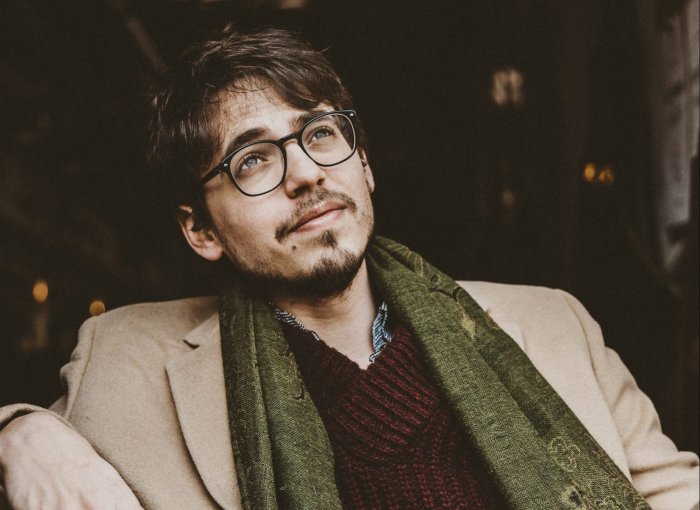
It is the relatively new concert organisation Live at Yours that presented French composer/improviser/pianist Lucas Debargue at a venue I’d not attended before – the Toorak Synagogue. It is a venue well suited to piano recitals – ample in space yet with no audience member too far from the pianistic action.
The recital was a very relaxed affair with Debargue being interviewed on-stage between each piece. He is a very engaging performer, generously expansive on his thoughts about his role as a live performer and the role of musicians in general. He also expounded on how his musical foundations emerged from improvisation rather than earnest highly-organised formal study, and how this informs his creativity both pianistic – “I never play a piece the same way twice” – and in his compositions.
Unusually in this concert, the fall-board of the piano (a vertically hanging board just behind the black and white keys) appeared to have been removed. Debargue seems to navigate his fingers further in amongst the black keys than other performers, and no doubt his long fingers would otherwise crash into the fall-board – hence the removal of the fall-board? I wonder if this might catch on with other performers.
Debargue first came to prominence, seemingly out of nowhere, when he secured Fourth Prize at the prestigious Tchaikovsky International Piano Competition in 2015. Since then he has forged a successful career, performing across the world while also recording and composing. This concert tour marks his first visit to Australia.
The program presented differed somewhat from the advertised program, but was no less interesting for that fact. Debargue opened with an unannounced free improvisation, one notable for its carefree spontaneity, lavish washes of pedal, and abrupt juxtapositions of starkly contrasting dynamics, a pianistic trope that was to be a feature of his playing throughout the night.
This was followed, somewhat logically, by Beethoven’s “Moonlight” Sonata, since Beethoven himself was unrivalled as an improviser in 1790s Vienna. Indeed, Beethoven’s early reputation was principally as an improviser rather than as either composer or pianist. The opening movement was taken at a very broad pace, yet the all-too-familiar upper melody, whose forte projection contrasted markedly with a pianissimo triplet accompaniment, maintained an implacable sense of line and direction. The finale, while not taken at a break-neck tempo, nevertheless realised much of the “emotional tempest” that Debargue referred to in his interview. Again, dynamics were starkly contrasted, with sudden sforzando outbursts (a typical Beethoven expressive gesture) the order of the day, with Debargue’s athletic finger-work bringing the dramatic musical narrative to life.
Debargue then moved to Ravel’s Gaspard de la Nuit, a work, he informed us, that he has performed more than any other in his career. Debargue’s demeanour at the piano is a very quiet and understated one, and this perfectly suited the diaphanous opening of Gaspard’s opening movement “Ondine”. The highlight of this iconic French triptych, inspired by the poems of Aloysius Bertrand, however, was the central “Le Gibet”, where Debargue’s refined tonal palette perfectly realised the mesmerisingly plaintive and relentlessly immutable single-note ostinato (reiterated some 153 throughout the movement). The despair within Betrand’s macabre poem emerged through Debargue’s carefully layered textures, replete with complex dissonances, and contrasting “open” harmonies. Debargue’s virtuoso technique also served him well in realising the nightmarish visions of the concluding “Scarbo”. Intriguingly, Debargue dove inside the piano towards the end of Scarbo to elicit a muted sonority by dampening a low D sharp string with his right hand while repeating the note with his left hand. Highly unusual yes, yet effective in its own way. Debargue is nothing if not a thinking musician, willing to experiment and veer onto less-trodden musical pathways.
The program concluded with Debargue’s own Summertime Variations, a work whose recording is due to soon be released alongside his own arrangements in the form of études of several other Gershwin tunes. (One can at least be sure that these will contrast vividly with the famed Earl Wild étude-transcriptions of various Gershwin songs.) Its 20 variations meander through bossa nova, saltarellos, a bit of pomp and circumstance as well as a less-than-academic fugue – with Debargue’s wry sense of humour surfacing frequently in the variations.
Debargue’s career commenced in unusual circumstances and it is clear that he does not see himself as a regular garden-variety concert pianist. In many ways he is reviving the composer/improviser/performer tradition that marked eighteenth and nineteenth century music-making, and his performances are offered with a sense of generosity and with a desire both to embrace and to be embraced. While not attempting to break the long-established mould entirely, he is trying to loosen it up a bit. Not a bad thing on the whole. I look forward to further Live at Yours presentations.
Photo supplied.
______________________________________________________
Glenn Riddle reviewed “Lucas Debargue – L’Enigme Française”, presented by Live at Yours at the Toorak Synagogue on June 2, 2026.