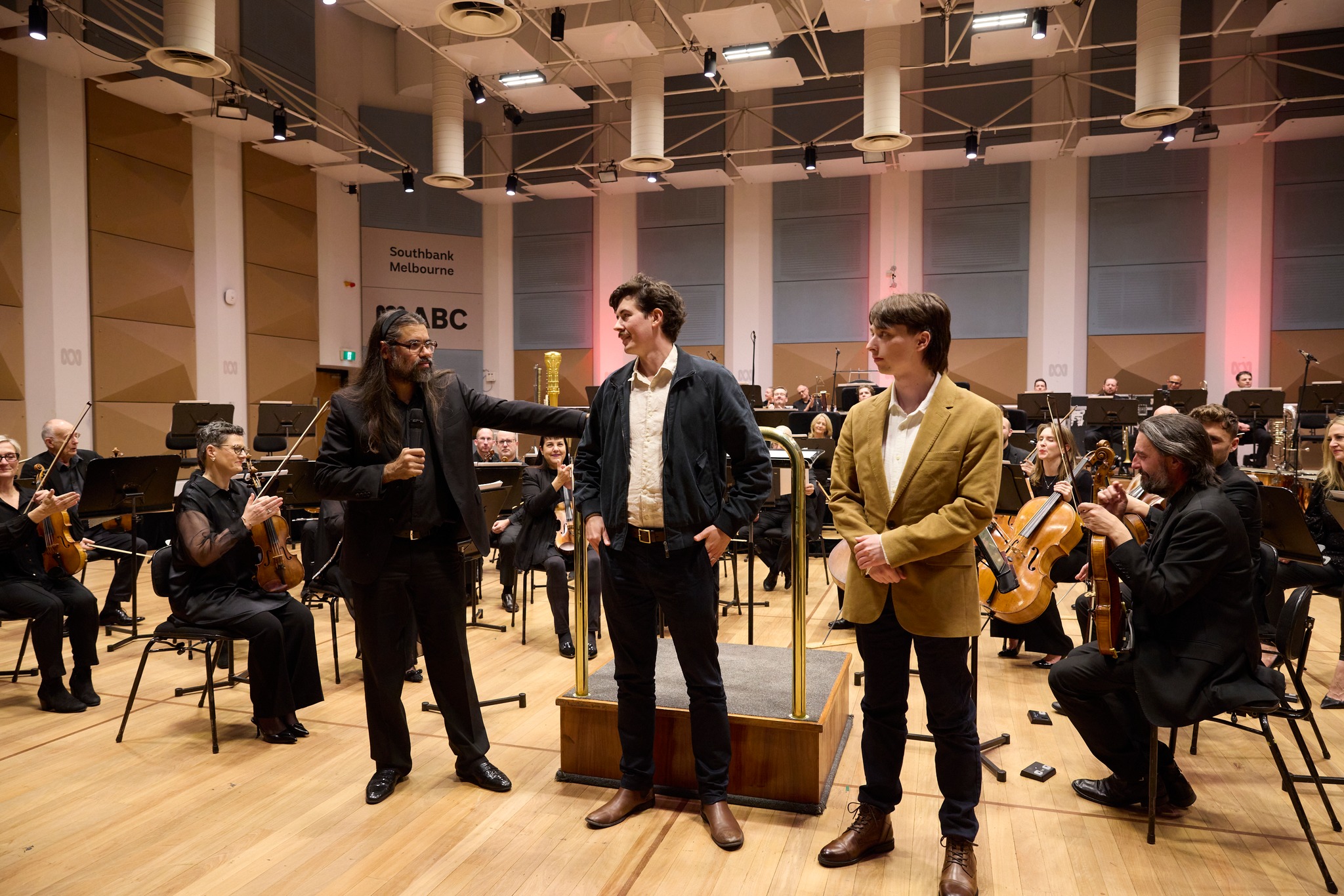
It is hard to keep up with the Melbourne Symphony Orchestra’s growing number of cultural initiatives, their commissions for new music and premiere performances all providing many exciting international and national collaborations that are proving popular with audiences of all ages.
Excited and expectant, a capacity audience welcomed the MSO’s First Voices composer program as two emerging First Nations composers realised their dreams with premiere performances. Already we have experienced the unique MSO initiative in the music of Acknowledgement of Country. We have been immersed in Deborah Cheetham Fraillon’s warm and glowing welcome, Long Time Living Here, which has been an opening feature for MSO performances from 2020 until 2025.
Tonight was indeed a showcase of “Firsts”. Aaron Wyatt, the first Indigenous Australian to conduct a state symphony orchestra, entered to great applause and immediately opened the concert with a stirring music performance: the full orchestral version of Acknowledging, by MSO Cybec First Nations Composer in Residence (2025), James Henry. In Henry’s Acknowledging, fine melodies on oboe and strings coloured a natural landscape where rhythm sticks and glockenspiel added the calm of earth and sky, then the work grew with surging power and beauty, uplifting and inspiring with anthem-like musical qualities. With a unique fusion of traditional colours, timbral elements and contemporary design, it was wonderful to hear the full symphonic colour and breadth of this Acknowledgement of Country, conducted with love, connection and assurance by a conductor achieving his dreams and becoming a mentor to others.
Wyatt proudly introduced this evening’s program of music and conversation with a welcome to Jaadwa composer James Howard, then shared conversation with him on his work Nyirrimarr Ngamatyata // To Lose Yourself at Sea. Personal, allegorical, a result of Howard’s response to political times and the social failures of the Referendum, the musical scene was pictorial and finely orchestrated. Beginning with clear skies, an opening three-note rising pattern wakened us to the sunrise with gorgeous string melodies, touches of colourful short glissandos and most earthy, ancient pizzicato rhythmic basses. Howard described his journey as being “lost at sea” with an “uncertain destination”, his own musical aspirations centred on First Nations storytelling, some loss of hope and direction coming with an explosive bass drum central climax causing fracture and disconnection in the music and in life. From the ensuing silence, bowed vibraphone tones and eerie strings brought a contemporary sound to a growing sad and despairing place, frozen in time with breath and breathlessness heard from brass instruments. In the hands of excellent musicians, these eight minutes of story-telling were heartfelt and quietly most innovative, just a small taste of Howard’s large and growing musical portfolio of contemporary and cultural Indigenous thought.
A fine conductor, violist, host and composer, Wyatt next introduced his three-minute work The Things Which Are Most Important Don’t Always Scream the Loudest (one of Bob Hawke’s most famous quotes), commissioned by the Bob Hawke College in Subiaco, Western Australia, to celebrate their Stage 2 opening in 2023. An introductory fanfare-like section showed orchestral sections building in layers over a grounded sustained double bass line expressing the nature of quiet confidence that can grow to triumph. Concertmaster Sophie Rowell led well blended strings with flutter tongue flute and cymbal rolls representing Kaal (fire), low driving winds and strings representing Boodjar (earth) and playful, melodic woodwinds depicting Maar (wind). The feeling for nature and the lands where the college was built was sympathetically described in this warm piece.
Gamilaraay composer Nicholas Astill (b. 2001) then spoke of developing a series of musical ideas which are then transformed in his work Mutations, where connections between tango and minor scale forms could evolve. This World Premiere of an MSO commission developed from a light theme on the flutes, which grew as it migrated and expanded as soloists passed it around and full orchestral sections injected more strength, with both sophisticated and contrasting quirky melodies developing as tango rhythms lengthened and augmented scale patterns crept in. Increasing counterpoint and flamboyant activity from the brass provided most enjoyable changing timbres as the work built to a close. But a surprise awaited us with the last chord! A crescendo from full orchestra reached the end abruptly, with an unresolved cadence bringing silence (and a little laughter), and we realised that in time life and music is not so easily resolved and further mutations and transformations will continue!
And indeed this celebration of First Nations composers will continue and grow as leaders like Aaron Wyatt and the MSO First Voices composers program inspire new cultural pathways and performing opportunities with valuable mentorship and collaboration.
Photo credit: Laura Manariti
_________________________________________________
Julie McErlain reviewed “First Voices Showcase 2026”, presented by the Melbourne Symphony Orchestra at the Iwaki Auditorium, Southbank Centre, on June 3, 2026.