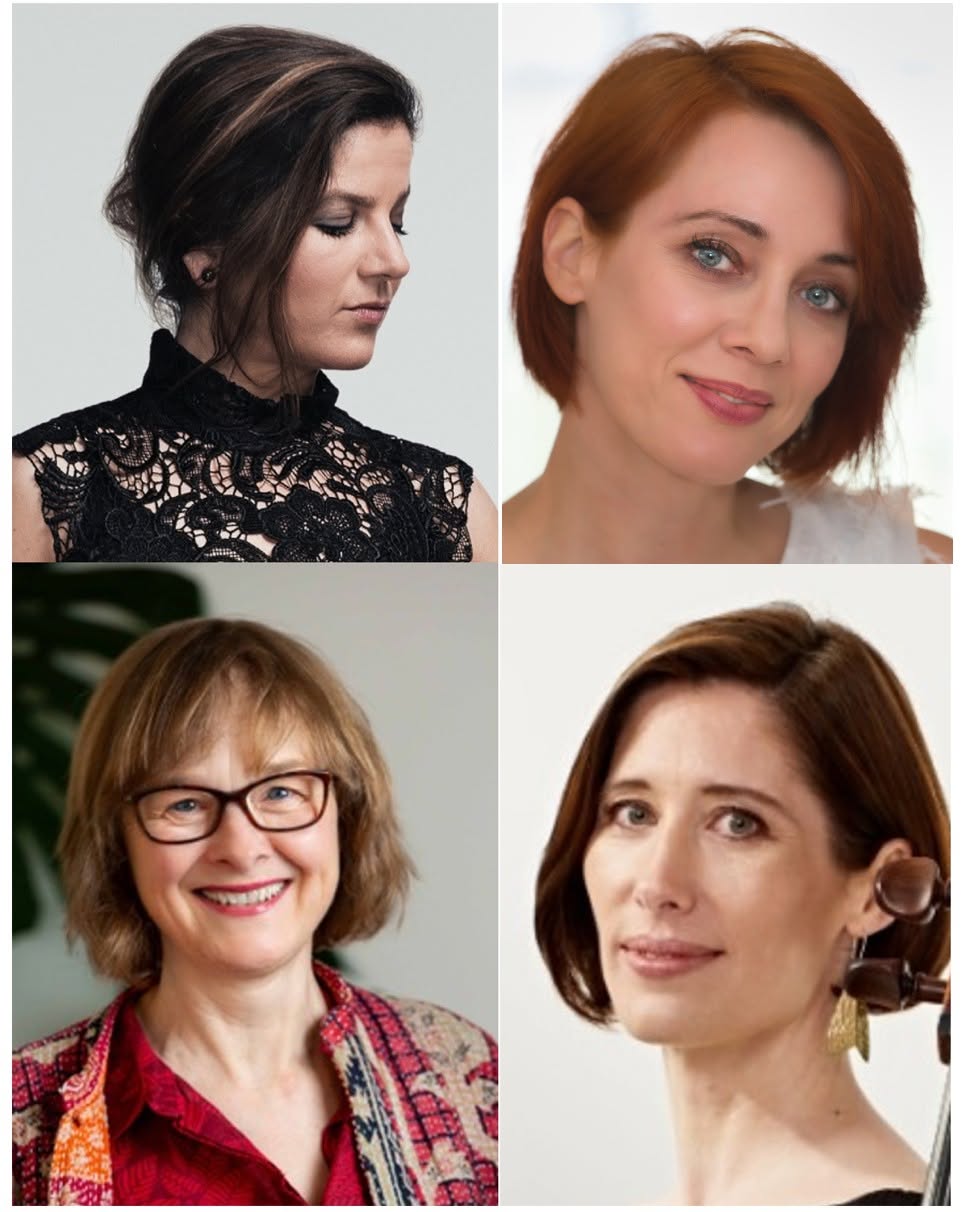
At first glance, Joseph Haydn, Heinrich Joseph Baermann and Fanny Mendelssohn-Hensel make for an unlikely program. Heard together, however, Imaginista Quartet’s latest appearance at Tempo Rubato revealed musical relationships that might otherwise have passed unnoticed. Across more than sixty years of composition, each work offered a distinct conception of chamber music: Haydn’s gradual transformation of the string quartet into a dialogue between increasingly independent voices, Baermann’s celebration of the clarinet as a newly expressive virtuoso instrument supported by strings, and Mendelssohn’s richly integrated Romantic ensemble. Performed on gut strings at A430, with guest clarinettist Craig Hill playing a copy of an 1815 twelve-key Grenser clarinet, the concert recreated an historically informed sound world whose warmth, transparency and intimacy beautifully suited the repertoire.
Haydn’s String Quartet in A major, Op. 20 No. 6 (1772) remains one of the composer’s most significant contributions to the development of the string quartet. The opening movement begins almost as though it were a miniature violin concerto with accompaniment before progressively redistributing musical responsibility among the four instruments. Haydn’s genius lies in allowing these contrasting conceptions to coexist, ultimately revealing the quartet less as accompanied melody than as an exchange between increasingly independent musical personalities. The opening Allegro gradually found its footing. As the first movement progressed, Zoë Black’s leadership became increasingly assured and, from the recapitulation onwards, Haydn’s carefully balanced dialogue between the four instruments was realised with far greater clarity and conviction. As musical responsibility broadened across the ensemble, the conversational interplay between the four voices became increasingly apparent, culminating in a persuasive account of the concluding Fuga a tre soggetti. Here, the quartet most convincingly realised Haydn’s architectural vision, balancing contrapuntal clarity, rhythmic vitality and a genuine sense of shared musical purpose.
Craig Hill’s engaging introduction to Heinrich Joseph Baermann’s Clarinet Quintet in E-flat major, Op. 23 placed the work within the remarkable career of one of Europe’s foremost nineteenth-century clarinet virtuosi. Written to showcase the expressive possibilities of the newly developed multi-key clarinet, the quintet remains unapologetically centred on its soloist. Rather than pursuing the equality increasingly evident in Haydn’s quartet writing, Baermann fashions an elegant chamber framework through which the clarinet’s lyrical warmth, tonal variety and technical brilliance can flourish. Hill responded with playing of considerable elegance, producing a mellow, sweet-toned sound that blended beautifully with the quartet’s gut strings. The outer movements delighted in the instrument’s agility and expressive flexibility, while Hill’s pre-concert invitation to listen for Baermann’s affectionate allusion to Mozart’s Symphony No. 40 added an engaging historical dimension. It was, however, the Adagio that revealed the performance’s emotional heart. Although the clarinet remained unmistakably the principal voice, the quartet matched Hill’s tonal warmth, dynamic restraint and expansive phrasing with remarkable sensitivity, creating an accompaniment whose expressive refinement elevated the movement well beyond mere support while never losing sight of the work’s underlying soloist–ensemble relationship.
Fanny Mendelssohn-Hensel’s String Quartet in E-flat major (1834) brought the evening to its artistic summit. If Haydn charted the emergence of equality within the quartet and Baermann celebrated the virtuoso soloist, Mendelssohn-Hensel began from an entirely different premise. Here, melody, accompaniment and contrapuntal writing continually exchange roles, creating a richly woven Romantic texture in which each instrument contributes equally to the unfolding musical argument. From the opening movement, Imaginista Quartet played with renewed assurance, producing a richer sonority and heightened sense of collective purpose. Caroline Henbest’s beautifully projected viola solos were among the evening’s most memorable individual contributions, emerging naturally from Mendelssohn-Hensel’s richly woven textures with warmth, expressive depth and tonal richness. Around them, the quartet responded with compelling unanimity, each instrument contributing equally to the work’s expansive Romantic language. Particularly compelling was the energetic finale, whose surging imitative and contrapuntal writing seemed both to acknowledge Haydn’s earlier fascination with the fugue and transform it into something unmistakably Romantic. The ensemble negotiated its intricate textures with impressive unanimity, combining rhythmic vitality, expressive warmth and finely judged balance in a performance that became the evening’s unquestionable highlight and a persuasive reminder that this remarkable quartet deserves a far more prominent place within the chamber repertoire.
The practical realities of this historically informed approach occasionally revealed themselves in extended retuning between movements. While these pauses briefly relaxed the concert’s dramatic momentum, they also served as a reminder that the warmth and transparency of gut strings come with practical demands rarely encountered on modern instruments. Ultimately, it was the juxtaposition of these three works that proved most rewarding. Rather than simply presenting works from three master composer-musicians, the program illuminated contrasting ways in which each reimagined the possibilities of chamber music itself.
Photo supplied.
__________________________________________________________
Stephen Marino reviewed Imaginista Quartet with guest clarinettist Craig Hill, presented by Tempo Rubato, at Tempo Rubato, Brunswick, on Friday 26 June, 2026.