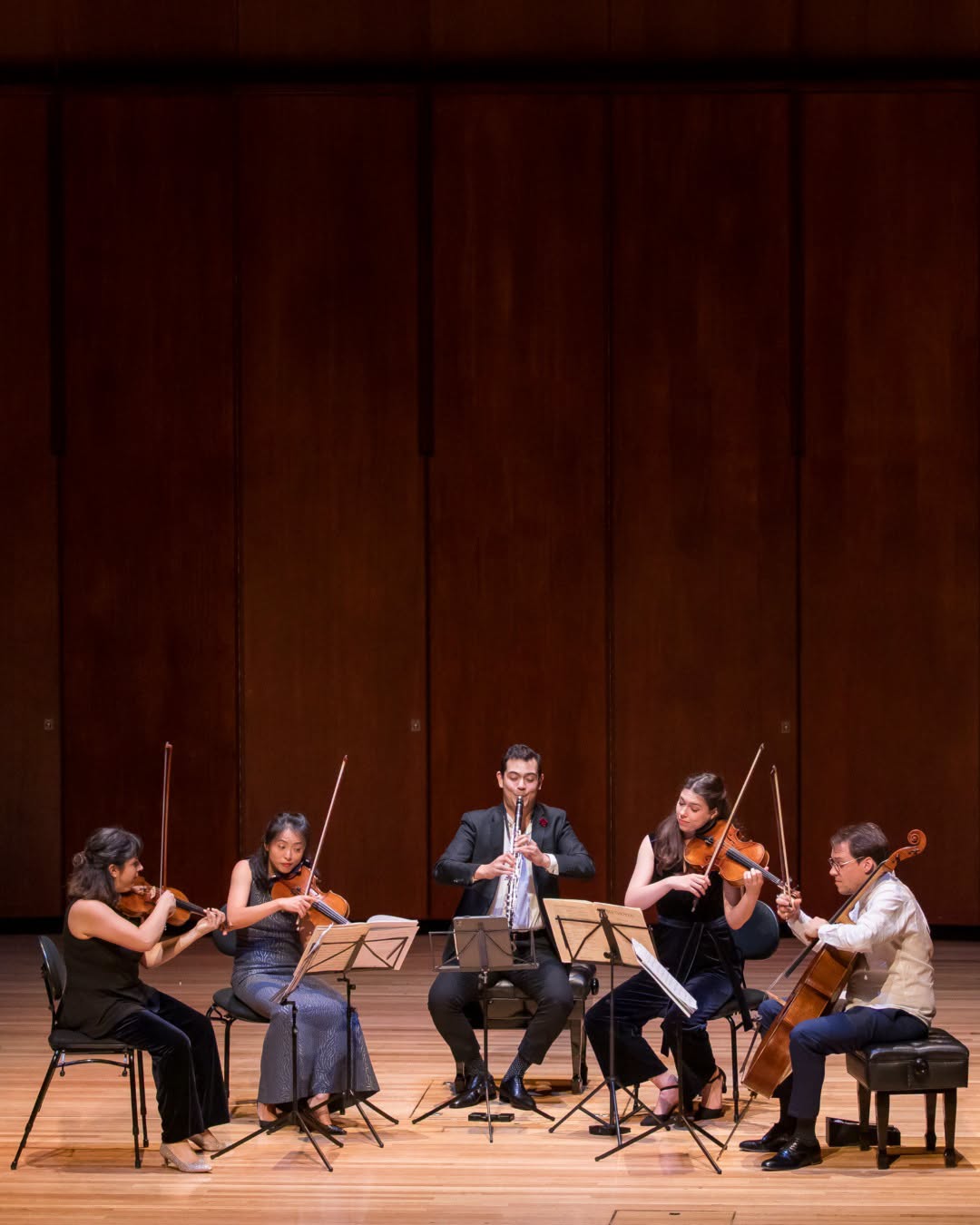
For its 2026 tour, the London-based Doric String Quartet is presenting a rarely-heard work by a very young Benjamin Britten; one of Beethoven’s groundbreaking middle-period Razumovsky quartets; and a very recent quintet scored for the basset clarinet, an eighteenth century clarinet.
Divertimenti are meant to be entertaining, but Britten seems to have taken his Three Divertimenti to the next level and added a comic touch. In music (as in emails) it can be hard to know for sure whether the content is meant to be taken literally or ironically. But Britten left little room for doubt and the Doric String Quartet made the most of it. March started with great gusto, but quickly (and intentionally) disintegrated; the lilting Waltz began elegantly but seemed to get derailed from time to time; and the Burlesque, true to its name, led the players and audience on a merry, somewhat discombobulated succession of exuberant, sometimes riotous moments.
The four members of the Quartet – John Myerscough (founding cellist), Maia Cabez and Ying Xue (violinists) and Emma Wernig (viola) – were joined by Australian clarinettist Lloyd Van’t Hoff to play Alchymia by the British composer, Thomas Adès. Adès is hailed in some quarters as Britten’s successor, so it was appropriate for his Alchymia to follow Britten’s Divertimenti.
“Alchymia” was the medieval science impelled by the desire to turn base metals into gold and, figuratively, to produce mysterious metamorphoses. Chemically speaking, Alchymia is the result of several musical chain reactions.
It’s important to know the genesis of each movement to appreciate the layers of meaning secreted in Adès music. It would be difficult to intuit these deeper layers merely by listening to it, so the program notes and emerging violinist Hannah Tyrrell’s engaging pre-concert talk were extremely helpful.
A Sea-Change quotes Ariel’s song from The Tempest, in which the sprite assures the prince that his father, supposedly drowned, has undergone a sea-change into “something rich and strange”. In The Woods so Wild Adès plays with William Byrd’s sixteenth century keyboard variations on a street song. In Lachrymae, Adès transforms a lute song by the master of melancholy, John Dowland. The final movement, Divisions on a Lute Song: Wedekind’s Round, refers to a lute song from a seedy play about prostitutes and sex crimes by the nineteenth / twentieth century German writer Frank Wedekind. Decades later, Alban Berg appropriated Wedekind’s song for his opera Lulu, where it was played on a barrel-organ; and now Adès has made a further “division” (variation), turning the barrel-organ into a basset clarinet.
The basset clarinet, in Van’t Hoff’s expert hands imbued this work with an unearthly quality. A “normal” clarinet is already mellow, but the basset clarinet, with its extended lower range, was super-mellow. In A Sea-Change, a pure, slow-moving opening phrase evoked a sinking feeling and, with the strings punctuating and floating around the clarinet’s theme, Adès deftly conveyed a watery landscape. The Woods so Wild conveyed – with some galvanising string playing – the fast and flighty energy of small creatures. In the sombre, contemplative Lachrymae and Divisions the quintet’s shared vision and fine ensemble playing were evident in the way that they allowed the music to ebb and flow.
The second half of the program was devoted to Beethoven’s first Razumovsky quartet, written in the composer’s middle period. It opened assuredly with Myerscough’s polished cello solos and, as this well-known music progressed, the Quartet’s superpowers became evident. They excelled at the numerous musical waterfalls (where a theme cascades as it passes from one instrument to another); they exuded tenderness in the slow movement; and their theatrical flair highlighted the many exciting, unpredictable and portentous moments in this complex score.
For an encore, Van’t Hoff returned to the stage with the Quartet to play the slow movement of Mozart’s Clarinet Quintet. It was sublime (an overused word, but the right choice here). Van’t Hoff seemed to have an endless supply of air, leaving Mozart’s melody free to float through the air in a single, spell-binding trail. The Quartet ably matched Van’t Hoff’s performance, bringing out the musical conversation between the soloist and the first violin, and providing a rich but gentle accompaniment.
Photo credit: Alex Jamieson
____________________________________________________
Sue Kaufmann attended “Doric String Quartet & Lloyd Van’t Hoff,” presented by Musica Viva Australia at the Melbourne Recital Centre on June 16, 2026.