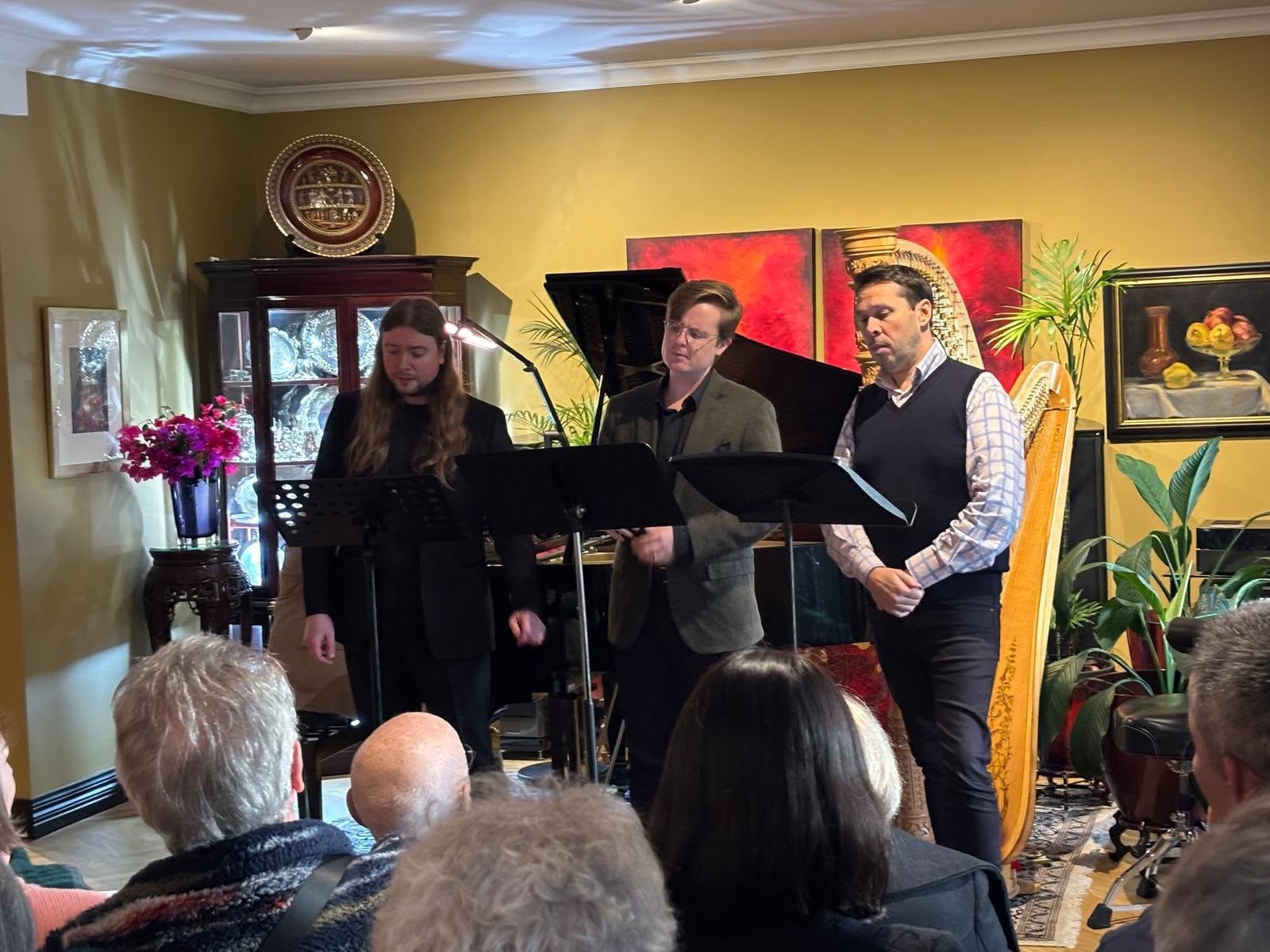
A fundraiser for Lyric Opera’s coming project, Handel’s Serse, this concert featured two of Benjamin Britten’s so-called “mini operas”, his Canticles. With the help of some generous supporters our handful of local independent opera companies work financial miracles to bring high quality productions of new or neglected works or inventive re-imaginings of standard repertoire. Lyric Opera leans more to the new and neglected, their recent production of Song from the Uproar at fortyfivedownstairs and their award-winning productions of The Children’s Bach and Biographica at Theatre Works being two outstanding examples. Serse will undoubtedly prove a vehicle for inspired invention.
The “Songs of Faith and Fever” concert, held in the intimacy of a large living-room space in the home of a committee member, was yet another example of the high standard of performance that Lyric consistently achieves. It dovetailed with “Songs of Devotion and Desire” concert at Church of All Nations in April, which also featured Benjamin Britten’s Canticles alongside the world premiere of the first two Books of the song cycle Sacred Songbook by Kevin March.
In April, three of Britten’s five Canticles were sung by tenor Louis Hurley and Olivia Federow-Yemm, with Canticle II: Abraham and Isaac receiving a performance of enormous musical and emotional impact. On Sunday, we heard Canticles IV and V performed by Hurley alongside baritone David Greco and countertenor Hamish Gould, accompanied by Isaac Mouskovias.
After an enthusiastic introduction by Lyric’s Artistic Director and Conductor, Patrick Burns, we heard Book III of March’s Sacred Songbook. This time, all five songs were sung by Hurley, whose performance was distinguished by a degree of unaffected delivery, beauty of tone and technical assurance such as any composer and poet (Marsh and Kim Yaged in this case) would have been overjoyed to hear.
All songs began quietly, progressing slowly and building in intensity at key phrases or single words. As expressions of transcendence, the songs often assumed a meditative quality, beginning with the slow, spread chords of “I revere you”, which ended on a low single piano note, typical of the sparse nature of the piano accompaniment, played so sensitively by Mouskovias. A pause following “a climactic exhale” in “Forgetfulness”; a flickering piano figure for the “Flickering light” at the core of “Yahrzeit”; the low, slow stately beginning of “I savour my scars” until the final quiet ambiguity of “I feel everything But it’s nothing at all” of “I feel” – all provided a soundscape that reflected the text for this exploration of the sacred and meaning in human experience. The texts were less rooted in nature per se than for the earlier Books, but the quest to express the almost inexpressible permeated the texts,
Canticle V: The Death of Narcissus (1974) was written in memory of William Plomer, a novelist, poet and literary editor who also wrote a series of librettos for Britten. A setting of a poem by T. S. Eliot, it is scored for tenor and harp and was premiered by Britten’s muse Peter Pears and the famous Welsh harpist Osian Ellis. With Megan Reeve on harp, Hurley gave a focused and most musical reading Britten’s musical realisation of a poem laden with fantastical graphic descriptions that end with images of violence inflicted on Saint Sebastian.
Almost as an antidote to the disturbing imagery of Eliot’s poem and Britten’s disquieting music, Vaughan Williams’ “Tired” from his Four Last Songs (1954-1958) followed. Although originally written for mezzo-soprano, three can be sung by baritone, and David Greco’s rich, expressive voice was well suited to convey a text, written by VW’s wife Ursula, urging a lover to “Sleep, and I’ll be still as another sleeper, holding you in my arms.”
It was thanks to rehearsals for Victorian Opera’s imminent production of The Coronation of Poppea that Hurley and Greco were in Melbourne. Together with countertenor Hamish Gould, they formed an excellent trio for Britten’s Canticle IV: The Journey of the Magi (1971). Again with a text by T.S. Eliot, it was scored for countertenor, tenor, baritone and piano – James Bowman, Pears, John Shirley-Quirk and Britten giving the premiere performance. We were most fortunate to have the line-up for Sunday’s concert. The blend of voices was all that could be wished for – distinctive in colouring but merging as one beautifully textured whole where appropriate. With Mouskovias at the keyboard, we heard four outstanding musicians bring Britten’s gripping work to life.
Britten’s arrangement of the British folk song “O Waly, Waly” proved to be a perfect ending to an afternoon of exceptionally gratifying music making.
We now have Lyric’s production of Handel’s Serse to look forward to. Although Patrick Burns appeared to lament the fact that the Melbourne Conservatorium of Music is mounting a production of the same opera (under the name Xerxes), for most Handel lovers, this confluence is more than welcome. Firstly, it is a truth universally acknowledged that you can’t have too much Handel, and, secondly, they will be very different productions with Lyric presenting the full opera with Sally-Anne Russell in the title role. I, for one, can’t wait.
Photo supplied.
____________________________________________________________________________
Heather Leviston reviewed “Songs of Faith and Fever”, presented in Glen Iris on June 14, 2026.