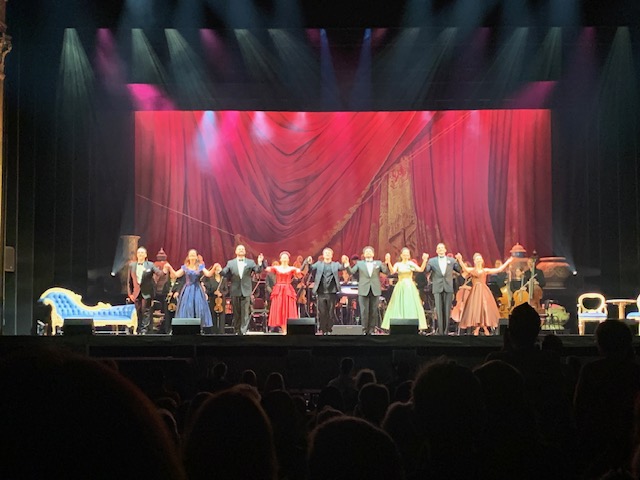
Instead of the “murder and mayhem” of the 70th Anniversary Celebration of Australian Opera, this celebration was offered as an evening of “operatic wit, whimsy and unforgettable song”. Again, we saw Victorian Opera’s Artistic Director, Stuart Maunder, guiding the ship. As one who has “worshipped at the [G&S] shrine” since 1965, when he first saw The Pirates of Penzance, and has subsequently had vast experience in mounting G&S productions, what better person to do so? Those who saw his exhilarating production of that same comic operetta, which launched Victorian Opera’s 2026 season in January, knew we were in for a rollicking good time.
The stars of this Gilbert and Sullivan celebration were also to be found among the Penzance leading pirates, notably baritone Ben Mingay and soprano Antoinette Halloran. They shone among a small elite crew of singers for this “Cook’s Tour” of memorable excerpts from ten operettas, with a show-stopping extra thrown in.
For this celebration, Orchestra Victoria was seated on the stage with some audience members seated cabaret style around tables in the usual “pit” area at the front of the stalls. The stage was tastefully decorated with some giant Mikado-esque porcelain jars arranged in front of a handsome red backcloth with a sumptuous curtain design. What really drew the eye was an enormous theatre organ – a type of Wurlitzer. Conductor Chad Kelly abandoned his rostrum to accompany Halloran for “The Lost Chord”. Although Kelly had introduced it as a crowd favourite and especially when sung by populae British dramatic contralto Dame Clara Butt, Halloran did not attempt to mimic her voice or delivery, opting for her own engaging interpretation. A whizz on the Wurlitzer, Kelly took us through a host of sonic features that has made this instrument such a thrilling part of theatre entertainment.
One operetta that was less successful for the famous collaborators was their penultimate work, Utopia Ltd; however, a redeeming feature must have been the aria sung by Captain Fitzbattleaxe, who “explains that when you are madly in love the voice is inclined to let you down – especially if you’re a tenor.” (Program note). Before each group of excerpts, one of the eight singers spoke about the items, sometimes taking an opportunity to tease. Poor tenors! But John Longmuir actually excelled when managing some very high notes as well as theatrically choking on the required ones.
As the singers work body mics, all of the introductions could be heard clearly and Sound Designer, Shelly Lee, ensured that good balance between singers and orchestra was maintained. It was one of several features that gave this celebration, based on a concept by Patrick Togher, a strong connection with the audience. Alex Lynn’s lighting design did much to enhance the ambiance, being particularly effective during the two Overtures: Iolanthe at the beginning and Yeoman of the Guard immediately after interval.
Having the orchestra seated on stage with a couch at one end and table and chairs at the other would seem to give the singers very little room to move but the stage never looked crowded. Instead, the singers seemed closer and they were all so light on their feet and well-coordinated that all the dancing and movement flowed splendidly. The medley from the six operas that opened the vocal part of the show was seamless in its transitions – a feature of the whole evening in fact. No choreographer was listed as such (presumably it was Maunder), but the precision of the movement was impressive, especially when performed as a tightly drilled unit such as the policemen in Pirates,.
Trumpets heralded the famous patter song “From the Sunny Spanish Shore” – a stirring way to begin the opening The Gondoliers bracket. This was followed by the group “rowing” on for a lively duo with Mingay and baritone Leon Vitogiannis as the gondoliers. It was all very physical and fun – very G&S.
Different kinds of fun came when the singers coloured their voices to suit the characters they were portraying – Ben Mingay (exuberant, larger-than-life and mingling with the audience as he sang at one point), tenor Alexander Lewis (shades of the great Dennis Olsen there) and Halloran being particularly adept.
A more pensive note came with Cathy-Di Zhang’s beautiful singing of “The Moon and I”, Yum Yum’s aria from The Mikado. The pace was leisurely, allowing her to linger and demonstrate just how expressive Sullivan’s music can be. A true operatic soprano, she took the interpretation of this aria to a new level. It was a complete contrast in style to the preceding Mikado trio.
Soprano Danielle Bavli, mezzo-soprano Ruth Strutt and Antoinette Halloran looked anything but “Three Little Maids” as they entered wearing sexy sheath dresses in silky scarlet rather than the glamorous ankle-length evening gowns worn for the other numbers. Lighter of voice than Halloran and Zhang, they blended extremely well, with Bavil’s pure soprano taking the top line. Like the four men, they were accurate, had good diction and moved wonderfully well.
If laughter, cheers and a final standing ovation are any indication, this high quality performance was much appreciated by the large audience. Most of us learned something new about witty librettist Mr. Gilbert and underrated composer Mr. Sullivan, and all of us had a most entertaining time. As the conductor of the splendid Orchestra Victoria put it, we had a “happy” time – made happy by music that was usually happy but sometimes surprisingly touching. Among those who were new to G&S there will have been some converts to this “very model of the best in entertain-e-ment”.
___________________________________________________________________
Heather Leviston reviewed “Gilbert and Sullivan: A Musical Celebration”, presented by Opera Australia at the Regent Theatre on May 22, 2026.