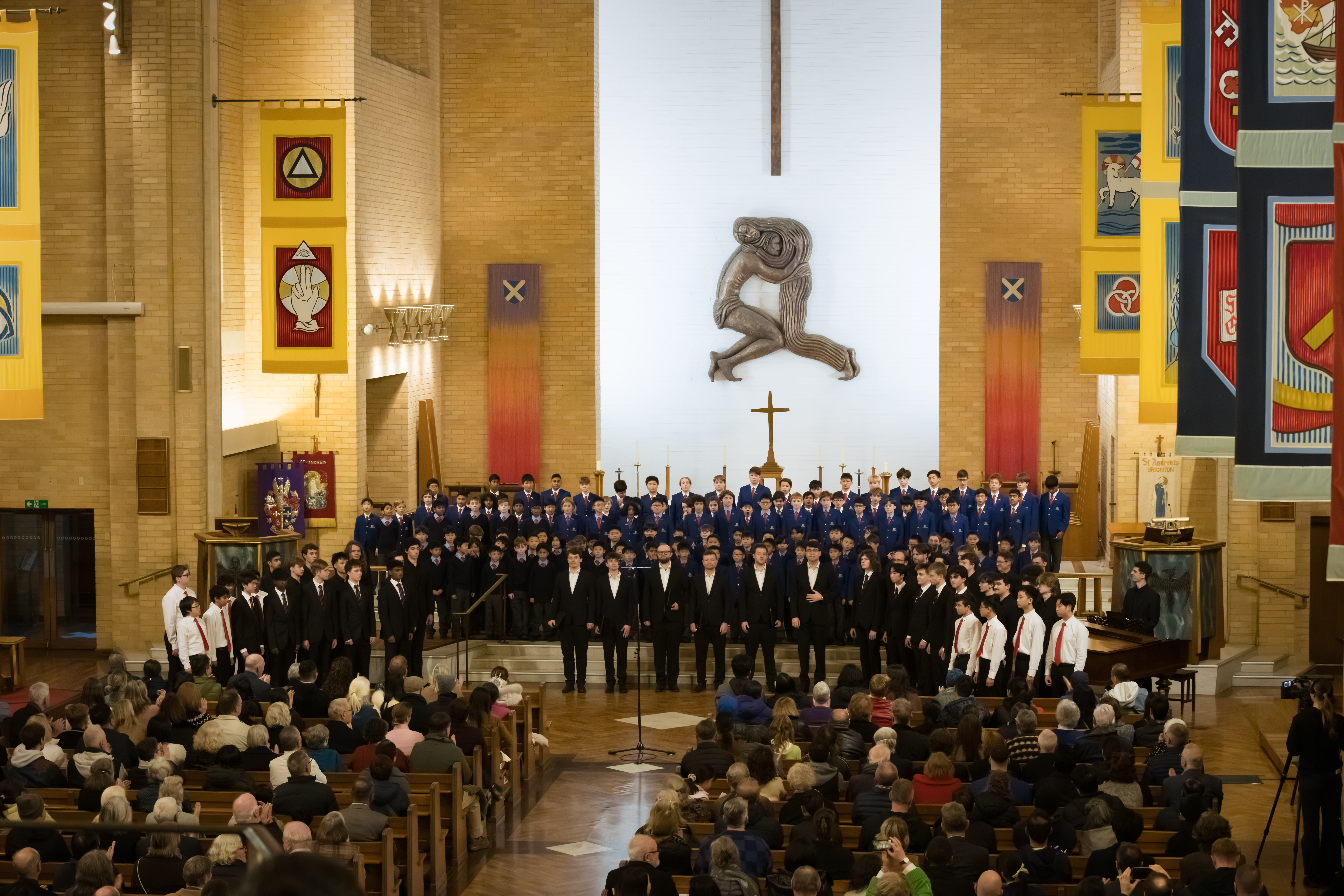
A collaboration between one of Australia’s finest training organisations for young male voices and one of the world’s finest all-male vocal consorts is surely a recipe for success. This concert by all six groups of the Australian Boys Choral Institute (ABCI) alongside visiting English sextet The Gesualdo Six was a parade of highlights, and an educational experience not just for the young ABCI singers but for us all.
The Gesualdo Six, directed by bass Owain Park, had spent the previous day workshopping the concert repertoire with the ABCI singers, both groups relishing the chance to learn from each other about new repertoire and vocal techniques. The results were outstanding: a concert full of joyous outbursts, quiet introspection, and polished musicianship of the highest order. Here was a carefully crafted mix of old and new, of Australian and (mostly) English, of accompanied and a cappella, of the esoteric and down to earth, of the familiar and folky and the most exquisite ‘high’ art.
The massed voices of the younger ABCI ensembles, conducted by Nicholas Dinopoulos and including the training choirs, opened the concert with two Australian works quite different in origin though similar in their bright, uplifting outlook. The rhythmic excitement of Dan Walker’s 2010 ‘Out There’ for treble voices, piano (Timothy Mallis), and drum (Stewart Webb) was a great way to start, sitting wonderfully beside Dulcie Holland’s charming ‘Sailing Time’ written at least thirty years earlier. If the articulation of the large swarm of the very youngest singers at times sounded slightly fuzzy in the vast space of St Andrew’s, this was not a reflection on their training or ability, but rather a projection of their enthusiastic commitment to presenting this exciting music on a big stage.
No such charge of blurring the edges can be laid on The Gesualdo Six, however. Their trademark is precision and crystalline purity. Yet this is not at the expense of deep expressiveness of the text and the musical phrase, nor an absence of emotion as has been levelled at some of their English confreres. No, their performances are, quite simply, perfection; like distilled droplets of the sweetest elixir, curing all ills, even when conveying sadness. Their main bracket of five works, ranging from the apparent simplicity of Purcell’s seventeenth-century funeral motet ‘Thou knowest, Lord, the secrets of our hearts’ to the specially commissioned recent work of Joanna Marsh ‘I Take Thee’, showed not only their versatility and range, but also their exacting tuning, unanimity of attack, and control of tension and release. All in attendance were schooled in technical mastery, artistic interpretation, and connection between words, music, performer, and listener.
Marsh’s sonorous and poignant composition was preceded by Howard Skempton’s ‘And there was war in heaven’, a setting of a text from the Book of Revelation, though it is sinuous and reflective rather than full of fire and brimstone. It was perhaps the most difficult and complex work of the evening, full of writhing, entangled lines that failed to resolve but, because they were so finely and cleanly delivered by the ensemble, we were never in doubt of the composer’s intention. Earlier in the set was Gesualdo’s responsory for Holy Saturday ‘Plange quasi virgo’, a nod to the origins of the group, and a rare chance to hear the most extraordinary harmonic language to come down to us from the early 1600s, performed with exciting and effective changes in dynamic and mood.
But the most masterly work of this half was Sir John Tavener’s ‘Funeral Ikos’, for which the six singers descended from the rear balcony and progressed slowly down the centre aisle. They paused for each verse, alternating between upper- and lower-voice trios in a mesmerising portrayal of an unhurried, serene ritual accompanying a departed soul on its final journey to heaven and peace.
The two choral groups then joined for two folk-song arrangements from North America: the spiritual ‘Keep Your Lamps’ arranged by Timothy Tackach and James Gordon’s ‘Frobisher Bay’, a Canadian song arranged by Diane Loomer. The Gesualdo Six took solo duties in both works, underpinned by the massed ACBI singers. Again, it was a perfect match of talent, the soloists soaring above the finely gradated and intricately woven accompaniment. I had wondered if two such differentiated groups could perform together successfully, but these pieces were so beautifully and fervently presented that any doubts were instantly dispelled.
The second half was of music in a somewhat contrasting style, more secular and playful, though having said that, Sarah Hopkins’ ‘Past Life Melodies’ probably fitted better in the first half. Composed in 1991 and dedicated to her father, the conductor John Hopkins, ‘Past Life Melodies’ is a deeply spiritual work. The melodies in question are inspired partly by Aboriginal chant Hopkins experienced while living in Darwin, and also come from deep within her own soul, as if she were remembering a past life. The choir is essentially wordless, having extended drones that the singers piled up to create a huge, energy-filled, almost deafening wall of sound. The work then subsides into peaceful rest, with only the other-worldly flute-like overtones of harmonic singing, skilfully executed by an unnamed soloist. Having been that soloist myself in a performance of this work in Adelaide in 1994, following workshops with the composer, I am delighted to know that it is still finding new choirs to engage with, and stunning new audiences into awed silence.
Sitting in stark relief, The Gesualdo Six’s second-half bracket gave us a delightful Byrd madrigal, two English folk-song arrangements (one by long-time King’s Singers arranger Gordon Langford), and a 2013 piece by Owain Park himself, ‘Louisa’, a setting of Wordsworth. Equally at home with fast and light as with their earlier slow and sonorous, the group showed off their remarkable facility with almost any style. The odd-work-out was ‘El Grillo’ (The Cricket), first published in 1505 and attributed to Josquin des Prez. I suppose it was of a piece with the Byrd madrigal: it was an entertaining and light-hearted end to their set and another dazzling display of virtuosity, but it’s showiness only served to make me want more of the other stuff. Langford’s ‘The Oak and the Ash’ was a perfect miniature: sweetly tuned and understated in effect.
The concert concluded by returning to its beginning, with all 160 voices on stage, accompanied by Tim Mallis on the piano, for a final Australian work, conducted by Park: Calvin Bowman’s ‘Crossing the Bar’. This was another masterclass in how to sing, how to communicate the text and bring out the most from the composer’s finely crafted music. The entire concert was expertly put together by Dinopoulos to make the best use of all the elements. The visitors put on a superb display of ensemble singing, and the locals gave them back the best of Australia’s commitment to musicianship, training, and excellence. The capacity audience disbursed into the cold night happy to get their hands on the Gesualdo Six’s latest CD; yes, indeed, they are still making them and thy are selling like hot cakes!
Photo credit: Pat Charles
______________________________________________________________________
Peter Campbell reviewed “Crossing the Bar”, presented by The Australian Boys Choir and The Gesualdo Six at St Andrew’s Church, Brighton on June 23, 2026.