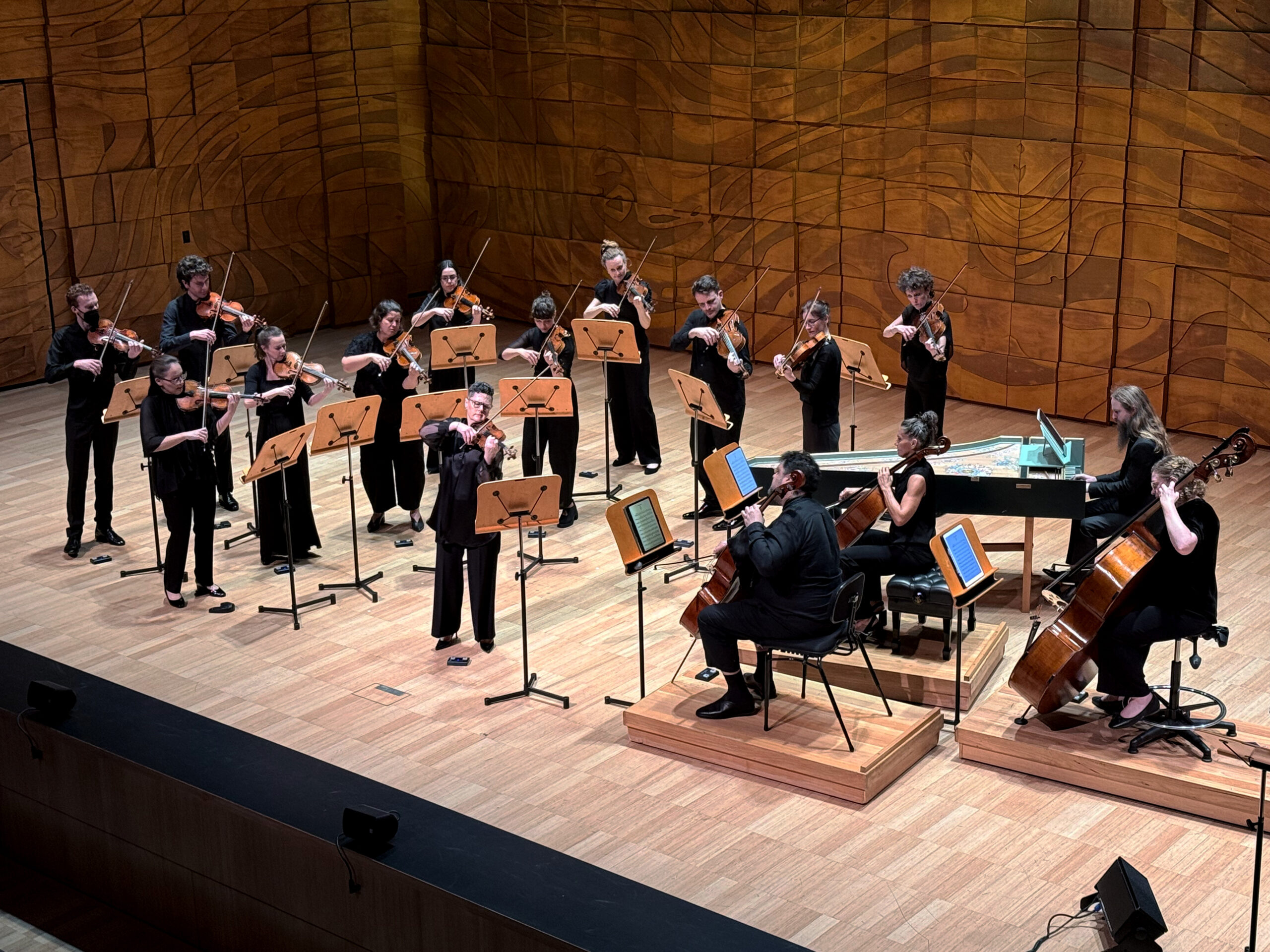
On one hand it seems extraordinary that the Melbourne Chamber Orchestra could schedule more than 70 performances in each season, on the other our high expectations are always fully met by the breadth of musical artistry, fascinating engaging commissions, re-imaginings of meaningful masters, and spine-chilling performances by world class soloists and ensemble performers. At the end of tonight’s concert the audience was on their feet giving long and rousing applause for this compelling program, in appreciation of the remarkable energy of all MCO performers, especially concertmaster, brilliant violinist Sophie Rowell.
Wolf’s Italian Serenade was a brightly dancing seven-minute single-movement piece, which curiously brought a mixture of warmth and daylight to the opening sections, connecting with skipping lines and interesting contrapuntal voices almost over-lapping at exciting cross-purposes. At times, sections of the ensemble wove in and out of the “group” or stepped out in high registers over powerfully toned and independent lyricism from celli and bass, with contrasting sections resolving together harmoniously at the end. A curious work, giving each instrumental section some attention-seeking and stylish moments.
The MCO has the X-factor, growing its young audience with music students and colleagues, developing regional events, demonstrating its own engaging musical personality, with individual soloists highly loved for their musical skill and their personal connection with the audience. Tonight cellist Blair Harris showed great authority as a section leader and an occasional M.C., introducing five selections from Janacek’s cycle of 15 miniatures: On an Overgrown Path. The title comes from a Moravian wedding song where a bride laments the path to her mother’s house that has become overgrown with clover, symbolising loss and nostalgia. Harris’ speech hinted at the “theme’ for this concert, describing Janacek’s use of spoken rhythms felt in Bohemian languages, with folk songs also reflecting the nostalgic melodies, words, dance and scenes from childhood days. Later, Sophie Rowell spoke further of her reflections on how a composer’s work might be illuminated by written and spoken text, with poetry also adding a further dimension to the listener’s experience of the music.
Originally composed for piano, the first of Janacek’s miniatures, No. 1: “Our Evenings”, was a very warm, elegant and introspective piece, with melodic sentences describing remembered evenings by the fireside in the composer’s hometown. In No. 5: “They Chattered Like Swallows”, and No 3: “Come With Us”, contrasting musical “paragraphs” in each piece brought us strong folk song melodies, nostalgic playful explorations of a child seeing new things, small touches of drama and a most thoughtful and tender string ensemble. No 9: “In Tears” was full of beauty and melancholy in tone and texture, a musical story told with just a touch of pain as modal coloured “word” patterns increased in dynamics with earnest repetitions in low strings. Beautifully affective MCO playing continued in the final selection No. 10: “The Barn Owl Has Not Flown Away”. Here, arpeggiated flourishes introduced varied sections of melodic lush string chord sequences. Frequent new phrases brought shades of the movement of a bird to our minds, with restful lyrical themes completing the portrait with an unusual fade out to close in the gentle night.
Highly acclaimed actor and speaker Helen Morse has featured in many collaborations with musical works, and was highly welcomed to the stage to recite the four short poems written by Eleanor Percy (b. 1981), which prefaced selections from Libby Croad’s Portraits for string orchestra – portraits from COVID time. 1. “Landscape” gave us a gorgeous pastoral symphony of sound from MCO in a quasi hymn-like texture with a most sensitive fade-out to close. The minor key of 2. “Heartache” brought us a heavy repeated low two-note pattern, as the bass strings delivered the music of a heavy heart with the poem’s bare words “Grief overflowing – universal loss”. 3. “Hope” built a symphonic texture and forward movement, driven by a lovely folk-song melody on double bass, giving lyricism and affirmation to our souls. In 4. “Mind” colours and ideas increased with rapid repeated patterns running on the spot, creating urgency and strength from a firm interjecting voice from Emma Sullivan’s pizzicato double bass.
Sophie Rowell described Vivaldi’s Four Seasons as “endlessly alive” and “a vivid portrayal of nature in all its contrasts”. Peter de Jager and his splendid harpsichord took centre stage, with Helen Morse returning to read the associated Sonnets, delivering the English translation with clarity and authority.
But this was Rowell’s night, and we were mesmerised with her brilliant and sensitive work as an outstanding soloist, a fantastic leader and inspirational violinist, who brought electricity to each of the four concertos with exhilaration and respect for the natural forces of nature. Cello and harpsichord continuo shared the earthy colours and fresh breezes of Autumn, and Winter was given a shivering strings and a harsh tonality for the final concerto, as if nature’s resonance and purity of tone had been frozen out. An extra long dramatic pause held us in silence following an exciting wind and storm before a closing grand, exhausting acceleration to the close.
The audience summed up their delight in yet another hugely stimulating and satisfying MCO performance with a long-held standing ovation.
Photo credit: Catherine Turner
____________________________________________________
Julie McErlain reviewed Overgrown Paths, performed by the Melbourne Chamber Orchestra at the Melbourne Recital Centre on May 7, 2026.