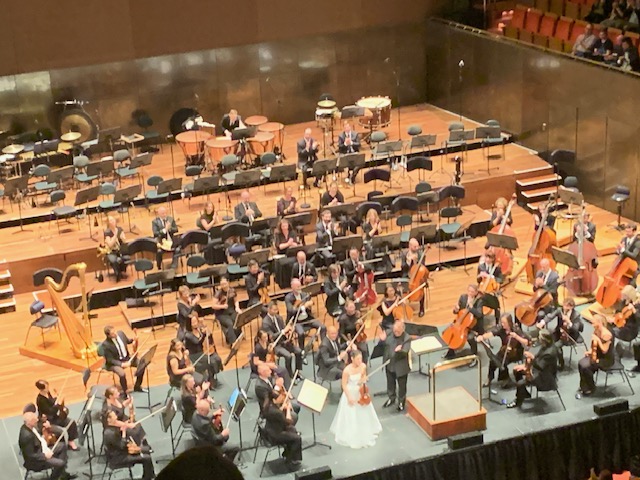
While the concert is named after Richard Strauss’ iconic tone poem, Strauss shared the program with two female musicians currently making their mark: Australian-American composer Melody Eӧtvӧs, and Spanish violinist, Maria Dueñas.
Eӧtvӧs is currently a Senior Lecturer of Music at the University of Melbourne’s Conservatorium of Music, and has already composed more than twenty orchestral works.
The concert opened with the Australian premiere of Eӧtvӧs’ The Deciding Machine, written in 2020 for a festival celebrating one hundred of women’s suffrage in Wyoming, USA. Taking a panoramic view of pioneering women, Eӧtvӧs pays homage to the visionary mathematician Ada Lovelace. Lovelace was ahead of her time. She had collaborated with Babbage on a theoretical model for an analytical engine and had the imagination to see its enormous potential. In 1843 she wrote that it could manipulate symbols other than numbers and compose “elaborate and scientific pieces of music”.
Eӧtvӧs acoustic Deciding Machine speaks to Lovelace’s vision. It begins with a sequence of repeated notes to suggest a code or alien language. The code is then processed as if it is being manipulated mechanically. Eӧtvӧs’ composition does not programmatically tell a story, but the human audience can instantly recognise error codes, system failures, and re-boots in the various tense, discordant moments. The performance was well-received and Eӧtvӧs took a bow.
The second item on the program introduced Maria Dueñas, making her Australian debut with the Melbourne Symphony Orchestra with a performance of Beethoven’s Violin Concerto. Dueñas has emerged as a musical force to be reckoned with since winning the Yehudi Menuhin Competition in 2021 and being awarded Young Artist of the Year for her debut album Beethoven and Beyond in 2023. Dueñas’ interpretation was calm and nuanced; she maintained a clear focus throughout, ensuring the MSO and the audience travelled with her through this long and complex musical journey. The MSO’s sensitive accompaniment provided support while also giving Dueñas the freedom to lean into the filigree solo moments, which included her own cadenzas. She received justifiably warm applause and played Valse Triste, by Franz von Vecsey as an encore.
The second half of the program was devoted to Richard Strauss’ symphonic tone poem, Also Sprach Zarathustra. Strauss selected scenes from Friedrich Nietzsche’s eponymous novel to depict nine stages in humanity’s evolution. Strauss creates a series of contrasting vignettes depicting Zarathustra’s deep longing, joys and passions and convalescence (a physical and mental breakdown) and eventual emergence as a “Superman”. Musically, Strauss creates tension between the natural world and humanity’s striving for knowledge by constantly juxtaposing two clashing tonalities and deflates the Superman by giving him a Viennese waltz as a character note.
It is clear that Maestro Martín and the MSO relish the opportunity to present works by Strauss. Strauss excels at creating a vivid scene with finely honed melodies and deft orchestration, and the orchestra has the depth of talent needed to give life to Strauss’ imaginative score. This was a very satisfying performance.
___________________________________________________________
Sue Kaufmann attended “Also Sprach Zarathustra”, performed by the Melbourne Symphony Orchestra at Arts Centre Melbourne, Hamer Hall, on March 12, 2026.