The idea of an Australia orchestra that unites local musicians with the Aussie diaspora has clearly resonated with musicians and audiences alike.
The 94-strong Australian World Orchestra (AWO) was the brainchild of Artistic Director and maestro Alexander Briger. Since its inception in 2010, the AWO has earned high praise from notable international conductors such as Sir Simon Rattle, who conducted the AWO in 2015.
The members’ profiles make fascinating reading, showing just how thoroughly Australian musicians, young and old(er), have infiltrated the international music scene.
Following on from its highly successful performance of Mahler’s ninth symphony in 2023, Briger has elected to presents Mahler’s fourth and fifth for its 2025 season in Melbourne and Sydney. Though written in consecutive years, these two symphonies are quite different, and rarely performed together. The media release quotes Briger as saying “Mahler’s 4th Symphony, with its ethereal beauty and celestial finale, offers a poignant contrast to the dramatic intensity and profound depth of his 5th Symphony. By performing these two symphonies in one evening, we aim to create an unforgettable experience that celebrates the power of music to transcend boundaries and touch the soul.”
Mahler’s fourth is scored for a small orchestra and has a relatively conventional four-movement structure. Nevertheless, its initial reception was mixed and Mahler subsequently revised it, dubbing it his “persecuted stepchild”.
It opens gently, with a joyous, elegant, typically Viennese melody, which the orchestra delivered with great style.
A highlight of the second movement – a leisurely scherzo and trio built around folksy tunes that might be played by a town band (Ländler) – was the violin solo played by concertmaster, Rebecca Chan. The solo part is scored for a violin tuned one tone higher than normal. Mahler’s inspiration is thought to have been Bocklin’s self-portrait, in which Death, a skeletal violinist, hovers expectantly behind the artist. The altered tuning produces a more vibrant, colourful timbre, creating a striking, somewhat eerie melodic shadow. Chan gave a convincing, evocative performance, using a second violin specially prepared for the solos.
The slow third movement is a double theme and variations, which opens with a sublime, melody exquisitely played by the AWO celli and equally exquisitely taken up throughout the orchestra.
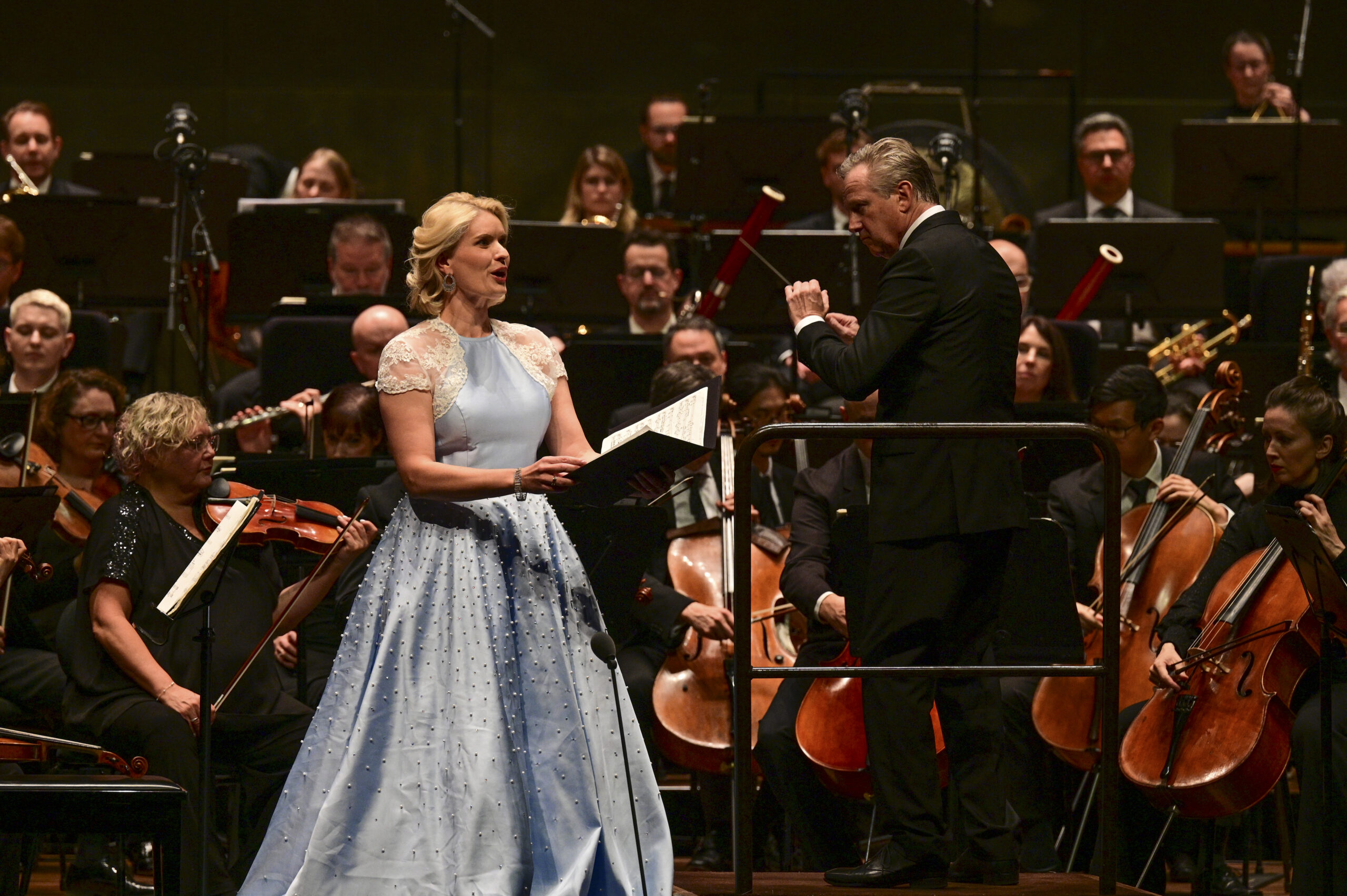
In the final movement, the AWO was joined by German soprano Sarah Traubel, making her Australian debut as the vocal soloist. Traubel made a theatrical entrance as she processed majestically through the orchestra to her place centre-stage.
Mahler envisaged the solo, “Das himmlische Leben” (“Heavenly life”) as a child’s notion of the joys of heavenly life: jumping and dancing to celestial music, rabbits running down the streets, fish swimming joyfully (towards a net), bread baked by angels, free wine, good herbs, a plentiful supply of greens and fruit, and a lamb and ox being led to the slaughter.
Musically, Mahler uses the wind, percussion and harp to colour this bucolic scene. The vocal line is lyrical but not passionate, expressive but not complex. Traubel is emerging as a sought-after concert and operatic artist and this role required an opera singer’s volume and a concert artist’s nuanced musicianship.
After interval, the stage was crowded with seats for the expanded forces required in Mahler 5. Trombones, tuba and two more horns joined the brass section, while the percussion swapped sleigh bells for a whip. The principals also rotated, with Daniel Dodds, Artistic Director and Leader of Festival Strings Lucerne, taking the role of concertmaster.
The symphony opens dramatically with funeral march, heralded by the brass. The orchestra seemed to be in the grip of a powerful, galvanising force throughout this symphony, particularly after the stormy opening to the second movement. Briger highlighted the sudden changes in mood and colour very effectively.
The “Adagietto” has become a musical icon since its use by Visconti in Death in Venice and the AWO’s strings and harp gave it a serene and heart-rending performance. By contrast, the final movement opens simply, innocently, with the wind and brass playing with pastorale sounding themes; however, as the music became more urgent, the AWO’s full power and energy was revealed.
Briger’s decision to perform the two symphonies back to back was vindicated; it highlighted the differences between them in mood and style and revealed the way that Mahler’s writing was developing.
There were numerous stand-out moments in this concert, making it difficult and potentially unfair to single out individual performances. That said, it would be remiss not to mention the violin and horn solos, the extraordinary range of colours evoked by the wind players, the brilliant brass, the sensitive string playing in the “Adagietto”, the flawless percussion, the celli, the power of the basses (particularly in the manic moments of the fifth symphony) – and last but not least, Alexander Briger’s insightful approach to both these works.
What makes this orchestra distinctive – and distinctively Australian? There is definitely something about the AWO’s playing that marks it out.
It is an amazing assembly of hugely skilled individuals, but it’s more than that. The fact that they have come from far and wide, drawn together by a sense of their shared musical roots in Australia, for a singular event seems to add zest and intensity to their playing.
The strength of their esprit de corps, their commitment to the music, the extreme pleasure they take in making their collective performance the best it could possibly be, is infectious.
The audience in Hamer Hall gave the AWO a rousing reception, making it hard for the Briger and the orchestra to leave the stage.
Photo credit: Heidi Victoria
__________________________________________________________
Sue Kaufmann attended The Australian World Orchestra’s performance of “Mahler 4 and 5” given at Hamer Hall, Melbourne on September 3, 2025.