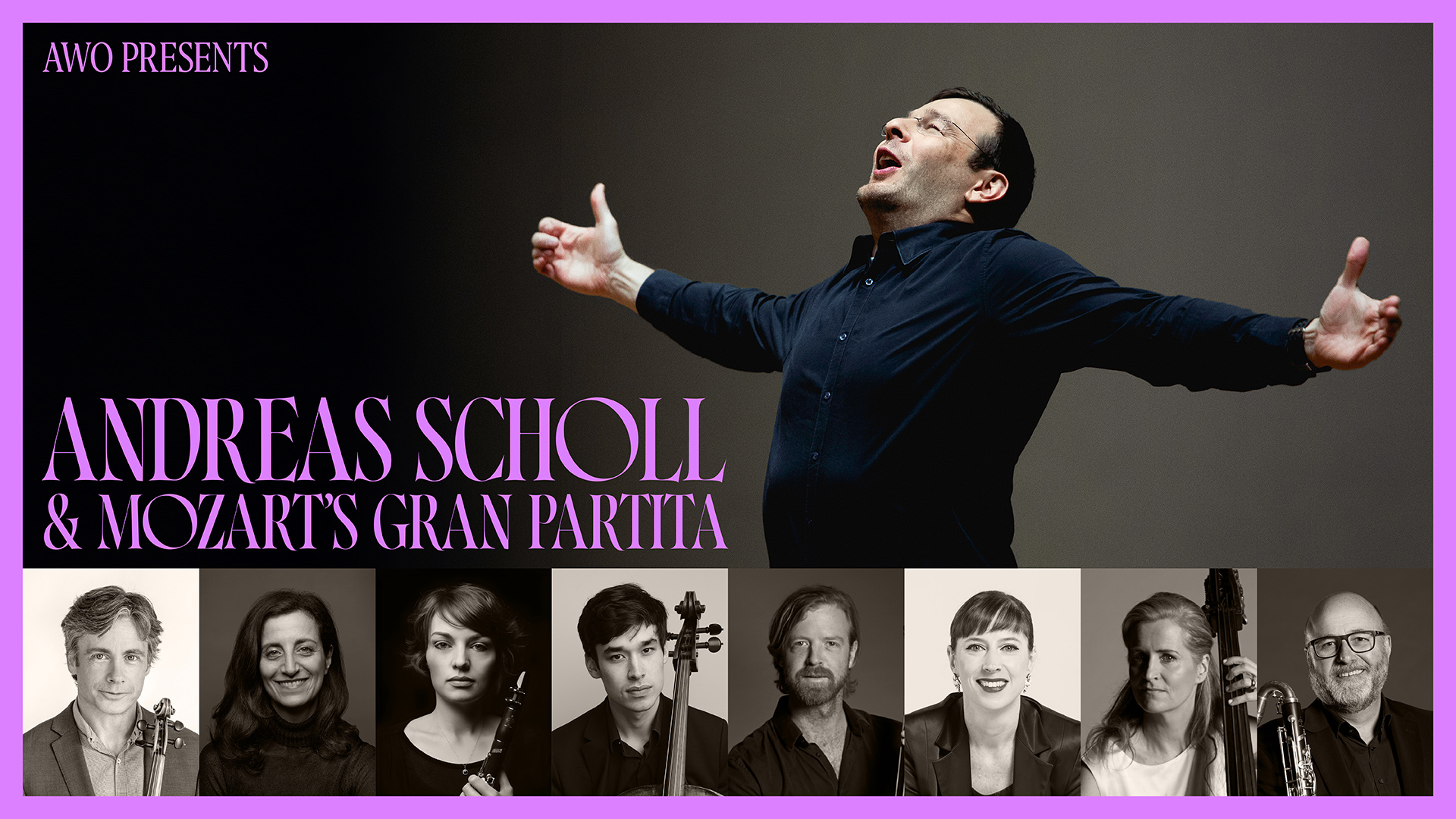
Established in 2011, The Australian World Orchestra (AWO) has since become a staple of the national touring calendar. Featuring Australian musicians from leading national and international orchestras and ensembles, it also provides a welcome annual opportunity for many of the leading figures of Australia’s musical diaspora to catch up with each other.
Next year sees the orchestra present two Mahler symphonies under the baton of their founder and artistic director, Alexander Briger. Perhaps in preparation, this year’s program was comparatively modest: a party of 28 musicians giving three concerts of chamber works in small venues, The Neilson at Pier 2/3 in Sydney, and the Hanson Dyer Hall at the University of Melbourne’s Southbank campus. As has usually been the case since the orchestra’s foundation, however, these performances were still anchored around a collaboration with a major international artist – in this case the German countertenor, Andreas Scholl.
Scholl is no stranger to Australian audiences; he has toured for Musica Viva Australia on several occasions and has also recorded with the Australian Brandenburg Orchestra – some may also remember his remarkable performance with them as part of their 2001 Proms season at the Royal Albert Hall.
As it happens, the AWO’s Melbourne concert coincided with the Australian Brandenburg Orchestra’s own tour to the city, indeed they were performing at the same time next door at the Melbourne Recital Centre and playing repertoire more commonly performed by an ensemble like the AWO: Mozart’s Piano Concerto No. 23 in A, K 488 and his Symphony No. 41 in C, Jupiter, K 551. The AWO’s program, on the other hand, included a substantial amount of early music. Such forays into repertoire outside an ensemble’s norm are no bad thing, the clash of scheduling, however, seemed less ideal.
The AWO’s opening work was Johann Sebastian Bach’s cantata Vergnügte Ruh, beliebte Seelenlust BWV 170. Written in 1726, it sets liturgical poetry by Johann Ludwig Christian Lehms that contrasts the expected contentment the soul might find in heaven (the “Vergnügte Ruh” of the opening aria no less) with the horrors of earthly existence. This contrast of perspective and associated affect is brilliantly expressed by the composer across the cantata’s three brilliant arias and interspersed dramatic recitatives. The performance itself, however, was less successful. Whether it was the comparatively dry acoustics of the hall (relative to a church), or the occasionally over-dominating orchestral texture (an ever-present risk with modern instruments), or perhaps Scholl’s voice not having quite the flexibility and power it once had (especially in its middle register), this was not always a comfortably balanced performance. Nevertheless, the underlying beauty of Scholl’s voice was evident enough, and the orchestra was stylishly led by concertmaster Madeleine Easton. Obbligato solos from Emma Black (oboe d’amore) and Nathan Cox (organ) were especially fine.
Their performance of the following work, Vivaldi’s stunning motet Filiae maestae Jerusalem RV 638 (originally composed as an introduction to a Holy Week setting of the Miserere), was much more successful, however. Here the balance between continuo and vocalist in particular was close to ideal. Similarly, the final work of the first half, Arvo Pärt’s Wallfahrtslied (Pilgrim’s Song) was also beautifully balanced. Originally composed for a tenor or baritone soloist, Scholl made a convincing case for it being also ideally suited to the tessitura and colour of a countertenor. The contrast between his ethereal, largely static, vocal part, and the chromatic weaving of the strings was nothing short of spellbinding. As an encore, Scholl and ensemble gave a polished performance of the Agnus Dei from Bach’s Mass in B minor.
After interval, a new set of AWO instrumentalists appeared on stage to perform Wolfgang Amadeus Mozart’s Serenade No. 10, K.361 (nicknamed “Gran Partita”). Best known, no doubt, from the cameo appearance of excerpts from two of its movements that appears in Milos Foreman’s 1984 film version of Peter Shaffer’s play Amadeus, it is indeed a grand work. Together, its seven movements last for much longer than most orchestral symphonies would have done at the time.
Here, the “luxury casting” that AWO proffers delivered in spades. Superb, characterful anchoring of the ensemble from Matthew McDonald (bass) and stunning solos from Shefali Pryor (oboe) and Frank Celata (clarinet), who were themselves first among equals, made this a thoroughly enjoyable performance of an unquestionably great work of art.
Two other aspects of this concert deserve comment. One is the sky-high ticket prices: the cheapest available ticket was $171 the most expensive $420. I can only imagine how difficult the financing of this particular venture must have been, but we are also far from living in a culture where classical music concerts can normally be priced similar to, say, one by Taylor Swift and still expect to remain accessible. On this evening, the Hanson Dyer Hall itself also did not perform well. An apparent issue with the sealing of a window generated air-conditioning noises that forced a pause and restart during the Vivaldi motet. Both are matters, I suspect, that will require further attention.
Image supplied.
______________________________________________________________________________________
Peter Tregear reviewed “Andreas Scholl and Mozart’s ‘Gran Partita’”, presented by The Australian World Orchestra at the Hanson Dyer Hall, University of Melbourne on October 26, 2024.