The launch of the James Webb telescope into outer space in 2021 has brought us previously unimagined vision and revolutionized the theories and history of our universe, as it details images and spectra from objects as close as Mars to as distant as 13.5 billion light-years. In the words of Melbourne composer Stuart Greenbaum, “A light-year is not a span of time, it’s a distance: 5.88 trillion miles. A distance so vast it is hard to imagine”.
Our need to understand the physical and philosophical journey of the human condition through time confronts and inspires all artists. Modern day cosmologists and composers like Greenbaum are increasingly inspired by the vast expanse of the universe, sharing unique responses with their personal meaning of that journey. Greenbaum’s musical language is indeed representative of the new Millenium: contemporary, contemplative, compelling. Always beautiful.
His ongoing grand Millenium Project, known as The Sonata Project, has resulted in 26 major works to date, each typically of “classical sonata length” of 20-25 minutes across each instrument from wind, brass, percussion and string families. This latest recording is a perfect sequel to Greenbaum’s 2021 recording, A Trillion Miles of Darkness, available on CD (Lyrebird Productions) and digitally on ABC Classics, featuring his stunningly beautiful Sonata for Clarinet (David Griffiths) and Piano (Tim Young).
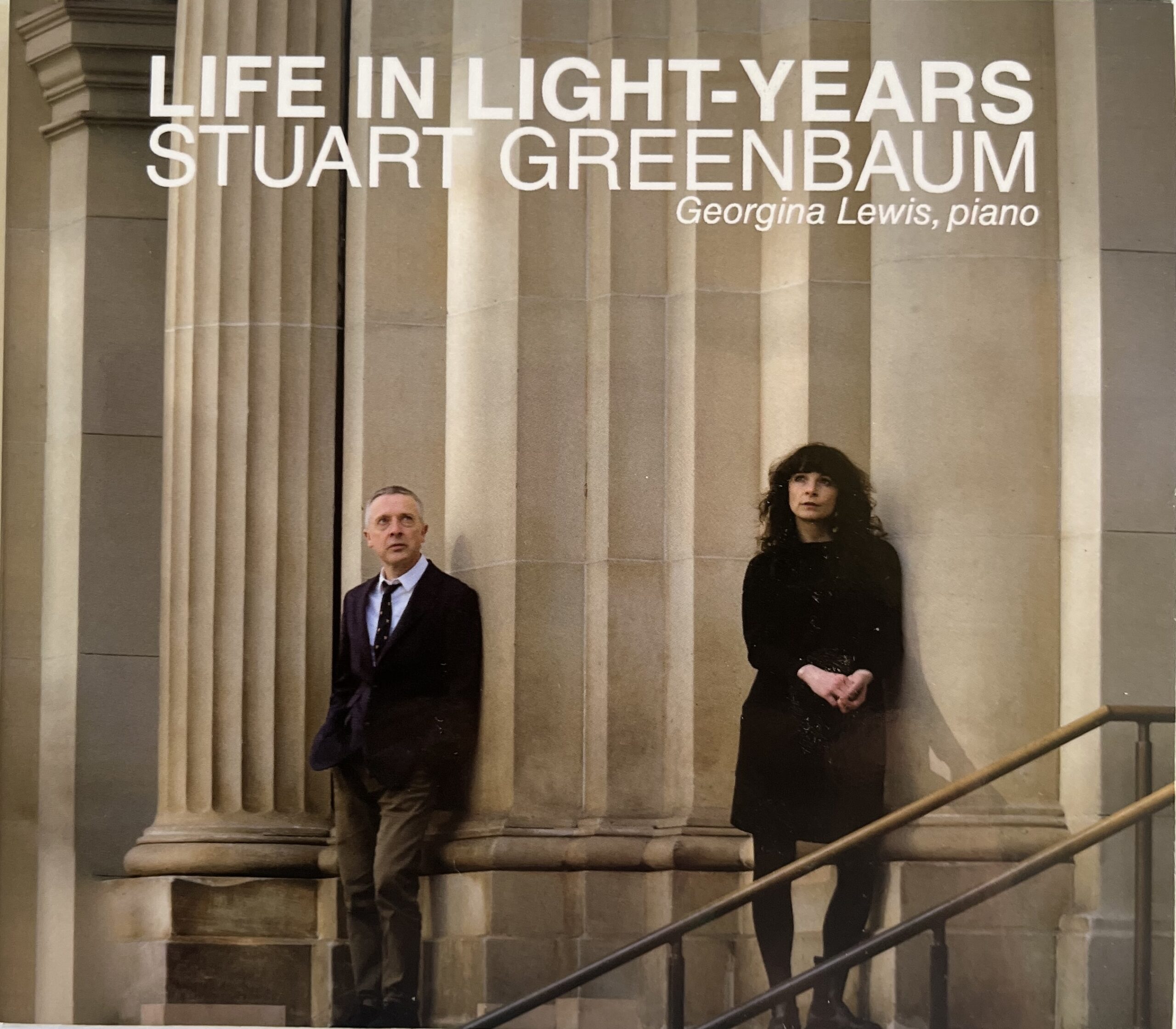
Greenbaum wrote Piano Sonata No. 3 Life In Light-Years for pianist Georgina Lewis, who premiered this uniquely designed sonata in the Peninsula Summer Music Festival on January 5, 2025. While I was present at this well-received and finely delivered performance in St John’s Church Flinders on a summer afternoon, that earthly aural experience of this work can be made more personal and extra-terrestrial today with a wonderful new recording – available on Salisbury Records (CD). Lewis has given a refined, sensitive and sophisticated performance, illuminated beautifully on the wondrous tone of a Steinway D grand piano, the result being another stellar Greenbaum recording that will “stop you in your tracks” to replay each track of this lustrous work at will.
In a new framework for space and time, this epic work of 70 minutes is described as being in six Parts, each part comprising a varied number of episodes, some recurring, some like the opening Part 1 No. 1, the emergence of life, clearly a successfully complete movement of five minutes, ideal for standalone performance. It opens with high flashes of light illuminating space with distant low dark chords, with developing textures and repeated high circling lights inspiring thoughts of deep space.
No. 2, the wind sweeps through, follows with a short thematic episode that recurs meaningfully at the end of each ensuing Part. In Part 2 No. 4, the world opens up, and in No, 13, the working day, more jaunty, modern rhythms are heard with varied settings of insistent short melodies and gently driving rhythms, surging fortissimo chords and muted piano string tones, coloured by creative pedalling. No. 15, the wind sweeps through, closes the Part, never disturbing the sense of infinity and wonder of this fascinating sonic journey.
With 30 “sections”, each given a poetic title, the journey is well-signposted with ideas. Symmetrical phrases and increasingly expansive and circling movements in the music offer almost minimalist simplicity at times as visions and questions always remain. Familiarity comes with the nicely placed repetitions of irradiant melodic phrases, warm harmony, colourful driving ostinato rhythms looking to the future with directness and human assurance. No. 10, hanging in/holding on, introduces a sparkling single note ostinato melody, whose shape moves through different pitches in loosely 5-timed pulse groups. This very spacey, optimistic theme becomes familiar through the Sonata, softer, slower, and more thoughtful as it becomes more distanced in No. 11, the weight of life.
Steady driving pulses take us through No. 23, distance, to the repeated ballad-like movement of No. 24, acceptance. With a minimalist upper melody given repetition and subtle variation, this musical vision of space is calming, as one note disappears and others appear in airless gravity, drawing on the lowest notes of the piano as the circles expand, and fade, in time and space. In No. 25, waiting for the days to lengthen, and the reprise of the themes of the weight of life in No. 26, Lewis’ performance furthers our emotive and thoughtful experience as the spatial dimensions of life in light-years grow in forthright chords and orchestral colour. At just under five minutes, here is another fine “standalone movement” for solo performance.
Beyond our own galaxy we know there is much darkness and space, felt in the tones of single notes floating in No. 28, empty universe. Previously heard melodic themes and familiar chordal passages are comforting in No. 29, homecoming, with the final part, No. 30, life flashing before one’s eyes, giving both a sense of urgency, optimism and a reflection on the joys and endurance of the world as we know it.
In an exciting close to the Sonata, the piano’s full tonal range is used, suggesting the brave new worlds yet to be found, and a taste of hopefully more new heavenly sonatas to come from the beautiful recordings of this most prolific Melbourne composer.
Image supplied.
________________________________________________
Julie McErlain reviewed the CD “Life in Light-Years”, Piano Sonata No. 3 by composer Stuart Greenbaum, performed by pianist Georgina Lewis.