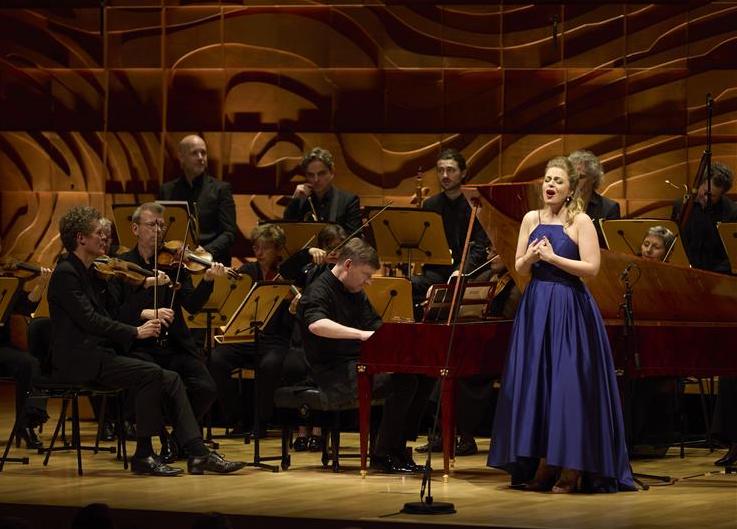
For the second Melbourne Recital Centre Signature Event, the presence of Siobhan Stagg with the Freiburg Baroque Orchestra and fortepiano virtuoso Kristian Bezuidenhout added to the glamour and excitement that had begun the previous evening.
For some, it might seem a little strange that a chamber orchestra with Baroque in its title should have chosen programs featuring the music of Mozart (1756-1791), but the appeal of the program and the excellence of the playing on period instruments was a most welcome opportunity to hear Mozart’s music afresh. The orchestra’s acclaimed Beethoven program at the MRC in March 2020 had already demonstrated just how powerful and rewarding such thoughtfully conceived and artistically executed interpretations can be.
After a lively, graceful account of Mozart’s Overture to La finta giardiniera, with its changes of mood and affect from delicate to robust, cheers greeted the appearance of our own super star soprano as she strode onto the stage in a burst of energy, the skirt of her midnight blue gown swirling, for the first of the evening’s four concert arias with Bezuidenhout joining her at the fortepiano. Four arias: Chi sà, chi sà, qual sia, Vado, ma dove? Ch’io mi scordi di te and Bella mia fiamma might seem a small number, but they are reasonably substantial works, especially the last one, which is ten minutes long and was the only programmed vocal work after interval. As she pointed out, in the first aria the emphasis is on coloratura and on legato in the second. And she commanded both. Bassoon and clarinet made outstanding contributions to these arias and the third was prefaced by a delicate introduction on the fortepiano. One of the most notable aspects of this longer aria was the way time was taken. Although fiery at times it was unhurried, with room for contemplation as the aria unfolded.
Apart from, basically, a list of titles, the printed program gave no information about any of the works being performed; however, if any singer could convey the basic sentiments of an aria, then Siobhan Stagg could. She is a gifted communicator, speaking to the audience in a friendly, enthusiastic way and using her dramatic skills to embody the essence of the narrative without exaggeration. Composed and focussed, her ability to immerse herself in the spirit of the music has been a notable strength of her work over the many years we Melbournians have seen her perform. Doubtless her vocal and dramatic skills have developed during her extensive international career, but her greatest strengths simply seem innate. The beauty of her voice, with its simply ravishing soft notes, plus agility, ease, outstanding breath control and steady evenness of production possess the qualities of the finest instrument.
In the first concert Bezuidenhout had played Mozart’s Piano Concerto No.9 in E-flat K.271 – the one with the addictive theme from the television series of Pride and Prejudice – and it was a joy from start to finish. The work chosen for this concert was Mozart’s possibly even more popular Piano Concerto No.23 in A K.488. As a keyboard virtuoso himself, Mozart ensures that the solo instrument can be heard without competing unduly with a full orchestra, or even any orchestra at times, as at the beginning of this concerto, thus enabling Bezuidenhout’s considered interpretation to be fully appreciated. The intricately nuanced precision of his touch and use of the fortepiano’s knee pedals to sustain the sound were astonishing. Even in passages where he played with the orchestra, the general texture benefitted from the fortepiano’s singular tonal qualities.
On the first night, I had the privilege of a seat near the middle of the front row and was only several rows further back for the second concert. Those who were further away might have found it more difficult to hear some of the subtleties but the clarity of Bezuidenhout’s articulation and the resonant acoustic of the Elisabeth Murdoch Hall made it possible to enjoy what this exceptional musician created. Distance from the stage also enabled a stronger sense of blended sound from the first violins as a section; having the leader often playing to the orchestra rather than to the audience, with an exceptionally strong violinist seated behind him, did not always produce the best outcome in terms of blended sound – unlike the rest of the orchestra, which was superb.
Two Mozart symphonies were played over these two performances: Symphony No.40 in G minor, then Symphony No.29 in A K.201, the latter being played after interval. Scored for strings and two horns and two oboes it was another opportunity to wonder at the beauty of both brass and wind instruments. How could those horns provide such a warm cushion of golden sound with hardly a blemish over both nights, whether playing softly or lending an assertive voice to the more jubilant passages? The special timbre of the oboes – not to mention the superb solo flute and the clarinets in the piano concerto along with the bassoons in other works – made this popular symphony a special experience. From the initial rising tiptoe notes of expectation and the graceful principal theme of the first movement to the final Allegro con spirito of the fourth movement, this was a performance the players appeared to enjoy as much as the audience, revelling in Mozart’s musical inventions.
Mozart loved the soprano voice, and the chosen arias could have been written expressly for Siobhan Stagg. Following the thunderous applause that greeted the conclusion of a wonderfully tempestuous Bella mia fiamma, with Stagg making a fiery entrance as the orchestra played, Stagg asked the audience whether they would like to hear an encore. An emphatic “Yes!” was rewarded with the charming “Dans un bois solitaire et sombre” (In a dark and solitary wood), Bezuidenhout providing the most delightful filigreed accompaniment. Tasteful ornamentation was a feature of the musical expressiveness of both artists throughout the evening.
We can only hope that this justly renowned orchestra and Kristian Bezuidenhout will once again weave their special brand of magic in the Elisabeth Murdoch Hall in 2030 – preferably with Siobhan Stagg.
Photo credit: Laura Manariti
_______________________________________________________________________________________
Heather Leviston reviewed “Freiburg Baroque Orchestra with Siobhan Stagg”, presented at the Melbourne Recital Centre on March 26, 2025.