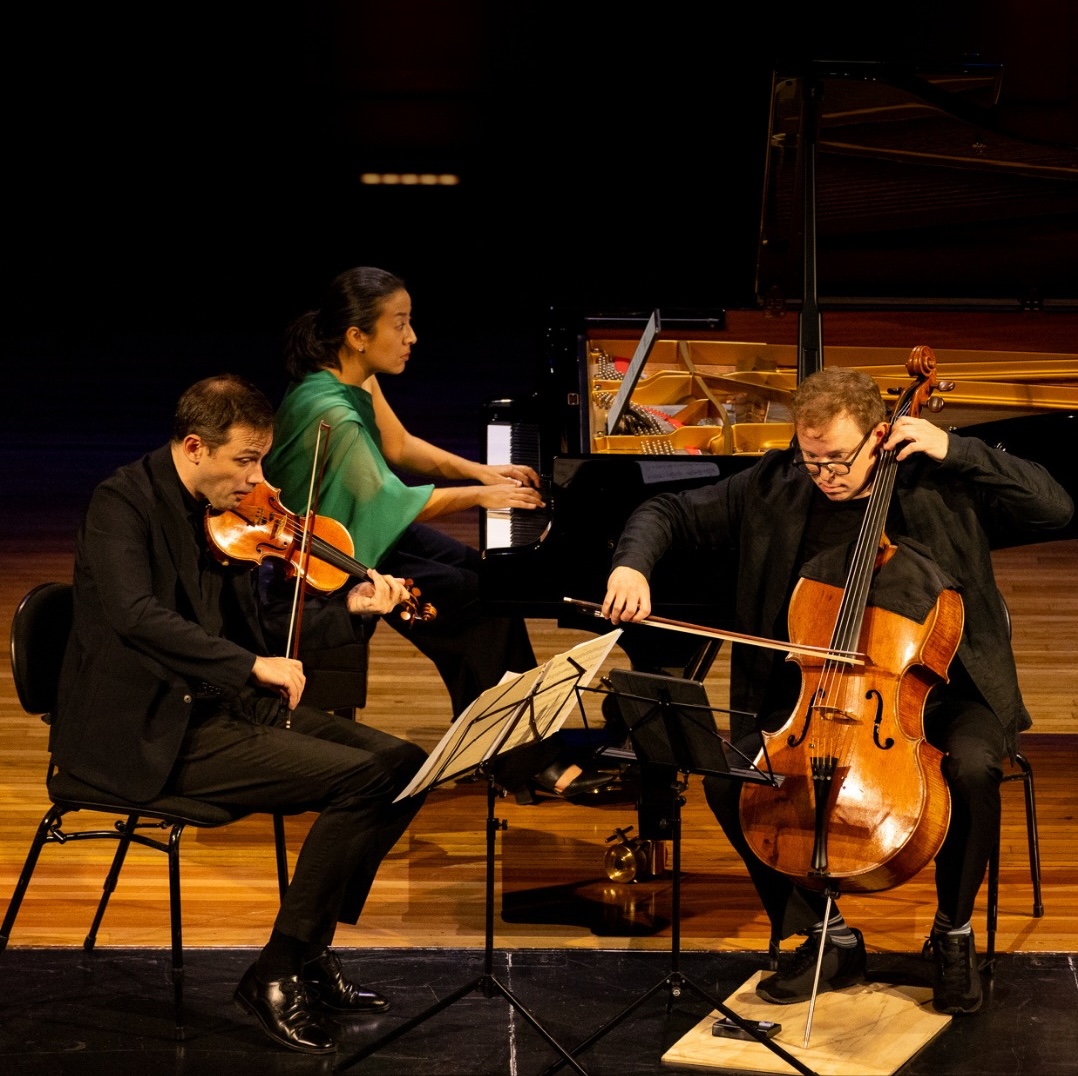
“Beethoven’s Ghost” is the first collaboration between Aura Go (piano), Timo-Veikko Valve (cello) and Kristian Winther (violin) as a trio. The program takes its name from the opening item, a middle-period trio by Beethoven (op. 71 no. 1), dubbed “Ghost” by Beethoven’s star pupil, Carl Czerny, for whom the eerie opening to the slow movement evoked the ghost of Hamlet’s father.
The pace and dynamism of the opening bars set this performance apart. This interpretation highlighted the latent energy and drama in the first movement, with sudden pauses, explosive force at the climaxes, and equally extreme restraint in the more subdued passages. In the second movement, this Trio opted for a tempo that supported a flowing rendition of the long, winding theme that “haunts” the music; and in the third movement, they created a veritable whirlwind of sound as they sped towards the spectacular finishing bars. It was an electrifying performance that communicated a strong, unified vision of Beethoven’s score.
A highlight of the national “Ghost” tour is the world premiere of Regnare by Melody Eӧtvӧs. Eӧtvӧs introduced her work explaining that it was inspired by – and in a sense, it profiles – the mountain ash (Eucalyptus regnans). The mountain ash, native to Victoria and Tasmania, is the tallest flowing plant in the world. It requires fire to regenerate and maintains what Eӧtvӧs describes as a “natural sovereignty” over its immediate environment. Contemplating the tree’s resilience and longevity, the composer had an epiphany: “rulership” can be founded on endurance rather than domination.
Musically, this finds expression in long phrases, sustained by the strings over (sometimes against) a pulsing, rhythmic piano part. Eӧtvӧs’ writing was well adapted to the three instruments; there were many beautifully textured moments, with the three instruments finely balanced, and the music evolved in a way that felt both exciting and controlled.
If the name Boulanger rings a bell, it’s probably on account of the recordings made of Nadia Boulanger’s works, rather than the compositions left by her younger sister, Lili. But Lili’s short life (she was just 24 when she died in 1918), was remarkably productive; she was the first female composer to win the prestigious the Grand Prix de Rome, and she left more than twenty completed works.
Lili Boulanger’s one-movement trio, D’un soir triste (Of a sad evening), completed shortly before her death sounds a little like Debussy or Faure. Translucent piano chords set the scene for a long cello melody, replicated later on the violin. At first, the mood seemed ambiguous, but soon it started to ebb and flow as if the composer was playing out a struggle against a sadness that threatened to overpower the sought-after equilibrium. Boulanger plays with unison writing, with the three instruments constantly passing the themes between each other. The performers’ close ensemble playing ensured that the musical interest and pulse was sustained throughout.
The ensemble’s exquisite performance of Lili Boulanger’s trio turned out to be a foretaste of the finale: an inspired performance of Maurice Ravel’s piano trio, now one of the canon of the repertoire.
Aura Go’s ability to find unsuspected colours in the piano is one of her many superpowers, and the way she played the opening chords indicated we were in for a treat. Kristian Winther and Timo-Veikko Valve (Tipi) achieved the same extraordinary range of colours and, with beautifully synchronised bowing, ensured that every nuance in Ravel’s detailed score was honoured. There were many sonic highlights: the exhilarating passages in the second movement, the sonorities they found in the Passacaille and the slow-burning climaxes they built throughout.
It was a technically brilliant performance, but it was far more than that; the three musicians had evidently internalised the music individually and collectively, so they had the freedom in performance to let Ravel’s imaginative music reveal itself organically.
Fingers crossed that this collaboration continues. There’s a chemistry between them that makes for a truly creative musical experience.
Photo credit: Peter Stoop
______________________________________________________
Sue Kaufmann attended “Beethoven’s Ghost”, presented by Msuica Viva Australia at the Melbourne Recital Centre on May 12, 2026.