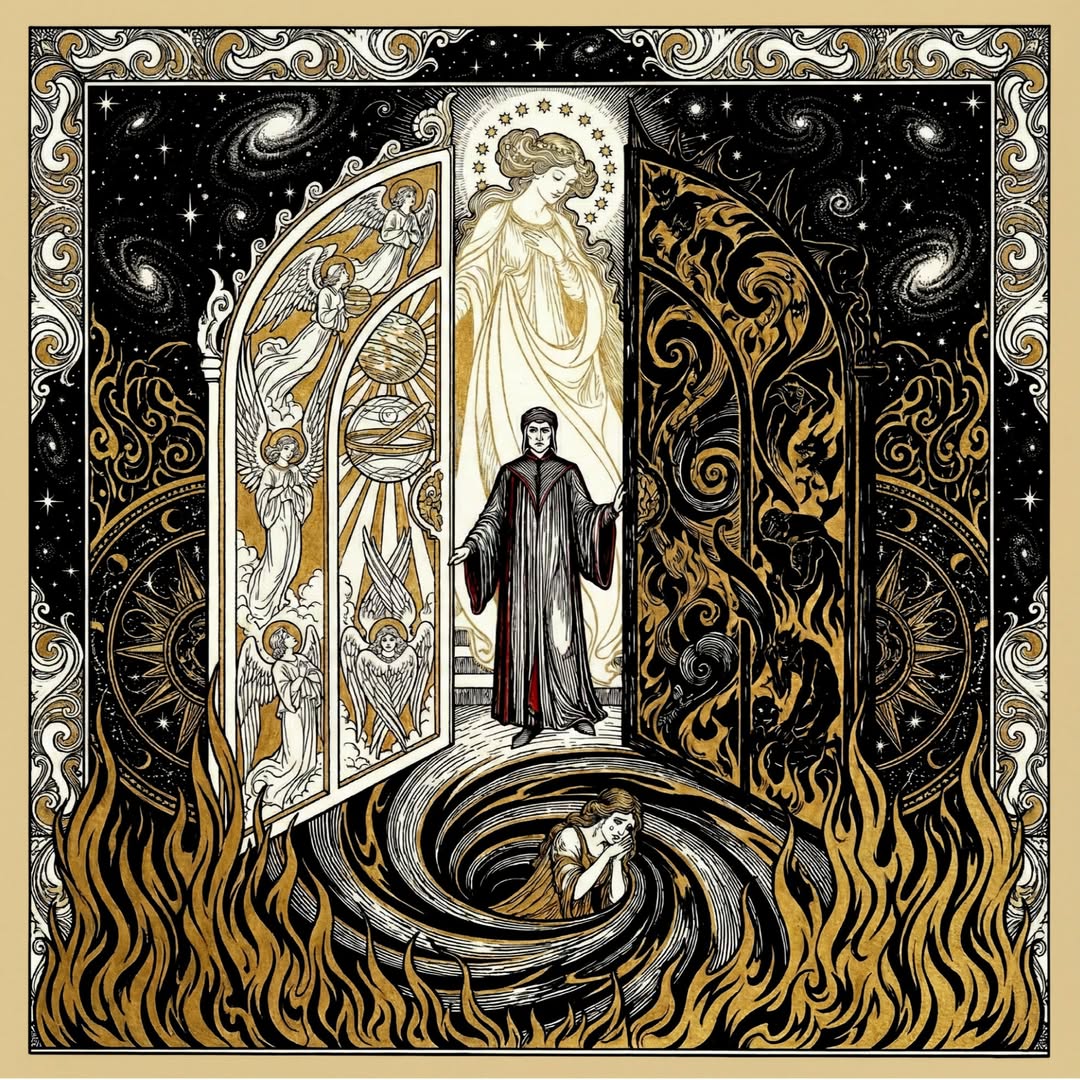
One of the joys of a live performance is the opportunity to see familiar works in unfamiliar company, making hitherto unrecognised connections between works created centuries apart.
“Dante & Beatrice: Lovers and Visionaries” was one of these events, with Dante’s thirteenth century epic, The Divine Comedy, sowing the seeds for a nineteenth century piano sonata and two contemporary Australian vocal works, both commissioned by Melbourne-based philanthropists.
Franz Liszt’s conception of Dante’s world came via the French poet, Victor Hugo. Après une lecture du Dante: Fantasia quasi sonata in the second volume of Liszt’s Années de pèlerinage (Years of Pilgrimage) was inspired by Hugo’s poem Après une lecture du Dante (After Reading Dante).
Hugo’s poem opens with the notion that when Dante paints Hell, he is painting his life; but the poem ends on a positive note: although Dante has painted the path through life accurately, all is not lost, because Dante has placed Virgil (calm and brilliant) on his right, encouraging us to continue.
Imagining the arresting opening theme as the first steps into Hell certainly helps explain the intensity unleashed in the first part of the work. Melbourne Conservatorium of Music student Ben Fu showed considerable mental and physical fortitude. He conveyed the horrors of Hell (fiendishly difficult passages with huge crashing chords) with great conviction, making effective use of Liszt’s pauses to reset the mood and savour the heavenly moments.
The second item was the world premiere of Dante and Beatrice, a song cycle by the prolific Australian composer Gordon Kerry, using lyrics based on Margot Costanzo’s story. By way of introduction, Kerry told the audience about a curious local connection with The Divine Comedy: Dante places Mount Purgatory (and the Terrestrial Paradise above it) in the Antipodes. Thickening this slender thread, Costanzo based her text for the song cycle on an Australian translation by Sir Samuel Griffith, better known as the High Court’s inaugural chief justice.
The four songs in Kerry’s cycle explore Dante’s relationship with his beloved Beatrice. In I fear for Dante, Beatrice (Rachael Joyce) confides she fears Dante has lost his way and asks Virgil (Christopher Hillier) to guide him. Dante ( Boyd Owen) encounters Virgil (Are you ghost or mortal man?), with his despair turning to hope as Virgil undertakes to lead him to Beatrice in Paradise.
En route, Francesca da Rimini (Dimity Hall) – a contemporary of Dante’s, murdered by her jealous husband – appears to Dante in a dream (You came through the purple air), and the poet shares the pain of her cruel death. The cycle ends with an uplifting quartet (You may not go beyond this wall of fire) in which the poets pass through the fire separating Purgatory from Earthly Paradise and are greeted by angels (Hall and Joyce).
Kerry’s vocal writing differentiates between the four protagonists, highlighting Beatrice’s tenderness, Dante’s trepidation, da Rimini’s passion and Virgil’s authoritative voice. The piano accompaniment similarly evokes the changing landscape: we heard, for example, turbulent, insistent music suggesting the raging fires, and harmonies evoking the ethereal atmosphere of the heavens.
Kerry’s work illuminates the emotional and psychological aspect of Dante’s journey, requiring considerable depth of understanding on the part of the soloists. All four soloists gave compelling performances, with pianist Coady Green providing assured support.
The third item was a new aria for voice and piano, Paper Love, by the young Melbourne composer, Gulliver Poole. This aria was presented as one of several arias written over the centuries for Francesca da Rimini.
Paper Love is a tender, lyrical song with a steady, harmonically rich, uncluttered piano accompaniment. Rachael Joyce and pianist Coady Green gave a warm and evocative performance that clearly resonated with the audience.
Image supplied.
__________________________________________________________
Sue Kaufmann attended “Dante & Beatrice: Lovers and Visionaries”, presented as part of the 2026 Chamber Music Festival at fortyfivedownstairs on April 22, 2026.