Sometimes attending a concert brings regret. In the case of Divisi’s “Human Instrument” vocal spectacular it was: Why didn’t I bring all my friends to hear this? And they didn’t have to be among the more adventurous of them; this program included music that would have thrilled even the most conservative listener. It was not only the attractions of the program to be considered; of even more importance was the quality of the performance – not only in terms of the singing, but also in the way it was presented.
South Melbourne’s Temperance Hall is a resonant space, plain but friendly, and intimate without feeling at all crowded. Each of the six singers took turns to introduce the fifteen works being presented – yet another vocal contribution that added to an atmosphere of sharing.
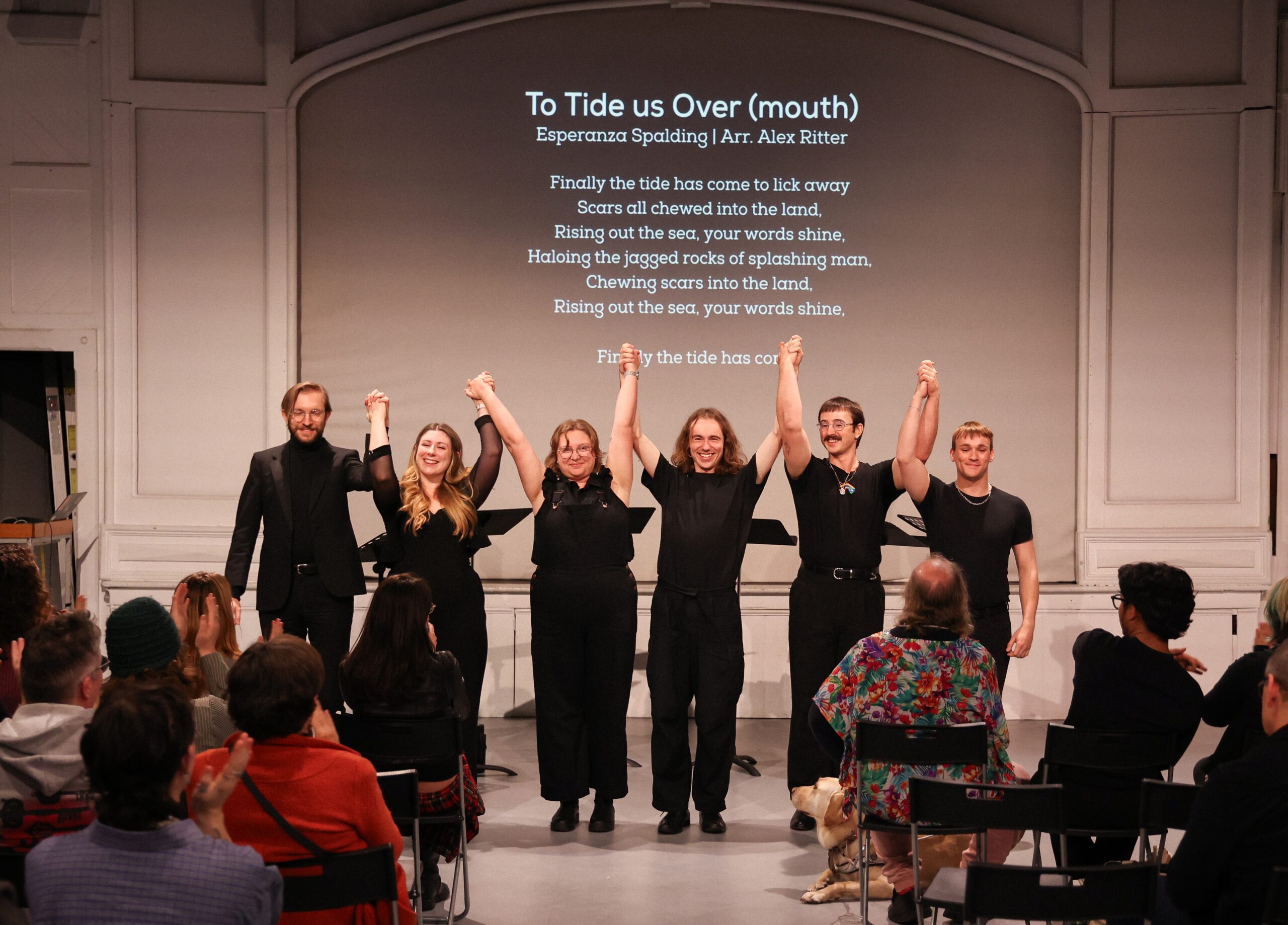
Although the invitation described the voice as “not just as a vehicle for text and melody, but as an instrument in its own right”, many pieces were based on a text, and these were projected in large font on the wall behind the performers. Like the visual content for publicity material and the program, clarity and imaginative style were prominent. The singers’ dress code was a blend of professional black with a dash of individual personality.
Foremost in this thoughtfully curated program was the carefully honed performance as the six hyper-vigilant singers – Alex Gorbatov, Bailey Montgomerie, Alex Ritter, Alex Owens, Marjorie Butcher and Monika Harris – took their cues from one another in almost telepathic awareness. Usually singing as a sextet but occasionally in a smaller group, their musicality and vocal virtuosity were consistently astonishing. To display their remarkable talents more suitable program would be hard to find. It was, as Alex Owen predicted, a “wild ride”.
Following some welcoming words from Divisi’s co-founder, Alex Gorbatov, the sextet launched the concert with the first movement of Ernst Toch’s “0-a” from his “Gesprochene Musik” (1930). As the title suggests, it is sounds rather than words that are vocalised. Like many pieces in the program, rhythmic drive is an essential ingredient, here aggressively warrior-like in its heavy chanting beat, evocative of a Maori haka. It was a great opener and its vitality set pulses racing. The second movement of Toch’s work. “Ta-tam”, was performed after interval, the syllables made even more threatening by being over-enunciated. A quickening tempo and two final shouts were more than enough to ward off any threats.
In his eloquent introduction to Reena Esmail’s “TaReKiTa” (2021) Owens spoke about diversity of the music being performed: the gamut of vocal colouring and traditions, such as classical Indian (Carnatic) music. Esmail’s work is rooted in the sounds of the Indian drum using, as she puts it, “onomatopoeic sounds that imitate the sound of the drum”. The upper voices employed a high, childish quality while the lower voices maintained the pulse with humming and repetitive articulations until a perfectly synchronised ending.
“Partita fragment: no longer for solo violin” (2025), an arrangement of Bach’s violin work by Huw Belling, took us almost into Swingle Singers style territory. A very high ”wa wa” soprano line and a wide dynamic range was skillfully handled.
Alex Gorbatov’s arrangement of “Beautiful Mother” (2026) by Björk and Dirty Projectors did have a text and featured the two soprano voices accompanied by clapping. It motored along serenely at a moderate pace until an unexpected ending of harsh bent notes on a final sliding chord.
Two very contrasting takes on Schubert’s “Die Forelle” followed, the first arranged by Ruben Ferderizon (2014). In his introduction, Bailey Montgomerie, Divisi’s co-founder, spoke about this version having the same form but being turned right on its head. A bass “pom pom” underpinned the mellifluous upper voices until the abrupt catching of the trout. Melbourne composer Raffæla Marcellino’s “Fish Tail” movement from “Memory” (1995) was indeed a very different kettle of fish. Using only the first verse of the Lied, it began with a held “In” and we did indeed hear the promised chaos with lots of portamenti and (organised) chaos – shouts, falsetto, big crescendos and diminuendos, changes of pace and bent notes. As with so much of this program, it was a lot of fun.
Katy Abbott would be one of Australia’s most recognisable composers and the two very short movements from “Words of Wisdom” (2003) presented here are among the most humorous of her appealing music. “The Mosquito” and “Secret” were performed with appropriate physicality. Marjorie Butcher’s introduction was probably longer than the few seconds of her high-pitched hum before the inevitable slap. After interval, “Secret” began with the singers creeping up from the back of the hall and whispering in the ears of audience members until Owens, Gorbatov and Harris teased us with their “Oh, I really shouldn’t be saying this, but…”
More weird and wonderful sounds ended the first part of the program with “Bats’ Ultrasound” from Pelle Gudmundsen-Holmgreen’s “Four Madrigals from the Natural World” (2001). This was the only work that was conducted – Montgomerie’s beat clear and unfussy – as low voices provided a drone while the upper voice added upward swoops. Whistling marked the end of an account of “sleeping bagged in a duplex wing…”
“Dido’s Lament” by Henry Purcell was probably the most familiar music on the program, and it is always interesting to see how a gifted composer such as Gavin Bryars can re-imagine such a famous aria. At three minutes, it was one of the longer works – well-placed as the first after interval. Sung by an SATB quartet, with Ritter’s steady, reliable alto voice adding lustre, Harris took the upper line, after a ground bass introduction, singing with commendable control of breath and dynamics that ended with some lovely softer notes.
A marked contrast to the serenity of the Lament, the half-strangled, distressed vocalisations of Alice Chance’s “Untitled” (2019) came as a shock. Butcher has a remarkable voice – pure, well-projected and virtuosic in its range, flexibility and control. Her soprano against a quartet of hums and sounds made a strong impression.
The highlight of the night for me was “in camera” (2026) by Xiaole Zhan, who was in the audience and spoke briefly about her composition. One of Divisi’s remits is to commission new work, and Zhan’s composition for SSATBB proclaims a striking contemporary voice. Written while she was hearing about the Herzog protests in Sydney and police brutality, “in camera” explores the nature of witness in the digital age when information is quickly accessed through footage recorded on our phones. She calls it a “nod to the paradox of truth” where court proceedings are held without public access (in camera) and involves the capacity of truth. As the singers held their phones the text was chanted and followed by a recorded echo of those words. Against a high soprano voice we heard phrases such as “What did you see?” ”I saw children bombed…” “to record what happened and not be believed”. Sometimes with hands over mouths and feet stamping,words became increasingly fragmented, until stifled parts of words morphed into voiceless mouthing. Prolonged, enthusiastic applause followed this thought-provoking finely wrought work.
“Tuning Meditations”, a movement from “Sonic Meditations” (1971) by Pauline Oliveros, gave the audience a chance to participate, humming along with or in opposition to the sounds others were making. It seemed that there were many in the audience capable of making musical sounds in this flowing stream of “listening out loud”.
The final work, “To Tide us Over (mouth)” (2026) by Esperanza Spalding, arranged Alex Ritter, was a real “wild ride” with Butcher on some stratospherically high notes, the other five singers harmonising and grooving, fingers snapping, hands clapping and almost dancing with the joy of it.
As a small independent musical organisation relying on enthusiasm and sheer talent, Divisi is a rare gem. This sextet’s relaxed alertness, well-rehearsed discipline and the way they revelled in the idiosyncrasies of the music provided sheer pleasure for the audience. Next time, my friends will be there too.
Photo credit: Kate Cameron
_______________________________________________________________________________
Heather Leviston reviewed “Human Instrument”, performed and presented by Divisi at the Temperance Hall, Soth Melbourne, on April 17, 2026.