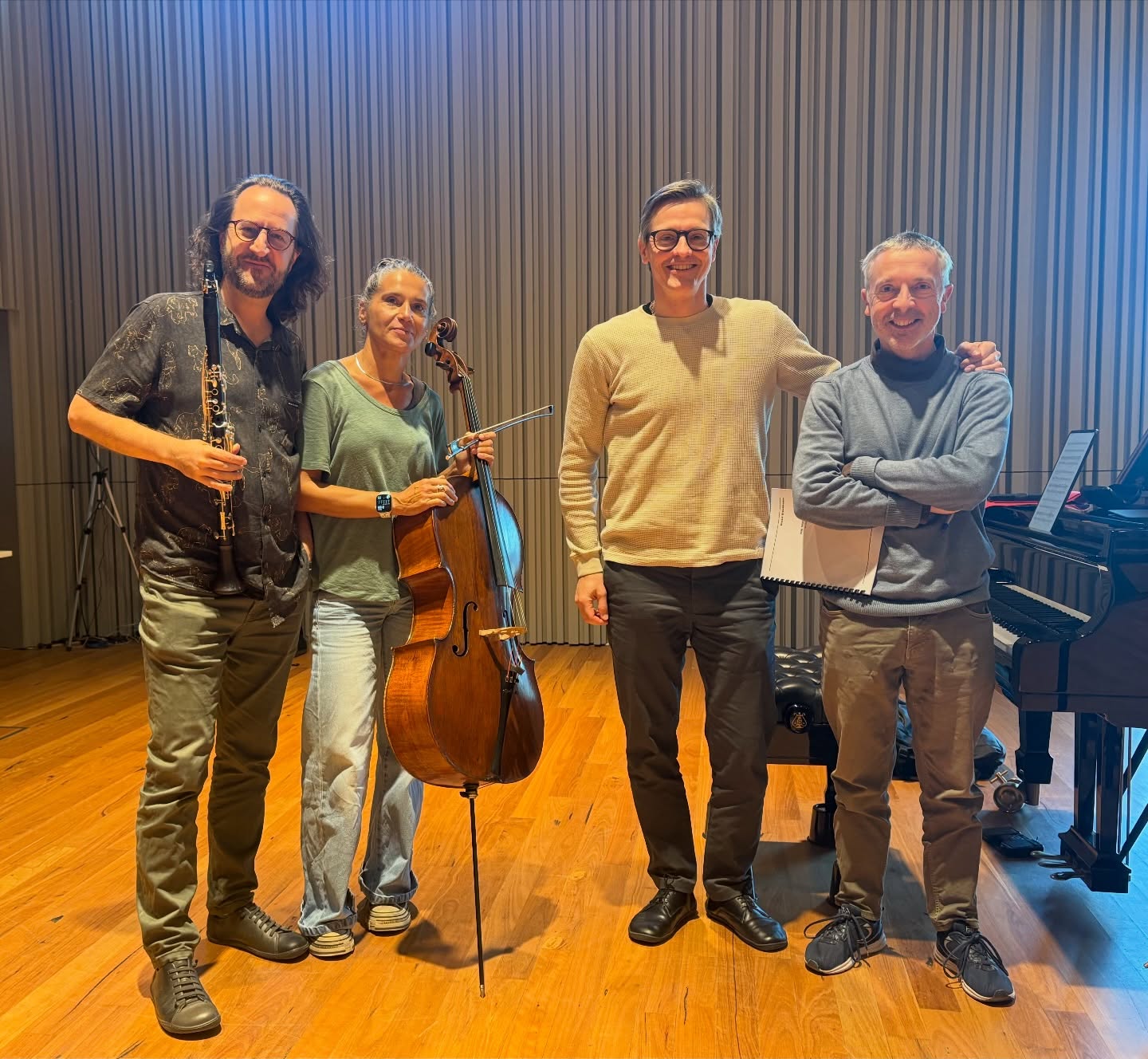
In a packed Hanson Dyer Hall there couldn’t have been a warmer, more enthusiastic welcome than that given to David Griffiths, as he introduced Ensemble Liaison’s first concert for the 2026 season, the 21st season in fact, for this popular and highly acclaimed chamber music ensemble.
In his role as M.C., Griffiths shared beautifully spoken insights and knowledge of the program, connecting the music, the composers and the times in history where Vienna played an influential role. He then added that we would first receive a special gift, a “support act” before the main fare, with pianist Caroline Almonte and Liaison cellist Svetlana Bogosavljevic coming to the stage to perform a moving work: David Popper’s Requiem Op. 66 for Three Cellos and Piano (1892). This ‘surprise gift’ to us also included two young cellists, Hugo Wang aged 15 and Jenny Wu aged 13, from the Melbourne Young Chamber Music Academy, a program established by the Conservatorium of Music for advanced string students aged 12-18.
Known as the King of the Cello, Popper’s calming and thoughtful writing sensitively began with unaccompanied strings delivering hymn-like peace, before heart-throbbing piano chords and a single-toned pulse supported a most lyrical and emotive solo cello melody. Hints of Schubert’s “Ave Maria” reflected the words from a touching poem on the score: “Tears that have become music, the loyal friendship is hers”.
Ensemble Liaison re-assembled in their “traditional” trio form of pianist Tim Young, clarinettist David Griffiths and Svetlana Bogosavljevic, and were joined by three guest artists: distinguished violinist Sophie Rowell, Jasmine Milton, violin, and Hanna Wallace, viola, for Prokofiev’s Overture on Hebrew Themes Op. 34 (1919.) The work’s percussive, marching rhythms on piano supported Griffiths’ wonderfully personalised klezmer feel with sensuous bends and ornamentation in true Giora Feidman style, mimicking the tears and laughter of the Yiddish traditions, weaving the melody freely as strings entered in overlapping layers. Composed for this unusual group of instruments, recurring traditional themes and a surprising bridge section for viola and cello alone, took us travelling to a distant landscape, with an exciting acceleration to the close capturing the essence of freedom and dance.
Well-loved Melbourne composer Stuart Greenbaum was cheered warmly when asked to present his premiere performance of The Drowned World (2025). The 1962 science fiction novel of the same name by J.G. Ballard, described as a “Potent and Atmospheric Apocalypse Set in a Flooded Tropical London,” (of 2145) inspired Greenbaum’s long-held interest and fascination with our place on Earth in the solar system, writing with an unmistakable contemporary musical language as he responded to the issues and characters in the novel. Themes of solar radiation, solar storms, global warming and climate change were felt in the five parts: Lagoon, The Ritz, The Jungle, Planetarium Submerged and Heading South. Greenbaum’s musical language captured the watery wonders of a lagoon with gentle silvery piano tones and deep sonorities, hypnotising repeated elements and smoothly flowing weaving patterns where bar-lines and fixed meters have dissolved in an open and fluid framework. A contemporary rhythmic flow underpinned the city activity of The Ritz with a special raw and earthy tone required from the cello and a lyricism in music both simple and sophisticated at times, as performers extracted the best colours from their instruments. A pulsating cello led the trio into the troubled disturbed world of The Jungle where living organisms rose from the depths, scurrying to airy heights, seeking a natural harmony and space. Most captivating were the eerie sounds achieved by continual glissandi on cello strings, triple pianissimo, fragile and mysterious. The piano led the final part with a gentle improvisation-like flowing line building into a chordal off-beat jazz-rock flow as the trio slowly blended their exchange of short rising patterns, building intensity in power and strength to its close. The superb detailed musicianship and the new composition brought much celebratory applause.
Webern’s Langsamer Satz (Slow Movement) for String Quartet (1905), was described by Griffiths as being written before the composer’s atonal period associated with him, this late romantic style Adagio being more like a “love letter” from the 21-year-old composer. Sophie Rowell led the quartet with the authority and passionate expression for which she is revered. With influences of Brahms and touches of Mahler and Wagner felt in the lush score, melodies were passed beautifully around each instrument, in solos or in pairs, as dreams, hopes, desires and pure romance circled freely in this perfectly balanced ensemble.
The final work showed why Ensemble Liaison is one of Australia’s leading ensembles, as they closed the concert with Zemlinsky’s Trio in D minor (1896), a rich and sonorous, quite symphonic three-movement work. The three musicians relished delivering technical virtuosity and highly intuitive musical teamwork in a work with powerful Brahmsian chordal flow and harmonic depth and breadth, communicating much questioning and heartfelt introspection in shifting hues and shades of colour and timbre. The Andante movement was a standout with Young’s highly lyrical and expressive playing, the trio producing a stunningly soft and unified closure. A passionate Allegro third movement sparkled with running exuberance, the skips and sunshine of Springtime, golden clarinet statements, dramatic pauses and tempo changes, with the music reflecting the outgoing and generous personalities of these exceptional musicians. What a fine performance.
Photo supplied.
______________________________________________________
Julie McErlain reviewed “Echoes of Vienna”, presented by Ensemble Liaison & Friends at the Hanson Dyer Hall on April 9, 2026.