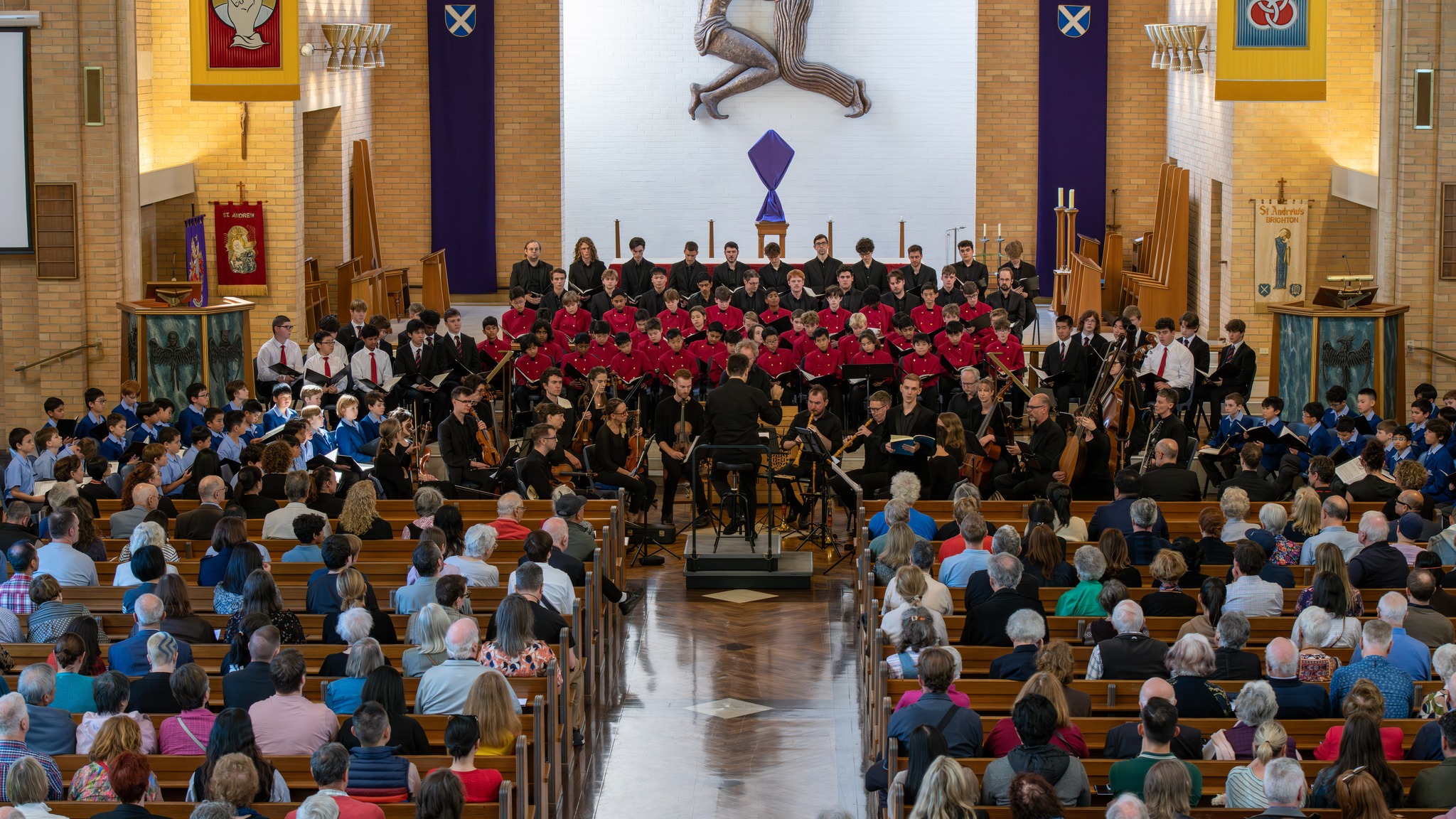
Apart from hot cross buns and chocolate rabbits, Easter is the time of JS Bach, and the Australian Boys Choral Institute (ABCI) served a compelling feast of JS Bach’s St John Passion on Sunday the 29th of March at St Andrew’s Anglican Church, Brighton.
With one caveat, there was nothing to criticise and everything to praise about this performance. The minor bugbear was the acoustic properties of St Andrew’s Church itself. Built like a vaulted bathroom, clad in tiles, it delivers a washy ambience that the performers had to cut through.
The choral singers were drawn the Australian Boys Choir, The Vocal Consort, The Kelly Gang and the Training Choirs of the ABCI, all under the charismatic direction of Nicholas Dinopoulos, who also lent his commanding bass voice to the role of Jesus.
The soloists were: Stella Horvath (Maid and Soprano Arias); Michael Burden (Peter and Alto Arias); Ben Glover (Servant and Tenor Arias); Timothy Reynolds (Evangelist and Tenor Arias); and Oliver Mann (Pilate and Bass Arias).
Timothy Reynolds is no stranger to the role of Evangelist and gave a peerless performance, starting out with some reserve and bringing an appropriate range of dramatic inflection as the drama unfolded – for the St John Passion is a deeply moving dramatic work. It could be staged and acted, but this would be superfluous; the drama and emotion is entrenched in the music itself.
With that in mind, the music doesn’t sing itself; it requires a fair bit of experience to deliver a convincing performance. Soprano Stella Horvath was outstanding, with a ringing tone that reached out across the audience. Oliver Mann too was technically on point, though the evident passion with which he sang had trouble reaching row 25.
This was a problem encountered by countertenor Michael Burden and tenor Ben Glover: their voices lacked strength across their vocal ranges – Michael Burden losing his low notes and Ben Glover fading on his top notes. An element of nerves and inexperience seemed to be the issue here (understandably, as the venue was huge and the score can be terrifying).
Speaking of terror, the opening chorus of the Passion is preceded by a churning, turbulent orchestral introduction before the choir bursts in like a mob on the verge of anarchy. Genesis Baroque was the guest ensemble, performing on period instruments, including the viola da gamba, the rare viola d’amore, a mezzo-soprano oboe d’amore and contralto oboe da caccia and the rare and hugely perpendicular contrabassoon known to be included in Bach’s 1749 scoring.
The band’s sound was surprisingly muted, the grinding strings of the opening being unaccounted for, victims of the washy acoustic. This continued, often with the oboes being the only instruments having a presence.
At the opening of the work, all the choristers were primed and ready. It is a very demanding work to sing even for experienced adult choirs, with complex fugues and some really perilous entries. The choral ensembles were absolutely on pitch and on time and followed the nuances of their conductor Nicholas Dinopolous beautifully. When they were called on to sing out at full strength their sound came through, but you can’t be nuanced and sing at full strength all the time.
Possibly some sacrifice in sound was made to accommodate the large and loyal audience that filled St Andrew’s. Despite that, this performance of Bach’s St John Passion was one for the books. Well done all. This is the great achievement of the Australian Boys Choral Institute, giving young fellows an unparalleled introduction to strong technique and fine music. We, the audience, look forward to applauding their future performances.
Photo credit: Ben Roe
_____________________________________________________
Nick Tolhurst reviewed JS Bach’s “St John Passion”, presented by The Australian Boys Choral Institute at St Andrew’s Anglican Church