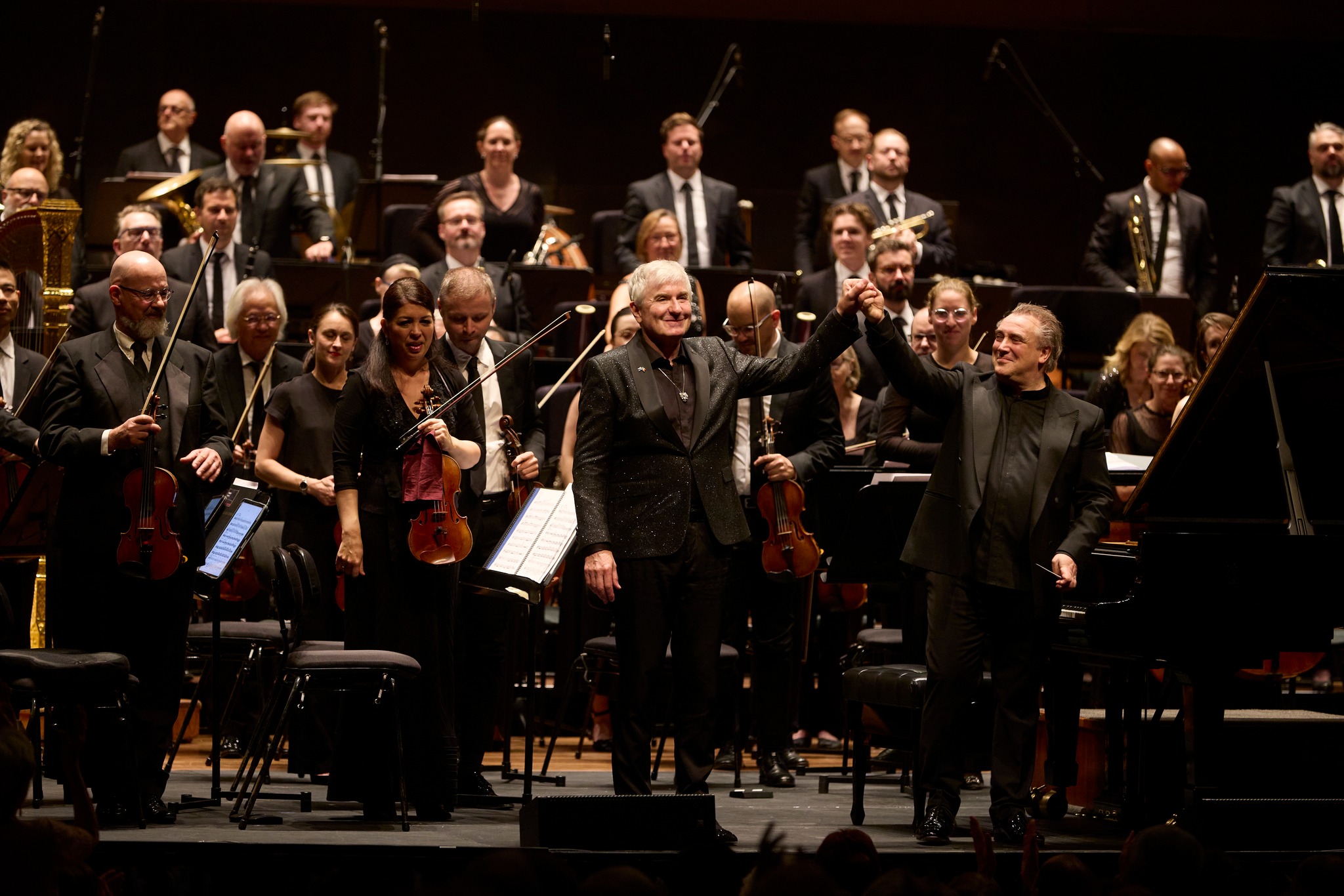
With a beautiful warm evening attracting many Melburnians to be out and about, a new season of orchestral music was given a special place in the centre of the many festive concerts programmed for the “long” weekend. Celebrating the Melbourne Symphony Orchestra’s 120th anniversary, young and old were part of an excited and very happy community of concert goers, all projecting much love for conductor Jaime Martín, whose energetic leadership and warmth of personality absolutely bounced off the stage to every seat in a well packed Hamer Hall. His arrival on stage had instantly followed a light and summery new Acknowledgement of Country, written by Cybec Foundation composer James Henry, and performed by a string quartet with calming simplicity and flowing poetic spoken word.
When the Star Wars: Suite took off, with the film in our memories our eyes were fixed on the vision of a Hamer Hall stage full to the brim with musicians, showing us what really made John Williams’ score so special. Behind almost 50 shimmering string players, listeners loved seeing lesser known instruments advancing with the familiar themes and flourishes of the opening scene, Main Title, particularly tuba, oboe, cor anglais, bassoon, harp and exciting percussion, all bringing the Star Wars’ characters to the stage. An intricate and beautifully phrased flute solo led oboe, harp and horn colours in Princess Leia’s March before stirring string crescendos built the full orchestral intensity towards an exciting third movement, The Imperial March, familiar to all as Darth Vader’s Theme.
Pure and expressive solo violin melodies came from newly appointed MSO concertmaster Natalie Chee, taking her place in tonight’s celebrated history of the MSO, standing on the shoulders of Bertha Jorgensen’s legacy of first female concertmaster, continuing to be a trailblazer for women leading the orchestra.
Later, Jaime Martín praised composer John Williams for bringing generations of people into the world of orchestral music through his music. The MSO excelled in this program, bringing an exciting tone colour in uppermost pitches, united on the highest tones, highlighted with superb crescendos, all well loved by this audience.
Famed and highly awarded pianist Jean-Yves Thibaudet brings more than classical piano music to the stage. With Gershwin’s Concerto in F for piano and orchestra he turned the concert grand piano into a section of the orchestra by itself, with a wide range of tonal and stylistic delivery. In 1925 Gershwin began his largest stage work, describing it as “employing the Charleston rhythm, quick and pulsating, the young, enthusiastic spirit of American life”. Melodic riffs and phrases felt familiar, balladic phrases and jaunty bluesy brassy bent notes, brass interjections all called out in true New York theatre style, “Here I come, look at me!”
From Thibaudet’s first solo entry, melodies were emphasised with much heartfelt tone, his fluent and dazzling technique projecting an effortless joy in incandescent soaring climbs. Jaunty sections became more “jazzy”, brilliant in syncopated chordal frenzies, and Gershwin added spice with exclamations on xylophone and wooden slap-sticks. This was an exciting musical journey to New York, accelerating into a big orchestral close, which brought immediate audience applause.
A second movement brought us sultry, short themes, from lonely muted brass, the familiar vocal lines of broken hearts in Broadway ballads, with early morning regrets felt in the blues. Again, Thibaudet’s right hand expressed much clarity and soul, as slow foxtrot dance rhythms took the movement to a surging crescendo and a gently fragmented dying away at dawn.
Gershwin described the final movement as “an orgy of rhythms”, very upbeat, with frequent snatches of assertive syncopated rhythms, driving repetitions, and zappy xylophone interjections. Brass and percussion solos all leapt forward frequently, and solo trumpet and clarinet jazzy solos made their mark. The blend of “jazz/classical” conventions in Thibaudet’s driving chords and variations on so many familiar melodic quotes developed towards a frenzied and virtuosic close.
Impressive, polished and so attractive, this popular soloist was highly applauded, and welcomed back to the stage to play the beautiful Brahms’ Intermezzo Op. 118 No. 2 in A, with highly projected poetic melodies and sonorous, individually landscaped chords.
Following interval, Rachmaninoff’s Symphonic Dances Op. 45 were quite wonderful, each of the three movements most imaginatively created originally for the renowned ballet choreographer Michael Fokine. The composer himself first called the work “Fantastic Dances”, with descriptive titles “Noon”, “Twilight”, and “Midnight”, references later dropped when the work was completed in 1940. With quotations from several earlier works, notably the main theme from his first symphony and motifs derived from Russian church music, this evocative work gave the MSO percussion section a full army of “sound effects” with tubular bells, tam tam, piccolo, cor anglais, contrabassoon, piano, harp and alto saxophone added to the (almost) overflowing stage area. This audience never moved, being totally engrossed in a complex and imaginative work, where the ‘Dies Irae’ theme and tolling of the midnight bell, a ghostly circling waltz and rising and falling melodic arabesques, brought much eeriness and fantasy to a beautifully designed work. Wistfulness, eerie winds blowing at times, an energised and vigorous ending brought much satisfaction and applause.
In perfect keeping with the Gala’s connection of film, dance, stage and fantasy, Jaime Martín spoke warmly to the audience, praising the MSO and giving us an encore with John Williams’ fine work, the “Flying” theme from the soundtrack of E.T. the Extra-Terrestrial.
Photo credit: Laura Manariti
____________________________________________________
Julie McErlain reviewed the Melbourne Symphony Orchestra’s Season Opening Gala, presented at Arts Centre Melbourne, Hamer Hall on March 5, 2026.