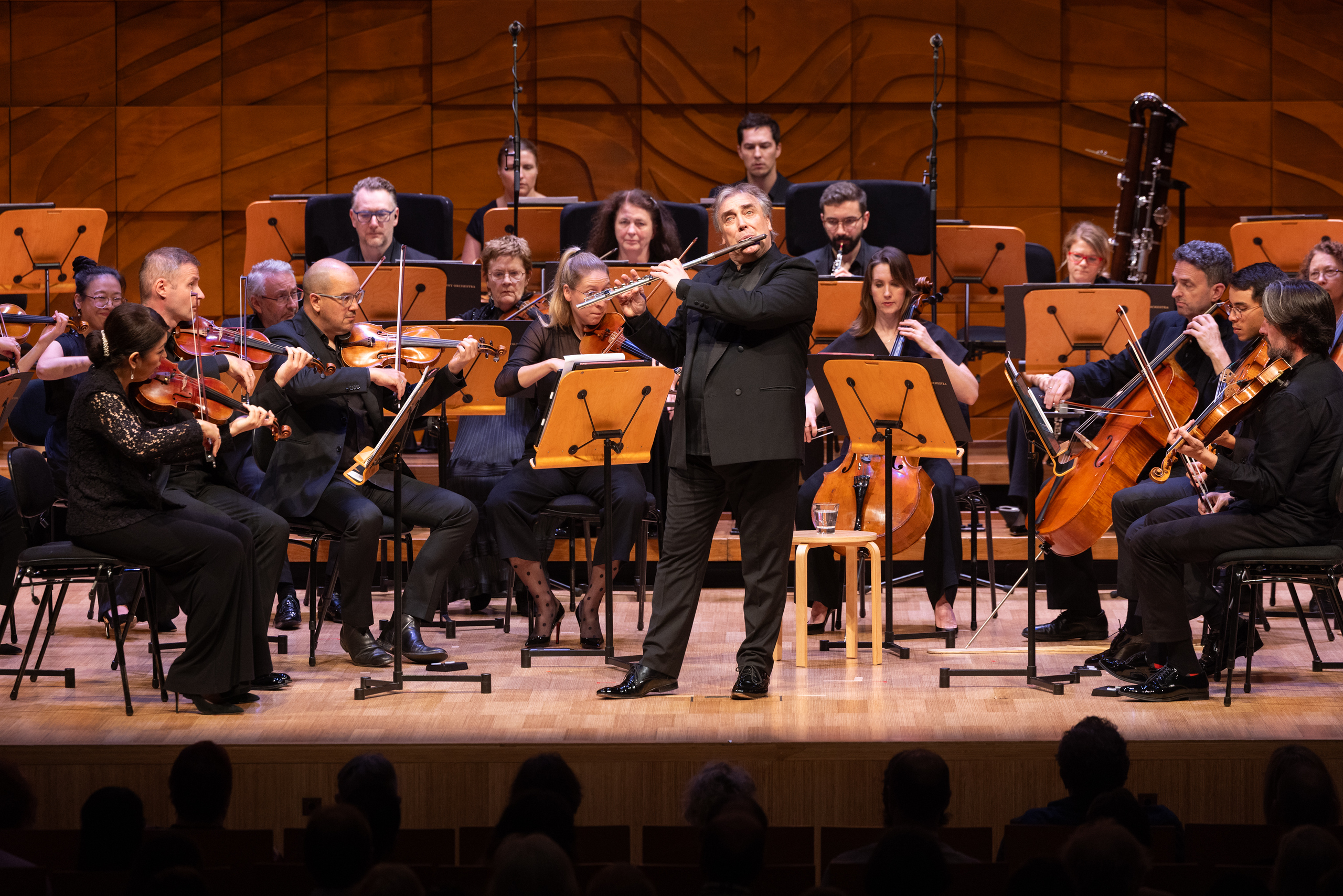
The Melbourne Symphony Orchestra’s program featuring major works by Mozart and Strauss was an exhilarating way to begin the 2026 subscription series of concerts. Sold out well before the event, the combination of the works, the orchestra, the Elisabeth Murdoch Hall acoustics and, above all, the featured soloist made this concert irresistible.
Another drawcard was the opportunity to hear the new Acknowledgment of Country by James Henry, the 2025-2026 Cybec First Nations Composer in Residence, at close quarters for the first time. Commissioned as part of the MSO’s ongoing Acknowledgment of Country Project, launched in 2019, the new work was premiered at the Sydney Myer Music Bowl concert on February 13 in its full symphonic glory. On Saturday night, we heard his version for string quartet with a member of the orchestra reading a text written by James Henry himself – a task he confessed to finding more difficult than writing the music, as he not only had to express his own thoughts but also those of the orchestra. His aim is to “reflect the complex journey towards recognition of Aboriginal people as custodians of the land”. Opening with rhythms inspired by various traditional songs, a warm melody emerges from the cello as the work traces the setbacks and determined progress of First Nations people, ending on an optimistic note.
Before assuming soloist duties for Mozart’s Flute Concerto No. 1 in G major, Jaime Martín took on his usual role as the MSO’s Chief Conductor, directing J.S Bach’s Orchestral Suite No. 3. Without rostrum or baton, he guided the chamber –sized orchestra (22 strings, two oboes, timpani and harpsichord) through the five movements, seeming to provide more inspiration than detailed control, setting tempi and sculpting musical expression judiciously.
In the version heard on Saturday, the Ouverture would have to be one of the most thrilling pieces of music ever written, the three trumpets sounding brilliant in the hall. Combined with timpani, oboes and rich string tone, the stately progress of dotted rhythm majesty was immensely soul stirring. The final reprise after the faster passage with prominent oboe was a joyously festive. The Air that followed is probably Bach’s most instantly recognisable tune: “Air on the G string”. A pulse-calming contrast to the Ouverture, it was played with beautifully integrated string tone. Velvety plucked lower strings in the first repeat provided a particularly resonant foundation for the violin melody. In the very soft final repeat it was possible to distinctly hear the harpsichord, which had been more a part of the general musical texture earlier. It was a most satisfying reading of this famous movement. Then it was back to the trumpets in dance mode with a pair of Gavottes, a rollicking Bourée and a final rousing Gigue.
With trumpets, timpani and harpsichord replaced by horns and flutes, Maestro Martín entered to demonstrate his prowess in what had been his former musical life – as an orchestral flautist. Mozart’s Flute Concerto No. 1 is a mainstay of flute auditions and competitions, and it would be no exaggeration to say that every serious flautist in the audience plus the MSO flautists would have played it. Notably, Prudence Davis, the MSO’s Principal Flute, could be seen smiling throughout Martín’s performance, and it would be hard to find a more discerning judge. The audience too was smiling, even laughing in the opening passages, captivated by Martín’s easy relationship with the orchestra as he conducted (sparingly), and his playful approach to the music. This, and a story-telling mode of expressiveness evoked thoughts of Papageno charming the birds – a reaction felt quite independently by a singer friend. An often referred to passage from one of Mozart’s letters has cast a shadow over the flute’s status as a worthy instrument, but circumstances at the time might have accounted for the negative “one I can’t stand” attack. If it were true, it would indeed be ironic that one of his most popular operas is The Magic Flute. The appeal of the concerto stems from something more inspired than professional pride. Martín negotiated all the considerable technical difficulties with aplomb, and impressed with the beauty of his tone – wonderfully golden, rounded and sweet, particularly on the high notes. As a welcome encore, he played a movement from a work by Telemann.
Not only was this Maestro Martín’s Melbourne Recital Centre debut, it was also a first for Natalie Chee in the official role of Concertmaster. Her contributions on violin to the opening Bach piece and her ability to provide leadership in the Mozart were exceptional, but it was in Richard Strauss’s Le bourgeois gentilhomme – Suite, Op. 60 that she displayed her capabilities as a soloist of distinction. Originally conceived as incidental music for Molière’s play, the overly ambitious project was abandoned as such and Strauss reconfigured the music into a suite of nine movements that portrayed characters in the play. With Martín now on a rostrum wielding a small baton, Chee was at greater liberty to impress with her virtuosity and musicianship as a soloist.
The piano is the prominent voice at the beginning, but an attractive oboe melody is also featured. In some movements, Strauss uses reduced strings – often only first desk or solo – providing a more intimate character to some of the music. It is a real showcase for the orchestra as various instruments are highlighted in a most colourful manner. From delicate, graceful and refined, though heraldic and marching with plenty of percussion, to a beautiful cello solo, and a final buoyant Viennese waltz, this was the MSO at its finest.
As a foretaste of things to come, it seems that 2026 will be a great year of music making from our MSO. This concert also begs the question: now that we know that Jaime Martín is the “real deal” on the flute – he has passed the “test piece” with flying colours – can we perhaps look forward to his performance in Mozart’s Flute and Harp Concerto some time in the near future?
Photo supplied.
_________________________________________________________________________
Heather Leviston reviewed “Mozart & Strauss”, presented by the Melbourne Symphony Orchestra at the Elisabeth Murdoch Hall, Melbourne Recital Centre on February 28, 2026.