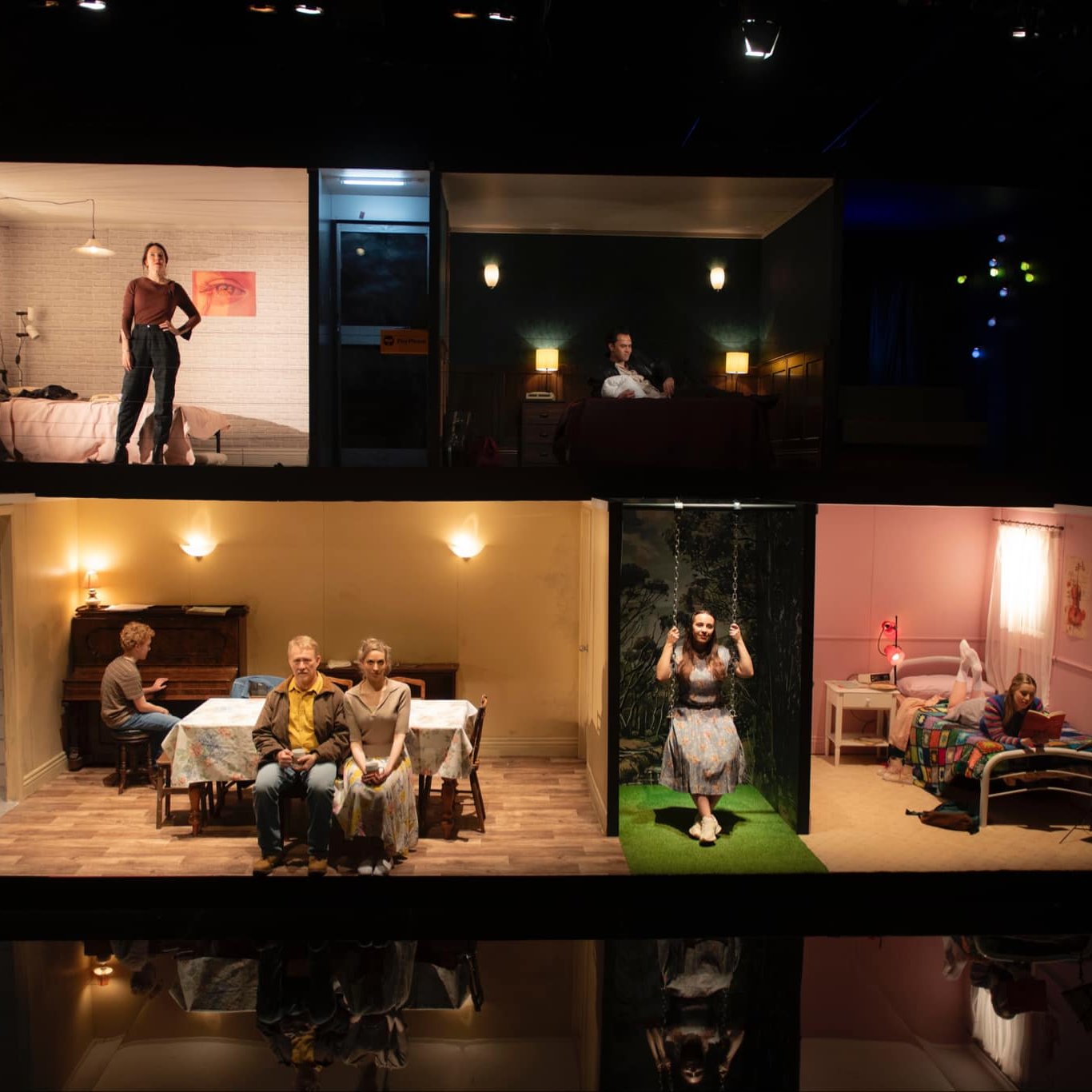
It is not often that operatic works by Australian composers are given a second season, or even a second performance. Commissioned by Chamber Made Opera, Andrew Schultz’s The Children’s Bach was first presented at the Malthouse Theatre in 2008. Now, the ever-enterprising and innovative Lyric Opera of Melbourne has given it a new lease of life in a fully staged six-performance season at Theatre Works.
With a libretto by Glenn Perry, based on Helen Garner’s 1984 novella, the opera seeks to explore not just the dynamics of intimate human relationships and social mores of aspects of 90’s Australian society, but also to render them musically in terms of the range of music that Garner makes integral to the lives of her characters. The title, and dominant musical feature, takes its name from a popular book of piano pedagogy from 1933 edited by E. Harold Davies – a collection of pieces by J.S. Bach designed to introduce his music to beginner pianists.
Feeling trapped in suburban Melbourne, Athena Fox is trying to master these pieces but lacks both facility and musicality – a rather obvious metaphor for her discordant life; her husband Dexter, with his hearty baritone voice, initially takes a more positive and pragmatic approach to life’s challenges, including those presented by their autistic son, Billy. Understandably, Perry has chosen to simplify the story and omit the other son, Arthur, who gives more positive balance to the novella.
The disruption caused by the intrusion of Vicki, the much younger 17-year-old sister of their friend Elizabeth, eventually results in an existential crisis as Athena tries to escape the numbing constraints of her life. Elizabeth’s sometime boyfriend: the philandering, charismatic rock musician Philip, provides a temporary escape that leads to (or perhaps confirms) Athena’s disillusion and capitulation to her fate. Of all the complicated relationships, it is the one between Philip and Poppy, his twelve-year-old daughter from a broken marriage that is depicted as the most genuinely loving. Poppy’s role is successfully amplified in the opera as she reads from Davies’ pedagogic work at key points to explain the structure of a fugue, a device that reflects how the characters and the evolution of their relationships with one another are presented.
It might be tempting to base an opera on a famous Australian work with such a strong metaphorical emphasis on music, but in important respects Helen Garner’s novella does not lend itself readily to operatic adaptation. The story tends to be fragmented, with limited chances for the reader to fully engage with the lives of the characters. Garner (but not the librettist) has Philip instructing an aspiring young composer to ‘Take out the clichés . . . Just leave in the images . . . Make gaps . . . Don’t explain everything. Leave holes. The music will do the rest.” Some will find this deliberate strategy frustrating, especially when further holes are created in the libretto.
Although Perry’s libretto uses a selection of Garner’s exact words, mainly sung but often spoken, it misses much of Garner’s poetic strength and fearless social commentary. Too much of her awe-inspiring mastery of language is missing and the opera has become a somewhat sanitised version of the original. And yet, this production does draw us into much of the essence of the Garner’s fraught suburban world.
Jacob Battista’s impressive two-tiered set of seven spaces depicting key arenas of their rabbit hutch lives has been thoughtfully conceived, particularly Poppy’s bedroom, which accentuated the bright warmth of her personality. The use of the dark reflective surface of the foreground, however, was more problematic. As the setting for what could now be classed as a rape scene, it seemed clumsily makeshift.
It was a difficult plot point for director Katy Maudlin to portray, especially in this MeToo era. Even within the context of Vicki’s deliberate alcohol-fuelled seduction of Dexter, it was disturbing. Michael Honeyman’s portrayal of Dexter’s morning-after remorse as he came to terms with his own frailty was perhaps even more dramatically convincing because of this. Lucy Schneider’s portrayal of Vicki also struck the right note, both as determined seducer and nonchalant participant in what she dismisses as a “one night stand”. Garner’s account is richer in context but difficult to present in operatic form.
Apart from that, the set served the story well. The largest area, the kitchen, complete with upright piano, was used effectively. Athena’s final restoration of order upon her return from her fling with Philip was a domestic prelude to sitting down to the orderly world of Bach’s music – a visual resolution, an accommodation of life’s challenges and love’s ambiguities.
So did the music do the rest? Some of Garner’s musical language was missing, but, beginning with ominous sounds of thunder overlaying spaced chords with shivering marimba, Schultz’s score is interestingly varied as it traces the melodic concord and atonal discord of the characters’ lives, incorporating some of their musical tastes. A small chamber orchestra comprising violin, cello, double bass, clarinet/bass clarinet, percussion and electronic piano, provided an evocative minimalistic soundscape, as soloists or together, the versatility of the keyboard being particularly useful. All musicians played well, with Alex Mouskovias negotiating the keyboard part admirably.
The singing too was of a uniformly high standard. Juel Riggall brought an appropriately hard edge to the cynical and unlikeable aspects of Elizabeth’s personality while revealing her softer side in the “But you could… “ duet. It was a lighter moment of happy connection but lost some of its significance as it was sung with Poppy rather than Vicki; a moment of reconciliation was lost. Dramatically this worked well as it was set against the seduction scene between Dexter and Vicki, even though the temptation to read the surtitles distracted from the action.
Chloe Taylor was a bright presence able to colour her voice to suit a youthful role while maintaining strong projection when both singing and speaking. Her duet with Adrian Li Donni as her father Philip was another of the warmer-hearted moments as she begged him to tell her a story. Li Donni has a strong, vibrant tenor voice – occasionally a touch forced at the top on opening night. Contrasting with the gentler more intimate moments, he conveyed a mixture of self-assured egotism mixed with a dose of cynical dissatisfaction at the hollowness of sexual relations. Like Dexter, he too could say, “Is this all there is?”
Lucy Schneider made a most appealing Vicki, bringing warmth to the role with both her personality and voice. Her interactions with Billy, played with commendable composure by one of the young Touzel twins, were oases of kindness. Her beautiful sparsely accompanied singing of The Skye Boat Song stood in stark with Athena’s frustration and rejection of the burden of Billy – an attitude to neurodivergence that has become more enlightened since1984.
While there are moments of tenderness such as ger invitation to Vicki to live with her family, the role of Athena is not easy to portray as a sympathetic character. Nevertheless, Kate Amos gave an admirable performance dramatically and vocally. Her full, bright soprano voice met all the demands of the music while her acting and focused delivery of dialogue conveyed a strong sense of barely contained angry – a life of quiet despair. Amos and Honeyman made a plausible pair in their painful emotional journey.
Artistic Director and Conductor, Patrick Burns, and his team of creative and performing artists have produced an account of Schultz’s thought-provoking opera that is well worth seeing.
Photo credit: Jodie Hutchinson
_______________________________________________________________________________
Heather Leviston reviewed the production of Andrew Schulz’s opera “The Children’s Bach”, presented by Lyric Opera of Melbourne at Theatre Works on August 31, 2024.