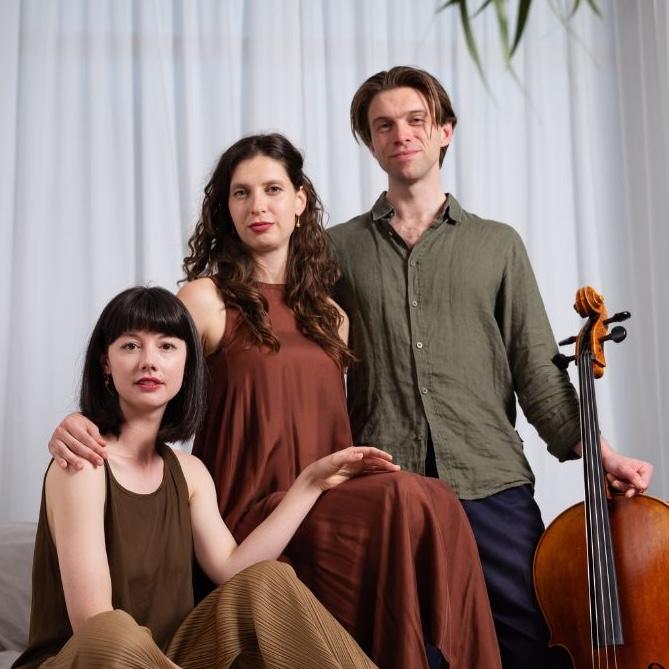
Young people in the performing arts are constantly advised to avoid waiting to be asked, and, instead, to take matters into their own hands and create their own opportunities. When it comes to entrepreneurship it would be hard to find a musician with more vitality, initiative and charm than violist Katie Yap. As a curator, organiser and performer, she has been involved in numerous musical projects. No less busy and entrepreneurial is violinist Meg Cohen, whose vast experience in major ensembles and orchestras also includes the commissioning of new works. Along with fellow alumnus of the Australian National Academy of Music, cellist David Moran, they have formed one of the most interesting trios around.
Seeking to expand traditional trio repertoire beyond familiar classical music territory, Wattleseed Ensemble describes its music as: “an invitation to intimacy; to the rawness of strings and eucalypt forest; to connection. We weave together music of the baroque period together with folk music and contemporary Australian music in a confluence of styles, finding cohesion in the telling of a story”. What we heard on Thursday night was just such a “confluence a styles”, performed by three gifted young musicians.
St John’s East Malvern, a smallish sandstone church with gorgeous, jewel-like stained glass windows, proved to be an inspired (and inspiring) setting – perfect for a concert entitled “Sanctuary”, a word that conjures up places of peace and refuge for all living creatures. The venue was also particularly well-suited for the first work: Donald Nicolson’s arrangement of “Ave Generosa” (Hymn to the Virgin) by Hildegard von Bingen (1098-1179). Although a feature of Wattleseed Ensemble is the distinctive timbre of gut strings, circumstances meant that modern strings were used on this occasion; however, this in no way seemed to diminish the power and sensitive voicing of the works played. In some pieces their more robust possibilities seemed an asset.
Following Cohen’s spoken Acknowledgement of Country, accompanied by a viola drone, her violin took over with an ethereal thread of plainchant verse as viola and cello supplied underpinning drones. As the work unfolded, with each instrument playing a verse, various combinations of drone accompaniment were offered. Instruments played in unison, in simple polyphony and in canon, with moments of intensity along the way. Stylish ornamentation with melismatic embellishments added further to an atmosphere of timelessness and a spirituality that went beyond the Virgin Mary to Nature itself.
In moving from Early to Baroque music, a sense of spiritual connectedness was maintained in five contrasting movements from J.S. Bach’s Goldberg Variations, arranged for the trio. Again, Cohen’s violin led the way in a slow delicate upper line as the cello acted as a pedal bass with the viola a discrete inner voice. In all the variations, the lines were cleanly articulated with minimal vibrato and precise attack. The players’ extensive experience in Baroque repertoire (Cohen is perhaps best known locally as a core member of Genesis Baroque) was plainly evident. Only two instruments were most often employed for the following fast movement, and the cello made the opening sonorous statement for the fugue that came next. After a slow, soft and rather plaintive movement initiated by cello and viola, the set ended on a sprightly note.
Lending its name to the concert as a whole, Sanctuary, by Adelaide-based composer Anne Cawrse, was its centrepiece and heart. Written for Bowerbird Collective co-founders, violinist Simone Slattery and cellist Anthony Albrecht, her music has been described by Katie Yap as blending “soaring, lyrical melodies, dexterous rhythmic interplay, and an unpredictably colourful harmonic palette”. Cawrse herself has written of finding inspiration in the cycle repeated by visiting shorebirds: “It follows a narrative of rest, feeding, and flight, punctuated by a pizzicato-accompanied interlude shared between the violin and cello.” Her music is tonal and appealing, beginning with familiar evocations of a bird in flight with a smooth, swooping violin, fragile and serene, punctuated by slight flutters. A nod to Vaughan Williams’ ascending lark may have been intended. Cohen and Moran successfully transported us to a place where creatures thrive in a natural environment, adding to the sense of reverence experienced in earlier works.
Prior to embarking on Missy Mazzoli’s Lies You Can Believe In, Wattleseed demonstrated another string to their versatile collective bow in a traditional Bulgarian folk song. Beginning with strong rhythmic drive and verve from the viola, it subsided into a gentler, hymn-like and more melancholy mood. It proved to be an appropriate segue into Mazzoli’s vibrant work.
Missy Mazzoli would probably be the most familiar female American composer of contemporary classical music to local audiences. Recently, we have seen three of her four operas (two of them live and one via the Met Live in HD), and her shorter works are regularly programmed – with good reason. In Lies You Can Believe In, Mazzoli views “lies” as referring to “an improvised and embellished story” rather than a malicious untruth. In this piece of “invented and embellished urban folk music [in which] the strings tell an improvisatory tale, touching upon the violence, energy, mania and rare moments of calm one finds in a city”. Katie Yap justly referred to the work as “a wild ride”. It begins emphatically with heavily accented driving rhythms and shifts in energy until a sudden crescendo brings it to a dead stop. On the way, we heard violin and viola busily motoring along, insistent against a slow moving cello line, slow muted passages and harmonics from combined instruments. Throughout, there was no reduction of dynamic tension from these three players. Mazzoli packs a great deal into seven minutes, making it an exciting ride indeed.
Inspired by modern gypsy music, punk, electronics and traditional Bulgarian and Romanian folk music, Mazzoli’s work nestled comfortably between the preceding Bulgarian folk tune and the following two pieces of Scandinavian folk music from Sweden and Norway that brought a thoughtfully curated program to a toe-tapping close.
Promoting a sense of connection between performers and audience, each player spoke about the works and their significance within the “Sanctuary” project. Although chairs had been arranged in an intimate arc close to the players, it was not always easy for everybody to hear every word. But this is a minor quibble in the light of the quality of the playing and the thought that had gone into the programming.
If you were unfortunate enough to miss this outstanding trio’s concert, Wattleseed Ensemble has just launched a multi-format recording that includes a range of similarly interesting music. Highly recommended.
Photo supplied.
____________________________________________________________________
Heather Leviston reviewed “Sanctuary”, performed by Wattleseed Ensemble at St John’s Church, East Malvern on February 12, 2026.