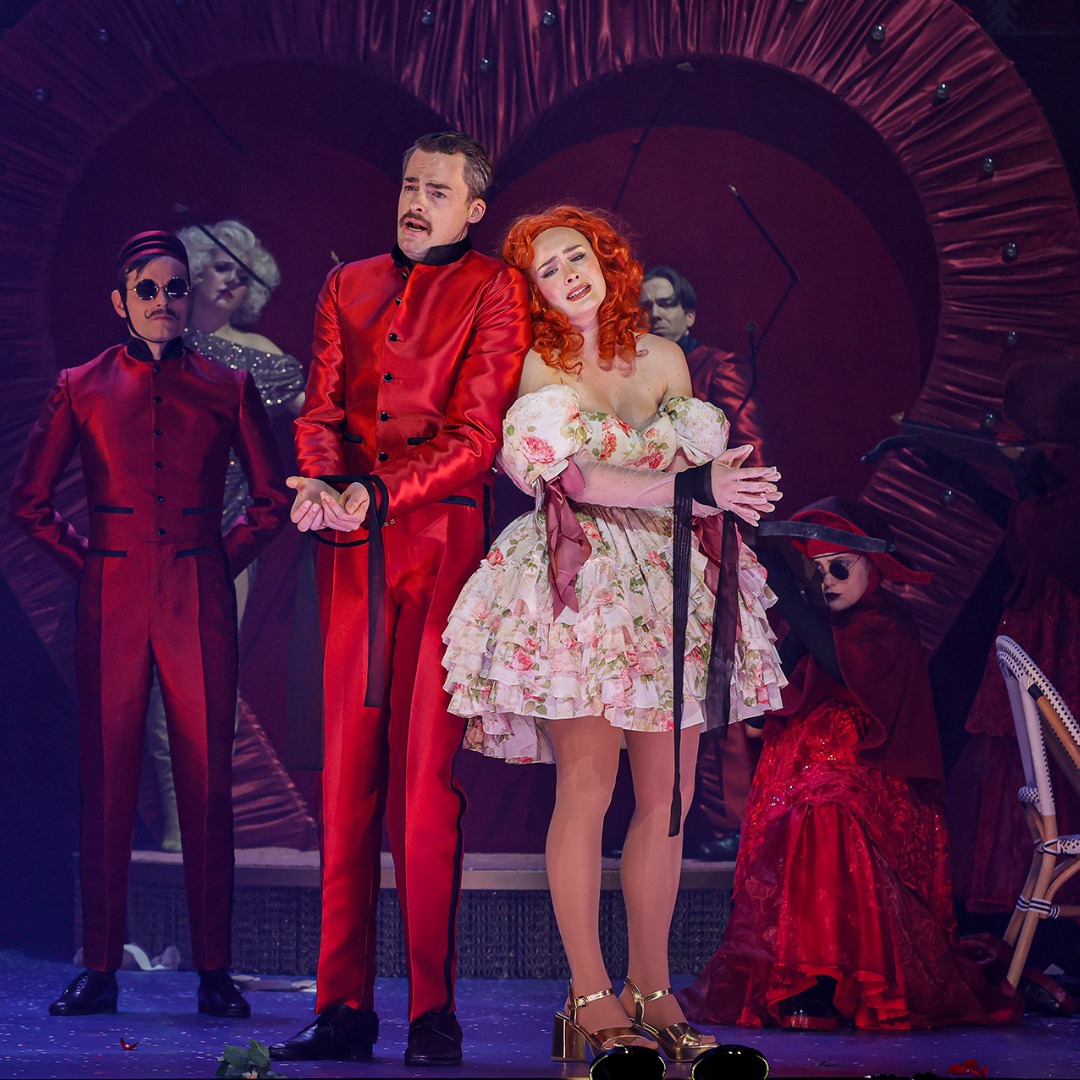
This “reimagined” version of Mozart’s Die Entführung aus dem Serail (The Abduction from the Seraglio), now running at the Palais Theatre, St Kilda is among Victorian Opera’s more adventurous projects. Audiences have become accustomed to the spoken part of Mozart’s two major singspiel operas, Il Seraglio and The Magic Flute, being adapted to include topical references and contemporary idioms, but Abduction takes this to a whole new level.
Those who consider tampering with Mozart and his works some kind of sacrilege – think of the outcry that greeted the film version of Amadeus, or even Peter Schaffer’s play. Many years ago some people became indignant about Ronald Maconaghie’s portrayal of Papageno with its Australian accent and idioms; but audiences loved it – as they will this production. Here, body mics made the English dialogue easy to understand while German remained the sung language – the best of both worlds.
A sizeable chunk of the original music has been “abducted” and replaced with other music by Mozart – all glorious, but sometimes puzzling as to exactly why those selections have been made. Within the context of a striking set design and imaginative costumes by Nathan Burmeister and Matilda Woodroofe, ingenious direction by Constantine Costi, and high quality performances, the end result, however, is not only admirable but also immensely entertaining.
The emphasised theme is love in this production, initially proclaimed by the heart-shaped entrance to the “seraglio”/mansion of pleasure, and later by a huge heart in the background and a mobile heart where, tied to a large mobile heart, Konstanze sang her famous aria “Marten aller Artern” (Tortures of all kinds) as arrows pierced the space surrounding her in keeping with the lyrics. In fact, there are numerous instances where the action reflected the text and/or the music. With this theme in mind, the role of The Pasha and the insertion of a large section of the “Kyrie” from the Great Mass in C minor evoked certain aspects of Sarastro’s domain in The Magic Flute. Much of the movement in VO’s production is ritualistic in character; chorus members garbed in dark red Venetian Carnival-esque cloaks and headwear that has been referred to in terms of “flying nuns” swept around the stage and gestured with stylized precision. The Pasha himself was imposing in an extravagant creation of layered flounces – a high camp Fashion Guru, who counsels Konstanze about the power of love.
Constantine Costi’s adaptation of Gottlieb Stephanie’s libretto and dialogue married well with Conductor Chad Kelly’s musical arrangements. During the Overture, Konstanze and Blonde entered from the aisles, mounting the stage to try to peer through the tantalising chain curtain into The Pasha’s mysterious domain. We in the audience also couldn’t wait to see what was behind the curtain. Meanwhile, the two fiancés, Belmonte and Pedrillo, were in hot and hilarious pursuit calling on their mobile phones and searching the theatre with torches. It was all high energy from the get-go. When the two fiancées did finally enter the Pasha’s ornate mansion, with its line-up of bellhops led by a tasseled Osmin, they were drawn into a seductive world where they felt more valued than by their partners – despite Pedrillo’s claim to being a feminist.
It is uncommon to have two tenors and two sopranos in the main roles of two pairs of lovers, and it is difficult to find four singers who are able to manage Mozart’s demanding music for these roles. The role of Belmonte is particularly taxing, but Kyle Stegall displayed some admirable qualities, singing long vocal lines with admirable breath control with a pleasing tenor voice. His manner contrasted well with Douglas Kelly’s portrayal of Pedrillo, which was much more frenetic in style while being vocally capable. Kelly’s performance was a major contributor to the liveliness of this production.
Luke Stoker made a splendid impression as Osmin. His singing was generally strong and firm, his bass voice projecting well into the vast auditorium, and he delivered the dialogue with panache. His lower register did not quite have the bass power needed for the very low notes towards the end of the familiar aria “O, wie will ich triumphieren” (Oh, how I want to triumph), but Chad Kelly ensured that he could be heard over the orchestra.
Although The Pasha is only a speaking role, Lyndon Watts’ voice held resonant authority. His larger-than-life presence commanded the stage, and he certainly knew how to swing those flounces for maximum effect.
As Konstanze and Blonde, it would be hard to find two sopranos who looked so fetching and sang as well as Cleo Lee-McGowan and Katherine Allen. Lee-McGowan’s transformation into a doll-like figure in the “harem” was extremely effective, and Allen was a sparkling figure with comic flair as Blonde. Both reached stratospheric heights in their arias and displayed excellent agility. Lee-McGowen appeared to be more vocally relaxed after interval, with interesting ornaments and an arresting extended cadenza for “Marten aller Artern”. The way she was able to spin a sustained high note was outstanding. The duet and quartet singing after interval were among the vocal highlights of the opera.
The chorus benefitted from some of the inclusions, singing two verses of the “Bundeslied” in the first half and the “Kyrie” in the second half with full rounded tone. All of their ensemble work was disciplined and effective, both vocally and physically. Under the guidance of Movement Director, Shannon Burns, the chorus did a terrific job with the dancing and stylised movement. It was a complicated production that appeared to go without a hitch.
Under the animated baton of Chad Kelly, Orchestra Victoria gave the level of performance expected of this consistently fine band of players.
This production is an ideal introduction to opera for young people. The time just flew by – What, interval already?! It is impossible to absorb all the many details, so a repeat visit will be on the cards for a few patrons. Highly recommended.
Photo credit: Jeff Busby
_______________________________________________________________________
Heather Leviston reviewed Victorian Opera’s production of “Abduction”, presented at the Palais Theatr, St Kilda on August 12, 2025.