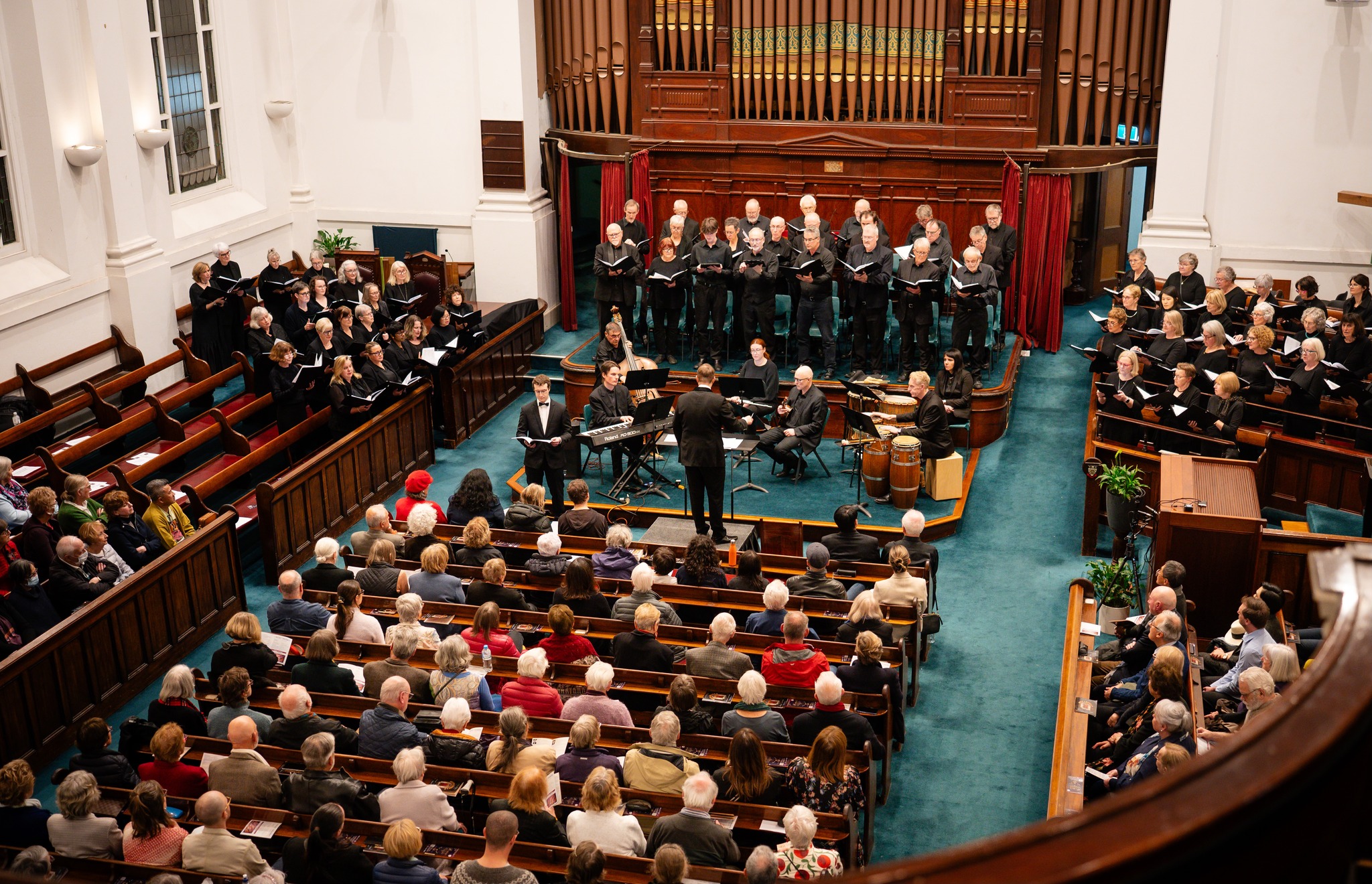
Concerts given by Victoria Chorale are increasing in their popularity as choir numbers grow, and audiences are at record levels for programs that are fresh, innovative and entertaining, often bringing the joy of the unexpected.
The Collins St Baptist Church sits in the centre of a bustling theatre precinct, so 5pm on a Saturday is peak time for patrons to be anticipating a festival atmosphere, creating their own entertainment zig-zagging across roads and tram-lines, helping strangers to negotiate the many challenging stairs to the venue entrance, the crowded entrances, varied seating options up more stairs or enjoying the social mixing and mingling through a maze of church pews.
With choristers coming from wider Melbourne and regional areas it is a truly “Victoria” Chorale. Conductor Dr Mario Dobernig introduced the Spanish-themed program, whose first part consisted of a selection of Spanish-influenced works – vocal, instrumental, classical, liturgical and traditional folk based music. He pointed out that we would hear a variety of Espagnol languages, reflecting different regional Hispanic and Latin American cultures. With much fine informative historical information in the program but only a few lines of English texts, it was a shame not to have texts and be able to follow the choral work with ease.
Our journey began with three motets by the most famous Spanish composer of the Renaissance, Tomás Luis de Victoria. With Chorale members spread widely across the full width of the venue and larger groups of female voices on either side of the central strong male voices, Dobernig achieved a well-balanced and united ensemble for these opening solemn and respectful, slow moving motets: “Jesu Dulcis Memoria”, and “O Vos Omnes”. The third, a well-loved “O Magnum Mysterium”, gained an expressive lightness of melody, with sopranos leading with a wider range of dynamics and more buoyancy in energetic Alleluias. From Barcelona, guitarist Fernando Sor’s only sacred choral work in Latin, “O Crux” gave us a warmer blended chorale tone for a melodically interesting and expressive work.
The Art of Sound Ensemble (flute, guitar, piano/organ/double bass and percussion) were welcomed to accompany “Hanacappachap Cussicuinin”, a Peruvian processional hymn whose bass line and earthy folk rhythm pattern underscored the traditional flute melody, creating an exotic atmosphere and bringing much applause. In the polyrhythmic instrumental accompaniment of the Venezuelan dance “Mata del anima sola” (Tree of the lonely soul), both vocal timbres and instruments imitated the colours and rhythms of traditional folk music. Verses were musically varied in structure, from lively dance form to meditative gentleness, and featured the special expressiveness and clarity of rising star tenor soloist Ben Glover.
Pianist William Schmidt was the central accompanist throughout the program in a variety of solo and ensemble keyboard roles. He provided baroque keyboard tones for the opening motets, and a colourful piano solo “Les Filles de Cadiz” where he played an arrangement of a Bizet-like medley of bolero and gypsy song styles by Delibes while infusing his own design. Guitarist Adam May also featured as a soloist with “Adelita” and “Lágrima”, two pieces by 19th legend Tarrega, and a favourite Brazilian “choro” piece, “Graúna” – a more intricate and improvisatory quasi-flamenco piece. An ever-popular end to this part of the Spanish journey, was a rousing performance of “Libertango”, with choristers using wordless percussive lines, imitating the jazz syncopated and heavily accented beats in Piazzolla’s famous tango rhythms.
Misa Criolla was the featured work following interval. This historically ground-breaking folk-mass, composed by pianist and composer Ariel Ramirez, first performed in 1965 and becoming a global sensation, set the traditional Latin mass to familiar Argentinian song and dance forms. In the opening “Kyrie”, the choir created a harmonious gentle humming against the slow triple meter footsteps heard on heartfelt percussion pulsebeats, allowing soloist Ben Glover to lead the fully dramatic texts “Lord Have Mercy, Christ Have Mercy” with great appeal.
The “Gloria” is probably the most exciting and familiar part of this Mass, with joyful percussive African dance rhythms introduced by the Art of Sound Ensemble with guitar, cuatro (four-stringed strummed small guitar), hand drums, conga, the caixixi (triangular woven basket shaker), wooden sticks and, perhaps, a triangle. Double bass added lowest drones enhanced with keyboard bass, but the crowded stage setting meant the instruments were not always clearly seen, and perhaps were subdued at times. Polyrhythms and colourful key changes brought excitement to the complex melodies of the “Credo”, and the audience certainly enjoyed the folk-like traditional accompaniment for the bright rhythms of the “Sanctus” with flute, strummed guitar, and drum. The mournful gypsy-like melodies of the “Agnus Dei” were given colourful flair and an emotive setting by Glover, accompanied by free gypsy style guitar plucking, a beautiful hushed chorus, then a final gentle slowing and fading text: “Give Us Peace”.
Fine repertoire, a packed house, enthusiastic choristers, colourful instrumentalists and a fine young soloist resulted from the work of many participants and behind-the scenes crew, and especially the enthusiastic and creative leadership of conductor Mario Dobernig.
Photo credit: Living Imagery
__________________________________________________________
Julie McErlain reviewed “Misa Criolla”, presented by Victoria Chorale and the Art of Sound Ensemble at Collins Street Baptist Church on August 23, 2025.