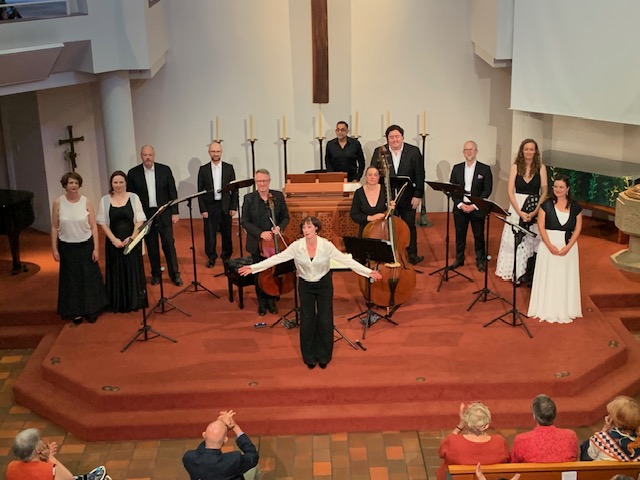
Johann Sebastian Bach’s motets occupy a curious position within his output: revered, rarely programmed as a complete group, and often treated as either historical artefacts or choral showpieces. This concert by Bach Akademie Australia under the direction of Madeleine Easton, in collaboration with The Song Company and guest alto Iris Korfker, proposed something more searching. Within a context of two modern sacred works, and punctuated by a solo movement from a Bach cello suite, the programme invited the listener to hear these motets not as monuments but as living, ethically charged music – works shaped by mortality, consolation, and the expressive power of the Word.
From the outset, Easton’s commitment to Bach’s motets was unmistakable. Her conducting revealed a musician deeply invested in the rhetorical life of the text, shaping gestures that resulted in abounding yet stylistically grounded contrasts of articulation, dynamics, and phrasing. With eight singers, supported discreetly by chamber organ, cello, and double bass, the performance favoured clarity and intention over choral mass. The physical arrangement – often in double-choir formation with continuo centrally placed, or in SSAA/TTBB groupings – made antiphonal writing both audible and theatrically legible.
The opening motets, Lobet den Herrn, alle Heiden, BWV 230 and Komm, Jesu, komm, BWV 229, immediately established the ensemble’s strengths. Singing throughout was clear and articulate, with particular care taken by the upper voices to prioritise control over volume. This allowed the tenors and basses – often enriched by cello and double bass – to provide a firm, warm foundation. In Komm, Jesu, komm, Easton negotiated the relatively dry acoustic of St John’s with finely judged cut-offs, allowing suspensions and pedal points on words such as “Ewigkeit” to register with expressive clarity. These moments of stillness stood in telling contrast to more charged forte passages, where continuo support gave the music weight without heaviness.
Occasionally, the balance exposed the vulnerability of the texture, particularly when the upper voices were momentarily unsupported by the bass instruments, but these were minor detractions in an otherwise sophisticated traversal. Detail over long spans of phrasing was the norm, especially in the central sections of each motet, while openings and conclusions were consistently delivered with confidence and conviction. One linguistic reservation remained: the German ‘ch’ consonant often hardened towards an “sh” sound, coarser than ideal for Hochdeutsch, though this never undermined textual intelligibility.
The first of the contemporary works, Sandra Milliken’s Herr Jesus Christus, provided a stark and moving contrast. Written in English as a Sanctus for The Bonhoeffer Project and based on texts by the Lutheran theologian Dietrich Bonhoeffer – executed by the Nazis in 1945 – the work is a study in lamentation and inner struggle. Milliken’s a cappella writing is deeply unsettling: murmured textures, wailing gestures, drones, and minor modalities combine with unresolved and resolving seconds to express pain with raw economy. The Song Company performed the work with intense focus and care, allowing repetition and echo-like effects to convey a sense of psychological and spiritual distress that felt profoundly contemporary.
Bach’s Ich lasse dich nicht, BWV 1164 restored a sense of grounded assurance. Its lilting compound-time opening demonstrated Bach’s gift for succinct, expressive text-setting alongside his more florid contrapuntal instincts. Particularly striking was the sustained, cantus-firmus-like long line threaded through the polyphonic middle section – shared across voices and held with poise – offering a palpable sense of constancy amid complexity. The closing chorale emerged warm, balanced, and quietly reassuring.
After interval, Fürchte dich nicht, BWV 228 continued this trajectory, its syncopated entries and dovetailing fugato handled with linear clarity. Here, the ensemble honoured Bach’s concern for continuity of line, never allowing vertical brilliance to eclipse horizontal flow.
A reflective pause came with the Prelude from Cello Suite No. 2 in D minor, BWV 1008, performed by cellist Daniel Yeadon. His reverent reading employed rubato sparingly, allowing phrases to breathe with a vocal warmth. Lines often dissolved into silence like apparitions – moments that felt less like interludes and more like solitary meditations on the concert’s central themes.
James MacMillan’s O Radiant Dawn bridged past and present with assurance. The Tallis reference in the opening was immediately apparent, but MacMillan’s harmonic language soon asserted itself through glowing dissonances, particularly on the repeated word “come”. Here, those dissonances functioned less as tension for its own sake than as a kind of spiritual invitation – an idea Madeleine Easton had returned to when addressing the audience, framing much of the programme as music that invites rather than declares. The consort shaped these moments with care, allowing the repeated entreaty to unfold patiently through subtle dynamic surges, maintaining ensemble clarity while letting the music’s sense of inward beckoning take hold.
The evening closed with Singet dem Herrn ein neues Lied, BWV 225 – exuberant, dance-like, and rhythmically alive. Changing metres and shifting emotional registers were negotiated with buoyancy, the responsorial middle section balancing chorale-like responses against ornate contrapuntal progression. It was a fitting conclusion: music that celebrates movement, renewal, and communal utterance.
Ultimately, this concert affirmed the motet not as a relic of funeral music but as a living form – music that speaks with urgency about faith, fear, suffering and consolation. Under Madeleine Easton’s thoughtful leadership, The Song Company offered a performance of intellectual coherence and emotional restraint, reminding us that Bach’s sacred music, at its best, remains less about spectacle than about meaning.
Photo: Classic Melbourne
________________________________________________________________________
Stephen Marino reviewed “Bach’s Motets”, performed by Bach Akademie Australia and The Song Company at St. John’s Lutheran Church, Southgate, Melbourne on February 5, 2026.