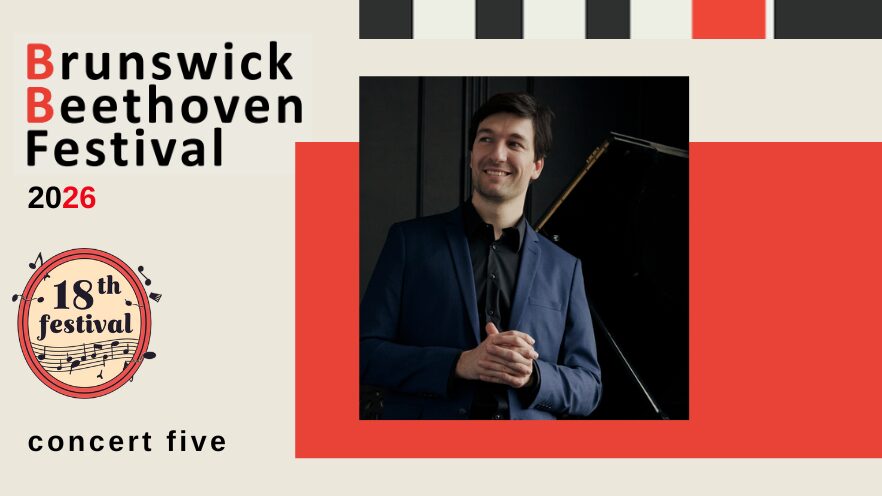
It is remarkable and highly commendable that The Brunswick Beethoven Festival this year reached its 18th birthday, with ten concerts programmed by director Mark Higginbotham offering high quality chamber music over a two-week period. Tickets were in high demand very early for the “not to be missed” Concert 5, where Kristian Winther, violin, and Konstantin Shamray, piano, were initially scheduled to perform works by Beethoven, Schumann and Prokofiev. Unfortunately, illness caused Winther to withdraw from this program, reducing the musicians from two brilliant virtuosos to one, so it was an admirable gesture for Shamray to conjure up an outstanding solo piano repertoire of his “favourite pieces” by Bach, Liszt, Wagner, Rachmaninov, Scriabin and of course Beethoven, all from memory of course.
The opening Prelude for Rachmaninov’s transcription of J.S. Bach’s Violin Partita in E was delightfully virtuosic, with notes flying assuredly on an energetic path, principal motifs echoing and separating with different colours and timbres, high bell sounds and brilliant cascading semiquaver runs blending in the resonance of the Brunswick Uniting Curch. The usual familiar footfalls and dance-rhythms of the Gavotte were softened and kindly expressed with a lithe and lively new character, in a freely flowing, quite rapid tempo, giving a fresh approach to this well-known work. The closing Gigue gave us a joyful demonstration of virtuosity and energy as Shamray highlighted individually repeated motifs, particularly in the left hand, under a more delicate flying right hand.
Overheard in the audience were the words, “What new things can be said or written about Beethoven?” Shamray did indeed show us. In Beethoven’s Sonata in F, Op. 54, we welcomed his bringing new colours and a touch of mellowness to the first movement, In tempo d’un menuetto. A variety of orchestral colours and the ringing tones of fluent sequences of rippling trills contrasted nicely with vibrant staccato double octave passages. Through the second movement, Allegretto, Shamray again strengthened Beethoven’s shaping of patterns formed from afterbeats, reinforcing surprising strong melodic points in the left hand, abrupt and sudden extreme changes of dynamics, then accelerating through this continually moving piece, seemingly with no limit to becoming faster and louder than Beethoven could have asked for on the instruments of his day.
The audience was again spellbound with the tonality and beauty of legato, heavenly lyricism in Liszt’s Ave Maria (Die Glocken von Rom), the second piece from a cycle of ten Harmonies poétiques et religieuses. I hope we hear Shamray perform the entire cycle one day. This spacious, reflective and introspective piece was simply stunning; harplike, sonorous chords and the softest pianissimo tones were produced from the highest keys, bringing us distant bells and spiritual elevation. A surprising growing section of chords and thunderous bass octaves seemed to describe the power of God, the glory of religious architecture, the symphonic grandeur of tone and volume from imagined pipe organs, coloured and dramatic. When passion was all spent, serenity followed with final chords fading to triple pianissimo.
More passionate “orchestral” beauty and grandeur came from Shamray’s virtuosic and descriptive portrayal of one of the most famous and familiar closing operatic scenes in Liszt’s arrangement of Wagner’s “Liebestod”, from Tristan und Isolde. In multi-layered textures, always the melody was raised above warm tremolo “string” accompaniment. In controlled rising crescendos, we felt Isolde’s “transfiguration”, we felt the music in our hearts, sensing that some audience members held back their tears.
Saturday nights in Sydney Road can cause many city traffic sounds to be heard through the walls of this church, but there was not one sound from an entranced and intensely focussed audience for the entire evening. Even in the next two Etudes-Tableaux, Op. 33 by Rachmaninov, Shamray’s powerful and progressive fortissimo sections were so powerful they even drowned out a passing motorbike, such was his stamina and power. The pianist never faltered as he maintained top speed in these bold studies with blistering chromatic runs, tremolos and most dramatic chords.
The composer Scriabin has enjoyed a re-appraisal of his ten sonatas in the last 50 years, with No. 7, Op. 64, “White Mass” chosen to end this recital. Written in 1911 as a “brighter’ response to his previous Sonata No. 6 “Dark Mass”, it was intended by the composer to be “ecstatic, evoking images of winged flight, voluptuous rapture and overwhelming forces”. From the opening bars we were immersed in an intense and colourful tone poem, hearing a rich vocabulary and exploration of harmonies, intuitive celestial themes wandering and finding new paths searching with high tonal flights then descending to low dark, bass regions. Surprising lyricism in the centre of the keyboard shone like gold, emerging from a dark web of chords, all taking us on a journey through a war of emotions. The music took us to strongly pedalled chordal peaks, with the final bars bringing what seemed like a technical impossibility: an arpeggiated fortissimo 25-note cluster chord! Then all resolved gently and beautifully with sparkling, fading, trilling clusters of celestial bells.
Following extensive applause, Shamray told the audience he would give us one more of his favourite pieces, a little more Scriabin, giving us an exquisite, lyrical and peaceful close to a brilliant recital.
Photo supplied.
__________________________________________________
Julie McErlain reviewed Konstantin Shamray’s piano recital, given as part of The Brunswick Beethoven Festival at Brunswick Uniting Church on February 7, 2026.